Archive
DIC Revolt
From High-Frequency Programmers Revolt Over Pay – Forbes.com:
“Pity the programmers toiling away at Wall Street’s secretive high-frequency trading shops–places like Goldman Sachs, Citadel and Getco. They wrote algorithms that take advantage of fleeting trading opportunities and bring in up to $100,000 a day. In return, they received a fraction of the pay doled out to their bosses.”
Now some programmers feel used and are instigating a revolt. They are doing so by striking out on their own or forming profit-sharing arrangements.
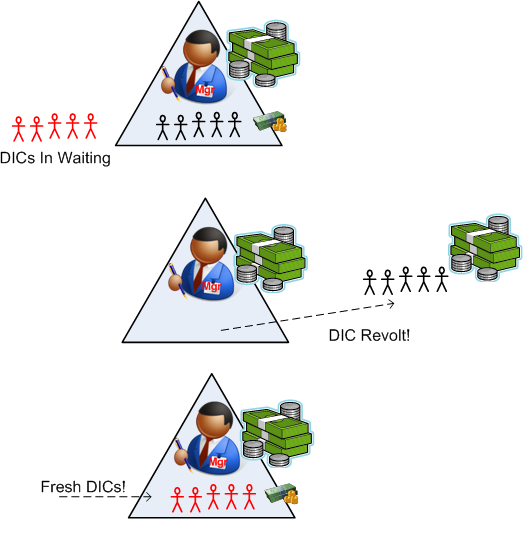
Wow! A sampling of DICs has risen above the talking, whining, complaining, poor-me stage. They’ve actually taken action toward their perception of justice. Of course, the holes they’ve created at their former Wall Street greed-masters will be filled by other willing slave-DICs who will revive the whining, complaining, poor-me tradition left behind.
Innovation Types
In the beginning of Scott Berkun’s delightful and entertaining “Managing Breakthrough Projects” video, Scott talks about two supposed types of innovation: product and process. He (rightly) poo-pooze away process innovation as not being innovative at all. Remember the business process re-engineering craze of the 90’s, anyone? Sick-sigma? Oh, I forgot that sick-sigma works. So, I’m sorry if I offended all you esteemed, variously colored belt holders out there.
According to self-professed process innovators, the process innovations they conjure up reduce the time and/or cost of making a product or performing a service without, and here’s the rub, sacrificing quality. Actually, most of the process improvement gurus that I’ve been exposed to don’t ever mention the word “quality”. They promise to reduce time to market (via some newfangled glorious tool or methodology) or cost (via, duh, outsourcing). Some of these snake oil salesmen dudes actually profess that they can increase quality while decreasing time and cost.
The difference between a terrorist and a methodologist is that you can negotiate with a terrorist – Unknown
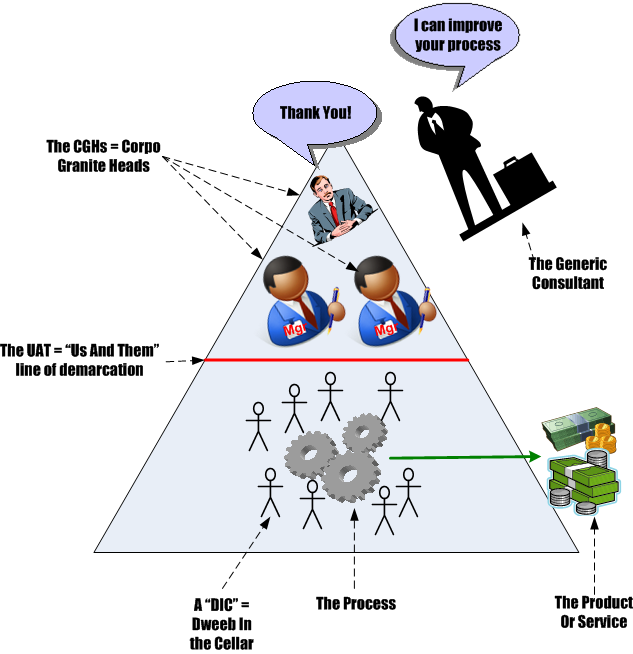
Most process improvement initiatives that I’ve been, uh, lucky(?) to be a part of didn’t improve anything. That’s because the “improvements” weren’t developed by those closest to the work. You know, those interchangeable, fungible people who actually understand what processes and methods need to be done to ensure high quality.All that those highly esteemed, title-holding, mini-Hitlers did was saddle the value makers and service providers down with extra steps and paperwork and impressive looking checklists that took away productive time formerly used to make products and provide services.
Process improvement is a high-minded, overblown way of saying “kill the goose that laid the golden egg before it lays another one“.
Be Humble
Zappos.com’s core value number 10 is: “Be Humble“. According to CEO Tony Hsieh via his book Delivering Happiness (DH), the “Be Humble” core value has probably had the most impact on hiring decisions at Zappos.com.
There are a lot of experienced, smart, and talented people we interview that we know can make an immediate impact on our top or bottom line. But a lot of them are also egotistical, so we end up not hiring them. At most companies, the hiring manager would probably argue that we should hire such a candidate because he or she will add a lot of value to the company, which is probably why most large corporations don’t have great cultures.
So, how can you weed out the BOOGLs, CGHs, CBMs, SCOLs, and determine whether a candidate fits well with your culture? Zappos.com requires each candidate-for-hire to go through two sets of interviews: one with the hiring group to evaluate skills fit, and the other with the Human Resources (HR) group to determine cultural fit. It’s the latter that sets Zappos.com apart from the herd (moooo!). They ask questions specifically derived from their set of 10 core values.
So much for being humble myself. If I was, this blog wouldn’t be soaked with acronyms like BOOGLs, CGHs, CBMs, SCOLs, and other childish terms from the readme.txt page 🙂

Note: Tony et al will be starting a book tour in August and they will be traveling around in a souped up DH bus. You can follow the happiness on Twitter at dhbus and dhbook and ceo@zappos.
The End Of An Era
I’m sad, very sad, to report the end of an era at my company. Because of the ominous near term business outlook in our industry, we’ve had to lay off 84 friends and colleagues after 25 years of no-reduction-in-workforce existence. In my mind, not having to lay off anyone in 25 years of operation is truly a remarkable achievement. Even the best make mistakes and go through tough times.
I feel very fortunate that up until now (and I’ve been around for a looooong time) I’ve never had to go through the experience of watching my employer shrink right before my eyes. But ultimately, ya gotta make money to stay in b’ness.

Google, Zappos, And Me
Check it out:

I was preparing to write a blog post about Zappos.com’s core value “Be Humble“, but I forgot what number it was. So, I decided to Google it, and the above picture is what appeared in my browser. WTF? Holy Shite!
If this doesn’t get me a free pass to Zappos Insights, I don’t know what will!!!!!
Note: I swear that the pic wasn’t photo-shopped. I ain’t no Bernie Madoff.
Much To Like
There’s much to like in Zappos.com CEO Tony Hsieh’s new book: “Delivering Happiness“. In addition to detailing the inspiring rags-to-riches Zappos.com story, Mr. “Chez” shares many nuggets of wisdom that he discovered along the way:
Don’t play games that you don’t understand, even if you see lots of other people making money from them.
It doesn’t matter how flawlessly a business is executed if it’s in the wrong business or if it’s in too small of a market.
Without conscious and deliberate effort, inertia always wins.
The presentation of the truth is as important as the truth.
Never outsource your core competency. If we were trying to be about customer service, we knew that we shouldn’t be outsourcing that (call center).
Without a separation of work and life, it’s remarkable how values can be exactly the same.
Don’t measure call times, don’t force employees to upsell, and don’t use scripts.
A key ingredient in strong relationships is to develop emotional connections.
It’s not what you say or do, but how you make people feel that matters the most.
For individuals, character is destiny. For organizations, culture is destiny.
As it turns out, many of the best ideas came about while having drinks at a local bar.

Layoffs
If you”re familiar with the Zappos.com business success story, you might think that it’s the perfect company. Unlimited growth, unlimited profits, enthusiastic employees, all good and no bad. But did you know that the company had to lay off some of their workforce not once, but twice? The first layoff, which came in the early startup years when they were struggling to survive month to month, was much more understandable than the second layoff, which occurred in 2008 while they were profitable.
When 2008 started, Zappos.com exceeded sales and profit expectations for 2007, so CEO Tony Hsieh and his leadership team decided to dole out a surprise, 10% bonus, to all Zapponians. Incredibly, eight months later he was hatching an e-mail stating that Zappos would be laying off 8% of the workforce. WTF, you ask?
2008 was a whirlwind year. The stock market crashed, the housing market crashed, hundreds of thousands of people were thrown out of work, and businesses everywhere, including Zappos, started reeling from lower sales. Since Zappos was growing like mad up to that point, they discovered that they were overhiring. Even though they weren’t losing money, the Zappos leadership team decided that they had to cut their workforce to better align their costs with decreasing revenues. In Tony’s words from his book “Delivering Happiness“;
Rather than trying to spin the story as a “strategic restructuring” as many other corporations were doing, we stuck by our core values and remained open and honest, not only with our employees, but with the press as well. – Tony Hsieh, CEO, Zappos.com
In November of 2008, Tony sent an e-mail announcing the cuts to all employees and the publicly visible Zappos.com blogs. After the bloodletting was over, he sent a followup e-mail. The full text of both e-mails is in the book, so buy it if you’re curious about what he said to the world.

Extended Business Model
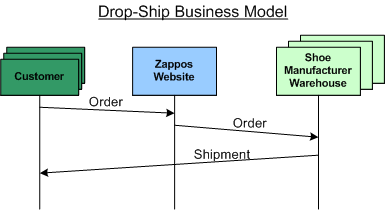
In Zappos.com CEO Tony Hsieh’s new book: “Delivering Happiness“, Tony describes the original Zappos.com business model as “drop-ship”. As the UML sequence diagram below shows, a customer would place an order at the Zappos.com website, Zappos would relay the order directly to the shoe manufacturer’s warehouse, and the order would be fulfilled and shipped directly from ground zero. It was a low cost model for Zappos, but it limited sales growth since many shoe manufacturers didn’t have the information systems in place to execute their end of the model. In addition, sales were limited to the inventory that warehouses held in storage, not necessarily what Zappos’ customers wanted.
During the initial stage of growth, Zappos.com was often short on cash (surprise!) and often just a month or two away from goin’ kaput (surprise, again!). The Zapponians needed to increase sales in order to increase cash flow. During a brainstorming session in a local bar (not in a committee of BMs, CCRATS, BOOGLs, consultants, and other self-important dudes) they came up with the idea of extending their existing business model.
Man creates by projection, nature creates by extension – Unknown
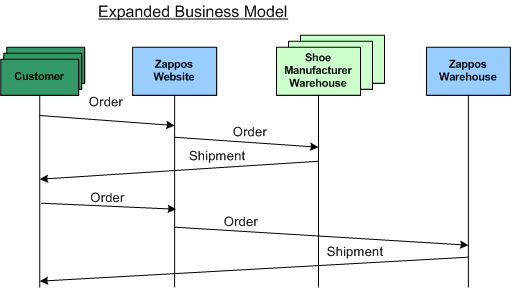
The sequence diagram below shows the extended business model that Tony “chez” et al decided to move toward. In a nutshell, Zappos would purchase or lease a warehouse and stock its own inventory based on trend information extracted from its website. As simple as it looks, the devil is in the details. Buy and read the book to learn how they pulled it off – despite being cash poor and close to going tits-up.
If changing our business model is what’s going to save us, then we need to embrace and drive change. – Tony Hsieh
How many times have you heard or spoken the “embrace change” words above but never experienced or executed any follow through?
Death By A Thousand Cuts
Zappos.com CEO Tony Hsieh has a new book out titled “Delivering Happiness“. Early in this heartwarming and wonderful little tome, he tells the story of the first real company he co-founded – LinkExchange. As LinkExchange grew and became more successful, he turned down offers of $1M (from BigFoot) and then $20M (from Yahoo!) to sell the company. He ended up selling out later for $265M to Microsoft. Tony’s personal take from the sale was a whopping $40M, of which $8M would be forfeited if he didn’t stay on for 1 year after the sale.
Before the sale of LinkExchange, he woke up one day wondering what happened to the company culture. Tony pondered how the day-to-day culture transformed from a joyous “one for all, and all for one” working environment into one that was dominated by “politics, positioning, and rumors“. He couldn’t put a finger on any one specific event or person(s) as the cause of the deterioration in culture, it was more like “death by a thousand cuts“; an insidious and undetectable rise in malady sustained by some unknown force.
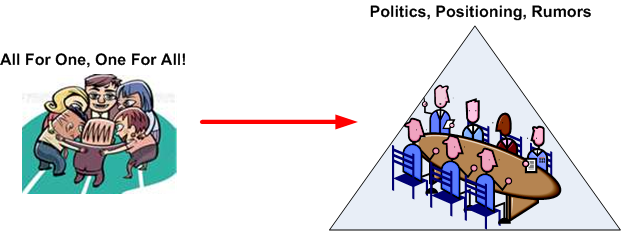
After the sale of LinkExchange, Tony walked away from the company before his contracted year was up, leaving $8M on the table. His reasoning was that he already had plenty of money and his happiness was worth more than the extra $8M. The end of LinkExchange was the start of Zappos.com…..
I had decided to stop chasing the money, and start chasing the passion – Tony Hsieh
My Leadership Cut
This is the way it is……
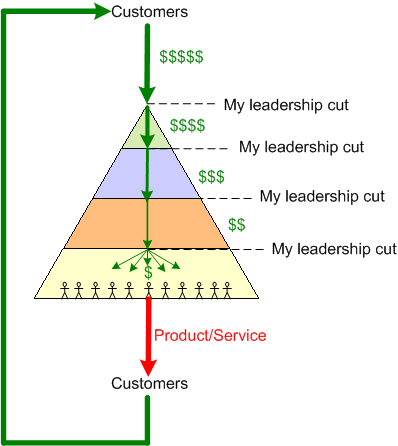 Is it the way it should be? Are there any alternatives that could “work”? Are there even any slight variations on this same-old, same-old, scheme that can make it work better compared to the rest of the herd? Nah. No way, right?

Why am I here?
WTF?
Meh!
D'oh!

My BTC Address



 Bulldozer00's Blog