Archive
Dinospeak
“I think there is a world market for maybe five computers.” – Thomas Watson, president of IBM, 1943
“Television won’t be able to hold on to any market it captures after the first six months. People will soon get tired of staring at a plywood box every night.” – Darryl Zanuck, executive at 20th Century Fox, 1946
“There is no reason anyone would want a computer in their home.” – Ken Olsen, founder of Digital Equipment Corporation, 1977
“Almost all of the many predictions now being made about 1996 hinge on the Internet’s continuing exponential growth. But I predict the Internet will soon go spectacularly supernova and in 1996 catastrophically collapse.” – Robert Metcalfe, founder of 3Com, 1995
Christine Lagarde, chief of the International Monetary Fund (IMF), recently said that banks have nothing to fear from Bitcoin. Jamie Dimon, CEO of JPMorgan bank and one of the recipients of the biggest taxpayer bailout of all time, said Bitcoin will not survive. Peter Ohser, the executive vice president of business development at global remittance giant MoneyGram, said: “We don’t see bitcoin in particular as a solution today to be able to disrupt us or provide a better or different service.”
The clueless heads of the institutional dinosaurs of today have spoken. Nuff said.

The Chasm Of Doom
In 1991, Geoffrey Moore wrote the following paragraph in his classic book, “Crossing The Chasm“.
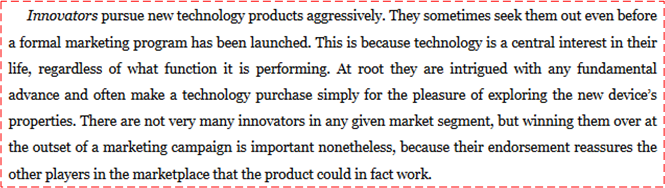
Mr. Moore also introduced the Technology Adoption Lifecycle (TAL) curve in the book as follows:

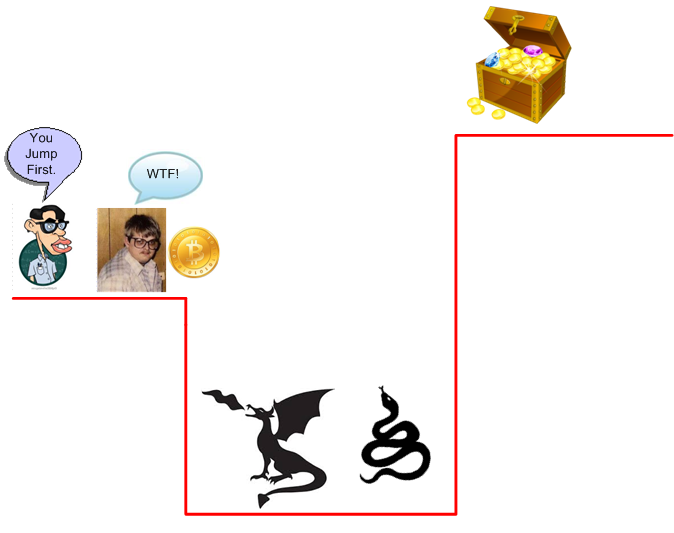
The “chasm” in the curve is the critical do or die period in the life of a disruptive technology. If its advocates can’t manage to catapult the technology over this imposing chasm of doom, the technology either outright dies on the vine or it lives on in an impoverished, niche market.
My interpretation of Mr. Moore’s quote places me squarely into the “Early Adopter” segment of Bitcoin technology. Sure, it’s been 6 years since Satoshi Nakamoto bootstrapped the Bitcoin network into existence, but Bitcoin’s goal of obliterating the deeply entrenched, inequitable banking system and changing world behavior is anything but assured. The question is: “Has Bitcoin already crossed the chasm? I think so, but do you?
Volatility Is Good
Before I read this insightful bitcoin.com forum post by Wences Casares, I thought that Bitcoin’s extreme price volatility was an inhibitor to mainstream adoption.
Of all the ways in which Bitcoin could fail the one that worries me most, because I think it has the highest probability of all the bad things that could happen, is a price panic that drives the price to zero, or $15, from which it may be very hard for Bitcoin to recover the public’s trust.
Right now most of the money that is invested in Bitcoin is money people can afford to loose and that makes it safe money. So when Bitcoin goes from $1,200 to $200 there is not a vicious cycle of people who need to sell, because they cannot afford to loose more money, that drives the price to zero.
It is hard to estimate how many people own bitcoins, but it may be somewhere between 13 and 15 million people right now. If Bitcoin is successful we will see hundreds of millions of people own Bitcoin and, eventually, billions. The only way we can get to billions of people owning Bitcoin is by the price going up by several orders of magnitude, let’s say $ 1 million (but this is highly speculative and risky). So, if I am right, and Bitcoin has to go from $390 to $1,000,000 the best way for it to get there without crashing irreversibly is with as much volatility as possible. If bitcoin went up a couple percentage points every week and everybody began to think about it as a “sure” thing, investing money that was destined to pay for kids colleges or for retirement, that is a disaster waiting to happen price wise. Because when Bitcoin corrects those people have to sell because they cannot take more losses, potentially creating a vicious circle which is hard to reverse.
Ironically, we have to thank Bitcoin’s volatility for people not investing money they cannot afford to loose. As long as the Bitcoin price remains highly volatile and perceived as risky, we are OK. Begin to worry when it is perceived as a sure thing that everybody should own a lot of. – Wences Casares
Wences is a staunch Bitcoin advocate and the star character in the book “Digital Gold“. When he speaks, I listen closely.
If you want to help make the world a better place for literally billions of “unbanked” people and you have some money you can afford to lose, then screw blowing that money on casinos and/or lottery tickets. Follow these instructions:
- Download a desktop computer wallet program (I use the Electrum wallet) and create an encrypted wallet.
- Open an account on a bitcoin exchange (I use Coinbase.com)
- Exchange your “lose-able” fiat currency for bitcoins.
- When your bitcoins get deposited in your exchange’s online “custodial” wallet, transfer it off of the web and into your desktop wallet.
- If you’re really paranoid about having your Bitcoins stolen, grok how to move your keys out of your desktop wallet and into a hardware wallet or paper wallet – and then do so.
If you don’t physically possess your private bitcoin keys, you really don’t own any bitcoins. You have to trust whoever has possession of those keys to keep them safe – like you have to trust a bank to keep your fiat money safe. And as we all know too well from the 2008 debacle, third party keepers of “other people’s money” like banks are not to be trusted if there is a viable alternative. Bitcoin is one such alternative, but you have to spend the time to educate yourself and take personal responsibility for your financial well being.

BTC For Joop
With over $100 USD worth of BTC in my mobile Airbitz wallet, I was jonesing to experience my first exchange of BTC for material goods. So I moseyed on over to overstock.com and started browsing around. I settled on purchasing my fave cologne, Joop! Homme.

I placed the item in my shopping cart and continued on to the checkout counter. As expected, the option to use BTC as payment for my French shower soap appeared right alongside the other “normal” methods of payment.

After selecting bitcoin as my payment choice, I continued on to the next page where the only info I had to provide was my name, phone number, and shipping address. So I entered the info, clicked “continue“, and was presented with this payment page:
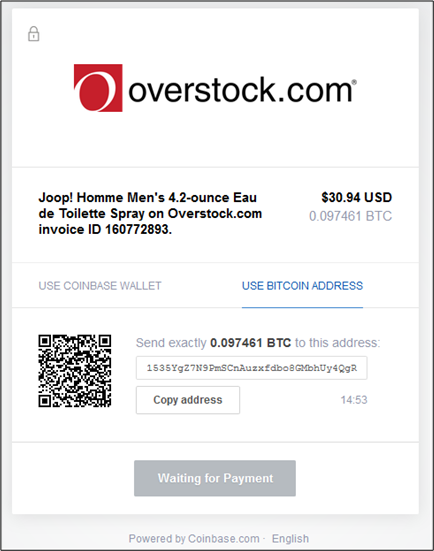
Note that overstock.com was requesting 97.461 BTC millibits from me. Also note that the bottom of the dialog box conveys the fact that overstock.com employs the service of coinbase.com to exchange BTC for USD – which is waaaay less costly for their business to use than using the Visa/Mastercard, or Paypal platforms.
Next, I opened the Airbitz wallet and pointed my phone’s camera at the QR code on the screen. The app focused in on, snapped a picture of, and decoded the graphic QR request for payment. I then entered my wallet’s pin and the transaction was executed.

As you can see, 97.368 millibits were deducted from my wallet and sent to overstock’s coinbase account. I don’t understand why the amount deducted from my wallet was 93 microbits (approx .03 USD) less than the amount requested by overstock, but I suspect it had to do with the USD/BTC exchange rate?
After acknowledging the payment, overstock.com completed the checkout process by presenting me with the following screen:

So that was it; a fast, painless, and secure transaction. Since I didn’t have to disclose any credit card info to overstock.com, I don’t have to worry about them getting hacked in the future (ala Target, Home Depot, etc) and getting my credit card info stolen from their servers. It’s a win for overstock.com (lower transaction cost), a win for the government (sales tax collected), and a win for me (no credit card theft worries).
The future is already here — it’s just not very evenly distributed – William Gibson
The Internet Of Money
The figure below contrasts the protocol that powers the web, http, with the protocol that powers the internet of money, bitcoin. Unlike http, bitcoin is both a protocol and a form of money transported via that protocol. Bitcoin-the-currency and bitcoin-the-protocol are inseparable – they’ve been purposely fused together into a brilliantly elegant and groundbreaking monetary system.

Note that http is a centralized, client-server protocol built on top of a decentralized protocol. On the other hand, bitcoin is a decentralized, peer-peer protocol built on top of the same decentralized protocol as http. Http transports abstract information. Bitcoin transports less abstract (but still abstract) virtual currency.
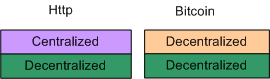
With the centralized http protocol, clients are at the mercy of those who own and control the servers that those clients issue “requests” to – those servers can be malicious. In addition, http server owners can go bankrupt or have their servers shutdown on the whim of “authorities who know what’s best for all” – taking whatever information or assets you thought you owned residing on those servers away from you.
Since bitcoin-the-protocol is decentralized, it can’t be “turned off“; just like the internet can’t be turned off. However, the possession and use of bitcoin-the-currency can be outlawed by governments if they decide that it’s a threat to them (behind the guise of “we know what’s best for all“). In addition, centralized client/server systems built on top of bitcoin-the-protocol, like currency exchanges and/or commerce sites that accept bitcoin, can be shuttered. But, with bitcoin-the-protocol, the cat is out of the bag. No matter how many “Silk Road” web sites get shutdown or how many “Mt. Gox” BTC exchanges go bust, you and I, as peers, will always be able to transact in bitcoin-the-currency over bitcoin-the-protocol.

BTC Dog
The Bitcoin system is designed such that only 21 million BTC will ever be minted – ever. The last BTC will be created in the year 2140. On first glance, one might say: “What? That’s not enough! If BTC is going to succeed, we’re going to need a boatload more BTC to be minted.”
But wait! Unlike the USD, which is divisible down to .01 USD, BTC can be sliced down to 1 “satoshi“, which is .00000001 BTC. Thus, when 2140 rolls around, 2,100,000,000,000,000 satoshis will have been minted world-wide. Man, that’s a lot o’ satoshis.

Fuggedaboud calling me BD00 anymore, just call me “BTC Dog” from now on. It’s got a nice gangsta rapper twang to it, no?

Bitcoin In UML
Abstraction Is Selective Ignorance – Andrew Koenig
All Models Are Wrong, Some Are Useful – George Box
The following figure attempts to show the relationships between major Bitcoin system entities as captured in a UML class diagram .

Starting from the bottom of the diagram, a Bitcoin user can own zero or more Hardware, Web, Mobile, PC, and/or Paper Wallets. Each type of Wallet is a Bitcoin node. A Miner is also a BTC network node. Each BTC node establishes a one-to-many relationship with other peer BTC nodes connected to the network.
An alternative UML structural “view” of the BTC system is given as:

Each BTC node retains a copy of the global, publicly shared Blockchain. As of this writing, the Blockchain has 380K+ Blocks. Each Block has one or more validated BTC Transactions embedded within it. Via the interface facilities provided by a BTC Node, a User composes a Transaction and submits it to the network for validation and execution. Each instance of a BTC Transaction contains a source address, destination address, the BTC amount to be transacted, and the source address owner’s signature.
The Blockchain Without The Bitcoin
If you read the financial press, you’ll see a lot of mentions of “blockchain technology” without any mention of Bitcoin. That’s because your friendly banksta (you know, the one who: almost blew up the world in 2008, never went to jail, and was bailed out with your and my money) wants the blockchain without the Bitcoin.
Bitcoin is an existential threat to the banking mafioso, but blockchain technology without the Bitcoin can save the Bankstas tons of money by allowing them to fire lots of accounting employees. Of course, if the Bankstas succeed in incorporating blockchain technology into their operations, dollars-to-donuts says they won’t pass on the cost savings to you and me; they’ll just write bigger bonus checks to themselves and their myriad of vice-presidents. Trickle down economics never worked before, and it won’t work now.
Which system do you think is better for average Joe’s like you and me: one with a decentralized, publicly scrutable blockchain, or the Banksta’s alternative; a proprietary blockchain hidden behind a centralized “just trust me” coalition of fee-obsessed banks?

A Sweet Gig
Because of my new found interest in Bitcoin, I started poking into the structure of the US federal reserve system. Directly from the Fed’s website, I snipped this interesting answer to a FAQ on ownership:

So, let me get this straight. The Fed is a non-profit seeking org, but it is owned by profit-seeking orgs (commercial banks). But why would a profit-seeking org want to own a non-profit seeking org?

Ah hah, the second, circled, text fragment yields the answer: the profit-seeking orgs who own the non-profit seeking org are guaranteed by law to receive a yearly, risk-free, dividend of 6%.
Unless I’m missing something big (and I might be since I’m quite the simpleton), the banksters have quite the sweet gig goin’ on here. Especially when dividend yields on short term US treasuries available to average Joe Schmoes like me and you are hoovering close to zero percent. I’d be thrilled to receive a guaranteed, risk-free, 6% annual yield on any bonds/notes that I own. Wouldn’t you?
The least our lawmakers could do is tie the yield paid out to the Fed’s owners to the yield on one year treasury notes, no? But I doubt that can or will happen; not while the fox is guarding the hen house.
As I learn more and more about how the current, centralized, financial system operates, I become more enthusiastic about the prospects of Bitcoin to: disrupt the status quo, cut out the middlemen, and weaken the fat cat institutions that are reaping big rewards from their system without having to place any skin in the game.
Gold, Currency, Bitcoin
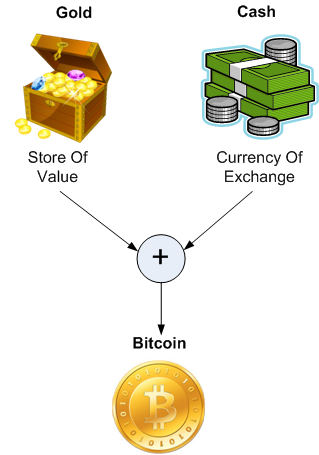
The diagram below shows some important attributes of a good “currency of exchange” and “store of value“; in other words, a good “money“. The most important characteristic is that people perceive the artifact that represents money as valuable. The second most important attribute, but not independent of the first, is scarcity. When fiat currencies collapse and lose their value, it’s because governments have printed too much of it (to finance wars and massive, unsustainable social programs). It ceases to be scarce and its holders lose faith in its value.

Gold and other precious metals serve as a good store of value and a hedge against volatile currencies because it is scarce. However, gold is not a very good, practical, currency of exchange because it’s not very portable in large amounts (armed guards, armored vehicles) or accurately divisible. That’s why you don’t see Amazon.com or Target accepting gold for their products, or governments accepting gold bars/nuggets as payment for taxes.
Physical, difficult-to-counterfeit, paper dollars and coins serve as a good medium of exchange because of their increased portability, fungibility, and divisibility relative to gold. Dollars can also serve as a good store of value as long as their issuer doesn’t go wild and turn the dials up to 10 on their mints – which is ominously becoming more common nowadays.
Theoretically, secure virtual currencies like Bitcoin trump gold and cash in all categories except for one.
- BTC is guaranteed to be scarce since there is no way to mint more than 21M BTC – this limit was baked into the system since day one by system designer Satoshi Nakamoto.
- BTC is portable because it weighs nothing – a BTC is simply a number in a disk file that can be transferred securely and speedily over the internet at will by its owner (with no middle parties taking a cut or delaying the transfer).
- BTC is fungible because it can’t be counterfeited. The huge amount of crypto computing power underlying the system ensures that double-spending is astronomically impossible.
- BTC is divisible down to .00000001 of 1 BTC, or 1 “satoshi”. When the BTC mint shuts down sometime in 2140, 1 X 10**14 satoshis will be in circulation and virtual vaults throughout the world.
The sole category where Bitcoin doesn’t trump gold/cash is in social consensus of perceived value. The vast majority of the 7 billion people in the world perceive the value of BTC to be zero.
As I write this post, the handful of millions of people who transact in Bitcoin (i.e. the market) “perceive” 1 BTC to be worth $200+ in cash issued by the most financially viable country on the globe – the USA. But alas, if the market turns, Bitcoin’s value might revert back to the value it was born with: zero.

Why am I here?
WTF?
Meh!
D'oh!

My BTC Address



 Bulldozer00's Blog