Archive
Interdisciplinary Team Effort
Where are the clowns? Send in the clowns. – Shirley Bassey
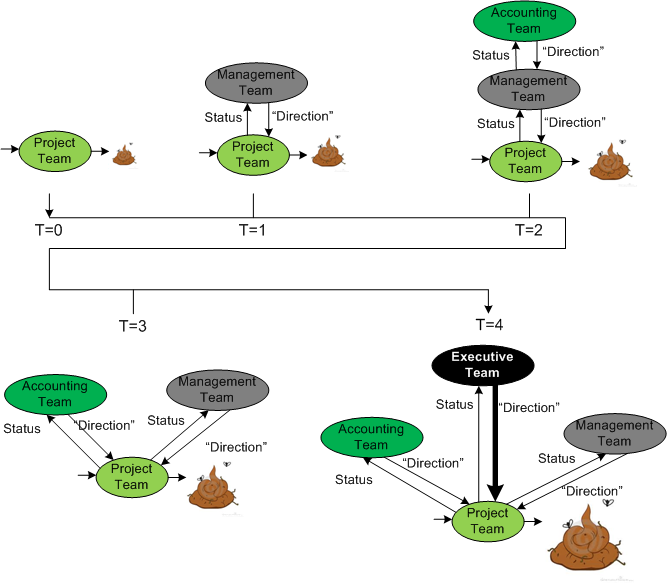
The Berkun Process
Scott Berkun’s brilliance never ceases to amaze me. In the video below, which runs at 30X real-time, we see a 1000 word essay that took 3 hours to write being created in 5 freakin’ minutes. While the footage whizzes by, Scott explains what he was doing and thinking during the creative act.
Like Gerry Weinberg does in his “Fieldstone Method“, Scott carries a notebook around wherever he goes and jots down notes/ideas as they appear in his head out of the ether. This crucial practice prevents the dreaded “blank page” syndrome from manifesting when it’s time to sit down and write.
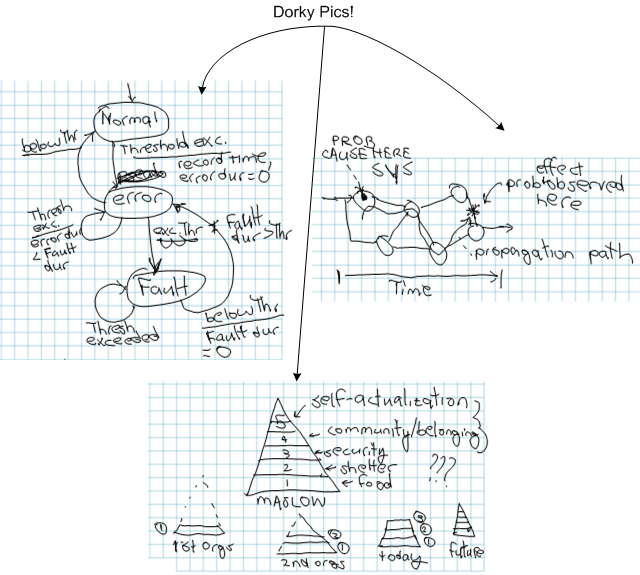
BD00 collects “fieldstones” in much the same way. He also sketches out dorky pictures for future enhancement and refinement in Microsoft Visio.
Sandwich Dilemma
In this dated, but still relevant paper, “Evolving a language in and for the real world“, Bjarne Stroustrup laments about one of the adoption problems that (still) faces C++:

Since the overarching theme of C++ is, and always has been, “efficient abstraction“, it’s not surprising that long time efficiency zealots and abstraction aficionados would be extremely skeptical of the value proposition served up by C++. I personally know this because I arrived at the C++ camp from the C world of “void *ptr” and bit twiddling. When I first started studying C++, its breadth of coverage, feature set, and sometimes funky syntax scared me into thinking that it wasn’t worth the investment of my time to “go there“.

I think it’s easier to get C programmers to make the transition to C++ than it is to get VM-based and interpreter-based programmers to make the transition. The education, more disciplined thinking style, and types of apps written (non-business, non-web) by “close to the metal” programmers maps into the C++ mindset more naturally.

What do you think? Is C++ the best of both worlds, or the worst of both worlds?
Standard, Portable C++ Concurrency
Recently, I downloaded the Microsoft Visual Studio 11 IDE Beta in order to start experimenting with some C++11 features. Lo and behold, standard and portable concurrency is now supported:
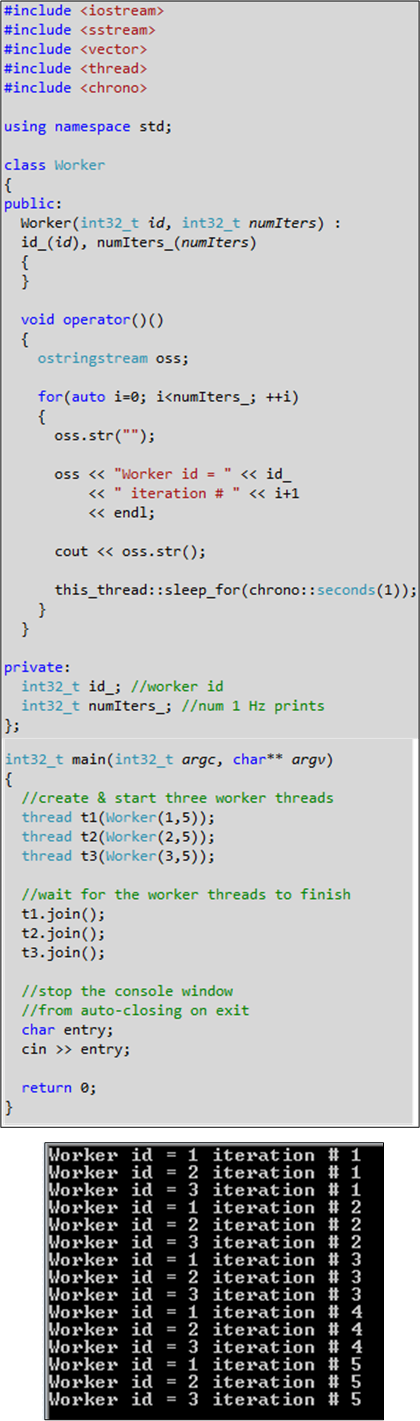
At least on Windows, there’s no need to use the Win API, Boost.Thread or ACE or any other third party library in the future to write multi-core friendly, multi-threaded C++ apps. I don’t know when GCC and/or CLANG will ship with the standard C++11 concurrency libs. Do you?
By the way, a series of quick tests verified that lambdas, strictly typed enums, auto, nullptr, std::array, std::regex, and std::atomic work. Initializer lists, raw string literals, “using” as typedef, and range-based for loops don’t work yet.
Customer Suffering
For some context, assume that your software-intensive system can actually be modeled in terms of “identifiable C”s:
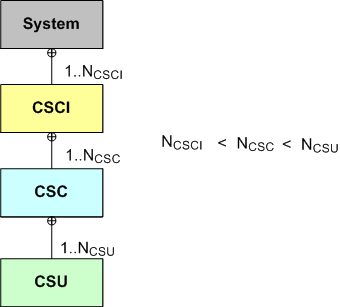
Given this decomposition of structure, the ideal but pragmatically unattainable test plan that “may” lead to success is given by:
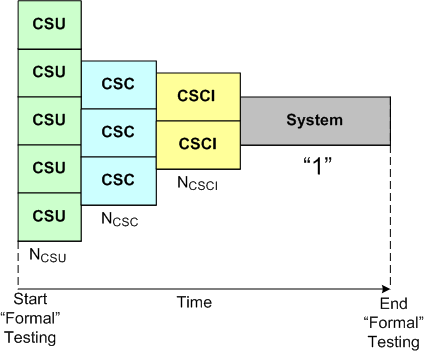
On the opposite end of the spectrum, the test plan that virtually guarantees downstream failure is given by:
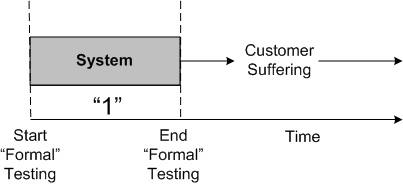
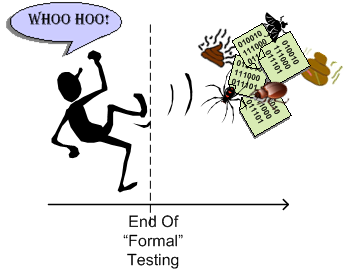
In practice, no program/project/product/software leader in their right mind skips testing at all the “C” levels of granularity. Instead, many are forced (by the ubiquitous “system” they’re ensconced in) to “fake it” because by the time the project progresses to the “Start Formal Testing” point, the schedule and budget have been blown to bits and punting the quagmire out the door becomes the top priority.
Messmatiques And Empathic Creators
Assume that you have a wicked problem that needs fixing; a bonafide Ackoffian “mess” or Warfieldian “problematique” – a “messmatique“. Also assume (perhaps unrealistically) that a solution that is optimal in some sense is available:
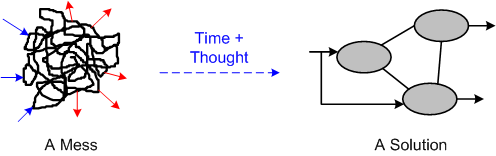
The graphic below shows two different social structures for developing the solution; individual-based and group-based.

If the messmatique is small enough and well bounded, the individual-based “structure” can produce the ideal solution faster because intra-cranial communication occurs at the speed of thought and there is no need to get group members aligned and on the same page.
Group efforts to solve a messmatique often end up producing a half-assed, design-by-committee solution (at best) or an amplified messmatique (at worst). D’oh!
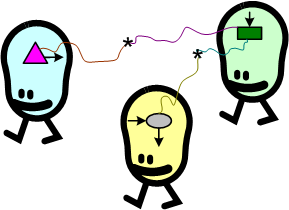
Alas, the individual, genius-based, problem solving structure is not scalable. At a certain level of complexity and size, a singular, intra-cranial created solution can produce the same bogus result as an unaligned group structure.
So, how to resolve the dilemma when a messmatique exceeds the capacity of an individual to cope with the beast? How about this hybrid individual+group structure:
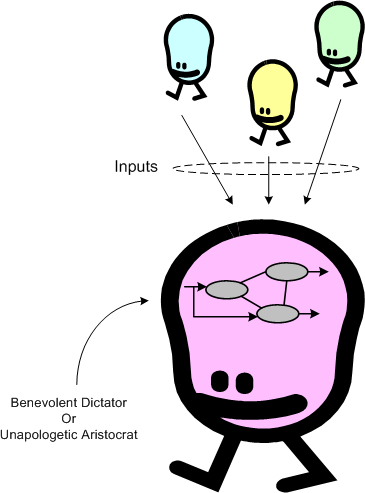
Note: The Brooksian BD/UA is not a “facilitator” (catalyst) or a hot shot “manager” (decider). He/she is both of those and, most importantly, an empathic creator.
Composing a problem resolution social structure is necessary but not sufficient for “success“. A process for converging onto the solution is also required. So, with a hybrid individual+group social structure in place, what would the “ideal” solution development process look like? Is there one?
The Gap Of Woe
In “Why Software Fails”, the most common factors that contribute to software project failure are enumerated as:
- Unrealistic or unarticulated project goals
- Inaccurate estimates of needed resources
- Badly defined system requirements
- Poor reporting of the project’s status
- Unmanaged risks
- Poor communication among customers, developers, and users
- Use of immature technology
- Inability to handle the project’s complexity
- Sloppy development practices
- Poor project management
- Stakeholder politics
- Commercial pressures
Yawn. These failure factors have remained the same for forty years and there are no silver bullet(s) in sight. Oh sure, tools and practices and methodologies have “slightly” improved project performance over the decades, but the increase in size/complexity of the software systems we develop is outpacing performance improvement efforts by a large margin.

A Dearth Of Libraries
In Herb Sutter’s talk at GoingNative 2012, he opined that the biggest weakness of C++11 is its dearth of libraries; which causes programmers to waste lots of time ($$$) writing their own code to implement mundane functionality like XML parsing, cryptography, networking/sockets, thread-safe containers (<- I’ve had to spend quite a bit of time doing this!), serialization, etc.
Using language and library specification page counts, Herb started out by showing the progressive growth of C and C++ over time:
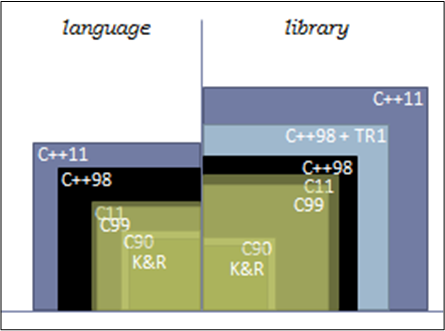
Next, Herb presented this eye-popping chart of relative library size for C++11, .NET, and Java:

Yes, that’s C++11 down in those tiny blue boxes. WTF! Note that the core language specifications on the left side of the chart are roughly the same size.
To address the issue, Herb proposed the formation of a an open-source Portable C++ Libraries (PCL) organization with the following guiding principles:
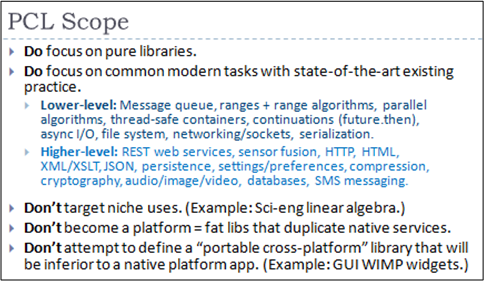
Herb also addressed the issue of how the PCL would interact with the C++ standards committee with this chart:

Basically, the PCL would serve as a front end vetter and integrator of library submittals in order to unburden the committee from the responsibility and allow it to concentrate more on tricky core language features (concepts, modules, static if, etc). The C++ committee would serve as the final fine-grained scrutinizer and approver of library additions to the language. In practice, libraries like poco and Qt could be shipped with every standards-compliant C++ compiler in the future.
I think Herb’s idea is a good one and I hope it blossoms into the real deal. How about you? What do you think?
BD00 – The Physicist
In case you haven’t noticed, BD00 liberally conjures up and uses abstract pictures to promote his rants and lies – just like a physicist:
The use of abstract pictures or symbols to represent real things is absolutely fundamental in physics –this is essentially what physicists use mathematics for. The power of the approach comes when the abstract pictures can be manipulated using simple rules to make firm predictions about the real world. – Cox, Brian; Forshaw, Jeff (2012-01-31). The Quantum Universe: (And Why Anything That Can Happen, Does) (Kindle Locations 512-514). Perseus Books Group. Kindle Edition.
Notice any resemblance?

Hijacked By Thought
In “The Most Direct Means To Eternal Bliss“, Michael Langford nails BD00 personally with a bullet to the forehead:

Confusing “knowing-insight-awareness” with “conceptual knowing“. That’s exactly the rut I’m in. What rut are you in?


Why am I here?
WTF?
Meh!
D'oh!

My BTC Address



 Bulldozer00's Blog