Archive
The BD00 Brand
For the past coupla years, “brand” has been a buzzword of choice in the mainstream of business propaganda. Some people on LinkedIn.com even tout themselves as “branding experts” like BD00:
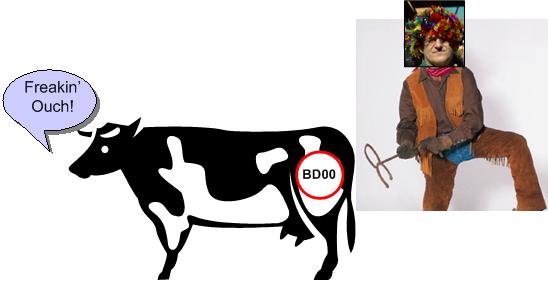
If I see another brand new article or book ad about “branding“, I’m gonna ralph.
The Three Principles
William James, who is regarded as the father of modern psychology, once wrote that the field of psychology had no true principles. He said if such principles were ever realized on a large scale, it would make the importance of every human advancement since fire pale in comparison.

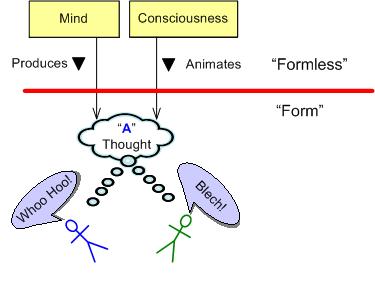
As always, it’s our choice to decide what’s true for ourselves, but the three principles behind psychological life are: Mind, Consciousness, and Thought (MCAT). From formlessness, Mind produces a formed Thought and Consciousness brings this thought form to life via our senses. It’s as simple (simplistic?) as: Mind->Thought->Consciousness.

As long as we are alive, the MCAT trinity is in continuous operation. Whether we’re aware that this irreducible, equation-less, metaphysical system is operating silently in the background of our psyche or not, that’s how we experience psychological life moment-to-moment.
Of the three principles, “thought” is what we are intimately familiar with. Unlike formless “mind” and formless “consciousness“, we can directly “see and feel” our thought forms in real-time. Thus, from the instant we wake up in the morning until we go to sleep at night, we act on them as they spontaneously emerge during the day.

Note that the universal MCAT trio is impersonal. It doesn’t say anything… nada… zilch… about quality of “thought“. That’s where the “personal” you and I come in.
As soon as we become aware of an impersonally created thought, we instantaneously attach a level of personal “I-ness” and judgmental quality to the thought. Thus, hypothetically given the same thought, you can experience its associated feeling as joy and I can experience it as sorrow. Ergo, quality of thought is personal.
Related articles
- RIP, Dear Syd (Bulldozer00.com)
Disengaging
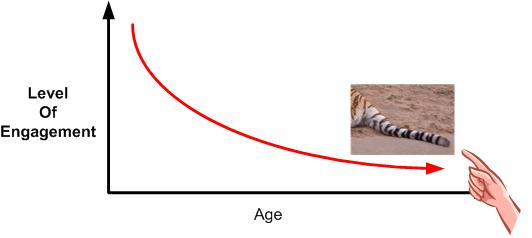
In “We Learn Nothing“, uber-essayist Tim Kreider said something like “it’s sad to see people disengage from life as they get older.” OMG! When I read that, I felt like Timbo had just articulated one of my greatest fears.

Except for a handful of painful but relatively short times when I’ve totally disengaged from participating in life, I’ve been committed to desperately holding on to the tiger’s tail and racing through the jungle of life with (almost) reckless abandon.
How about you? Do you feel yourself sloooowly disengaging from life as the years tick by? If not, then good for you. If so, then do you think you should wake up and start searching for that tiger tail?
Respectable And Family-Oriented
For your viewing pleasure, here are some pix that BD00 snapped down in Nawlins‘ during Mardi Gras 2013. The scoundrel sent me many more pix, butt, uh, I chose not to hoist them on this respectable and family-oriented blawg.

Motorcycle And Software Maintenance
Robert Pirsig’s “Zen And The Art Of Motorcycle Maintenance” is one of my fave books of all time. I have a soft cover copy that I bought in the nineties. Because of its infinite depth and immersive pull, I’ve read it at least three times over the years. Thus, when Amazon.com sent me a recommendation for the kindle version of it for $2.99, I jumped at the chance to e-read it and capture some personally meaningful notes from it.
(Published in 1974) the book sold 5 million copies worldwide. It was originally rejected by 121 publishers, more than any other bestselling book, according to the Guinness Book of Records. – Wikipedia
In a nutshell, ZATAOMM is about a college professor (Pirsig himself) who ends up going insane over his obsession with trying to objectively define what the metaphysical concept of “quality” means.
Quality…you know what it is, yet you don’t know what it is. But that’s self-contradictory. But some things are better than others, that is, they have more quality. But when you try to say what the quality is, apart from the things that have it, it all goes poof! There’s nothing to talk about. But if you can’t say what Quality is, how do you know what it is, or how do you know that it even exists? If no one knows what it is, then for all practical purposes it doesn’t exist at all.
During my fourth read of ZATAOMM, I started noticing how much of the wisdom Mr. Pirsig proffers up applies to the “art” of software development/maintenance:
When you want to hurry something, that means you no longer care about it and want to get on to other things.
This comes up all the time in
mechanicalsoftware work. A hang-up. You just sit and stare and think, and search randomly for new information, and go away and come back again, and after a while the unseen factors start to emerge.Sometimes just the act of writing down the problems straightens out your head as to what they really are.
The craftsman isn’t ever following a single line of instruction. He’s making decisions as he goes along. For that reason he’ll be absorbed and attentive to what he’s doing even though he doesn’t deliberately contrive this. He isn’t following any set of written instructions because the nature of the material at hand determines his thoughts and motions, which simultaneously change the nature of the material at hand.
Any effort that has self-glorification as its final endpoint is bound to end in disaster.
Stuck. No answer. Honked. Kaput. It’s a miserable experience emotionally. You’re losing time. You’re incompetent. You don’t know what you’re doing. You should be ashamed of yourself.
This gumption trap of anxiety, which results from overmotivation, can lead to all kinds of errors of excessive fussiness. You fix things that don’t need fixing, and chase after imaginary ailments. You jump to wild conclusions and build all kinds of errors into the machine because of your own nervousness.
Impatience is close to boredom but always results from one cause: an underestimation of the amount of time the job will take. You never really know what will come up and very few jobs get done as quickly as planned. Impatience is the first reaction against a setback and can soon turn to anger if you’re not careful.
Impatience, stuckness, underestimation, anxiety, and carelessness. These are just a subset of the feelings and behaviors that pervade dysfunctionally soulless organizations whose sole focus is on “following prescribed process and meeting schedule“.

Hand In Hand
Me thinks that these two quotes go together hand in hand, and in the order presented:
“At first I hoped that such a technically unsound project would collapse but I soon realized it was doomed to success.” – C. A. Hoare
“The bitterness of poor system performance remains long after the sweetness of low prices and prompt delivery are forgotten.” – Jerry Lim

Have you ever participated on a project that made it out the door but caused financial and social “problems” sometime downstream? Lucky for him, BD00 hasn’t.
My C++11 “Move” Notes
Being a slow learner, BD00 finds it easier to learn a new topic by researching the writings from multiple sources of authority. BD00 then integrates his findings into his bug-riddled brain as “the truth as he sees it” (not the absolute truth – which is unknowable). The different viewpoints offered up by several experts on a subject tend to fill in holes of understanding that would otherwise go unaddressed. Thus, since BD00 wanted to learn more about how C++11’s new “move” and “rvalue reference” features work, he gathered several snippets on the subject and hoisted them here.
Why Move?
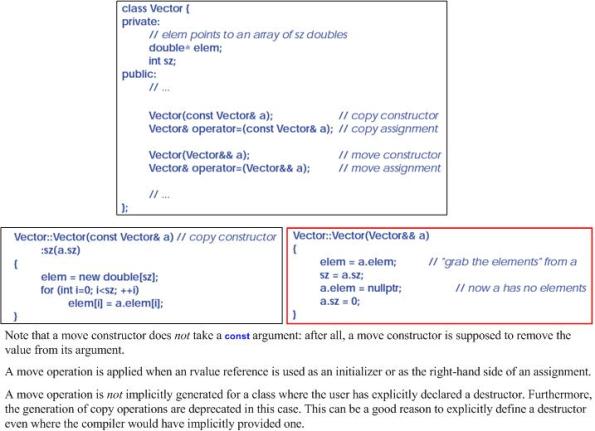
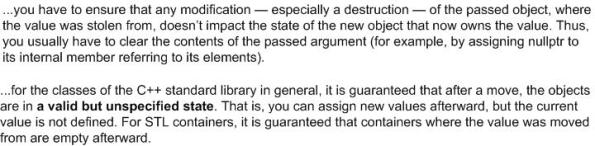
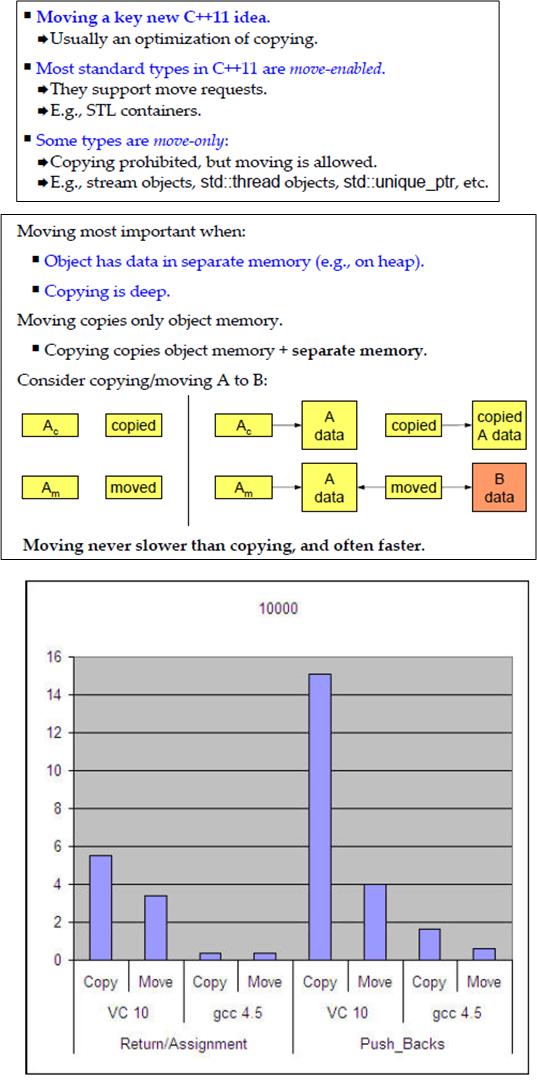
The motivation for adding “rvalue” references and “move” semantics to C++11 to complement its native “copy” semantics was to dramatically improve performance when large amounts of heap-based data need to be transferred from one class object to another AND it is known that preserving the “from” class object’s data is unnecessary (e.g. returning a non-static local object from a function). Rather than laboriously copying each of a million objects from one object to another, one can now simply “move” them.
Unlike its state after a “copy“, a moved-from object’s data is no longer present for further use downstream in the program. It’s like when I give you my phone. I don’t make a copy of it and hand it over to you. After I “move” it to you, I’m sh*t outta luck if I want to call my shrink – until I get a new phone.
Chapter 13 – C++ Primary, Fifth Edition, Lippman, Lajoie, Moo

Chapter 3 – The C++ Programming Language, 4th Edition, Bjarne Stroustrup
Chapter 3 – The C++ Standard Library, 2nd Edition, Nicolai M. Josuttis
Overview Of The New C++ (C++11), Scott Meyers
What’s The Diff?
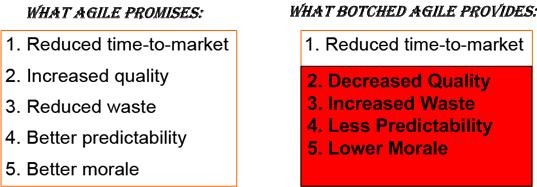
One of the problems I’ve always had with the word “agile” is that it’s so overloaded (like “system“) that anyone can claim “agility“:
Everyone is doing agile these days – even those who aren’t – Scott Ambler
Along this vein, check out this slide from a unnamed agile expert:
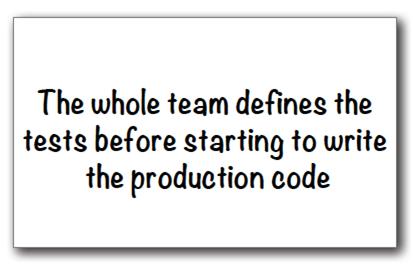
Now tell me, how is this advice different from the unconscionable and anti-agile:
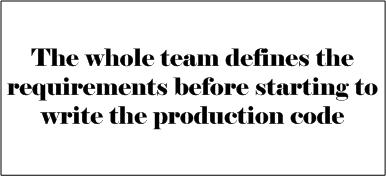
To define tests, you have to have some understanding of the requirements to test against in your cranium, no? It’s just that, in agile-land, you’ll be excommunicated from the cult if you formally write them down before slinging code. WTF?
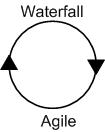
Like “agile” was a backlash against “waterfall” in the past, maybe “waterfall” will be a circular backlash against “agile” in the future?
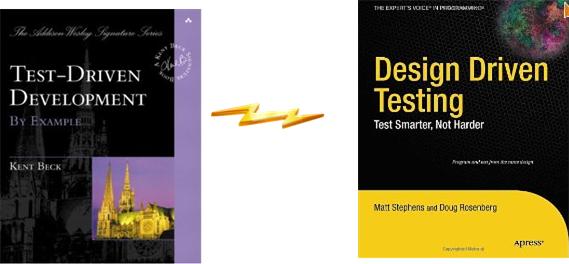
Likewise, instead of creating an emergent Frankensteinian design with revered “TDD“, why not hop off the bandwagon and create emergent tests with “DDT“?
Road Trip

And what will you be doing on FAT Tuesday, dear reader?

Why am I here?
WTF?
Meh!
D'oh!

My BTC Address



 Bulldozer00's Blog