Archive
Staffing Profiles
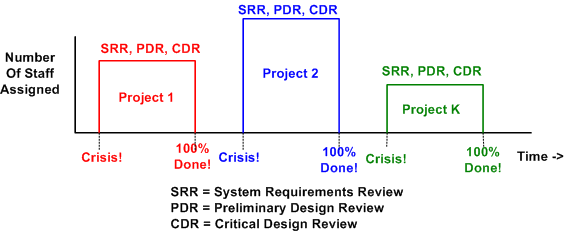
The figure below shows the classic smooth and continuous staffing profile of a successful large scale software system development project. At the beginning, a small cadre of technical experts sets the context and content for downstream activity and the group makes all the critical, far reaching architectural decisions. These decisions are documented in a set of lightweight, easily accessible, and changeable “artifacts” (I try to stay away from the word “documentation” since it triggers massive angst in most developers).
If the definitions of context and content for the particular product are done right, the major incremental development process steps that need to be executed will emerge naturally as byproducts of the effort. An initial, reasonable schedule and staffing profile can then be constructed and a project manager (hopefully not a BM) can be brought on-board to serve as the PHOR and STSJ.

Sadly, most big system developments don’t trace the smooth profiling path outlined above. They are “planned” (if you can actually call it planning) and executed in accordance with the figure below. No real and substantive planning is done upfront. The standard corpo big bang WBS (Work Breakdown Structure) template of analysis/SRR/design/PDR/CDR/coding/test is hastily filled in to satisfy the QA police force and a full, BM led team is blasted at the project. Since dysfunctional corpocracies have no capacity to remember or learn, the cycle of mediocre (at best) performance is repeated over and over and over. Bummer.
Nested Bureaucracies
By definition, ineffective bureaucracies (are there any effective ones?) consume more resources than they produce in equivalent value to their users/consumers. According to Russell Ackoff, the only way an ineffective bureaucracy can remain in place is by external subsidization that is totally disconnected with its performance. In other words, bureaucracies rely on clueless sugar daddies supplying them with operating budgets without regard to whether they are contributing more to “the whole” than they are withdrawing. Unchecked growth of internal bureaucracies siphons off profits and it can, like a cancer, kill the hosting org.
The figure below shows a simplistic bird’s eye view of an American economic system dominated by CCH bureaucracies. The irony in this situation is that even though the Corpo Granite Heads (CGH) in charge of the CCHs are staunch supporters of the distributed free market model which rewards value creation and punishes under-performance, they run their own orgs like the old Soviet Union. Ala GM and most huge government departments, they operate as centralized, nested bureaucracies where the sloth at the top trickles money down to the mini-bureaucracies below – without regard to value produced.
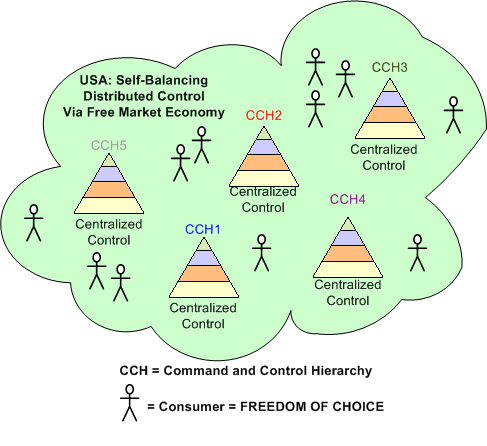
Bureaucracies, being what they are and seeking to survive at all costs, jump through all kinds of hoops to camouflage their worthlessness and keep the money flowing down from the heavens. Since the cabal at the top is too ignorant to recognize that it’s a bureaucracy in its own right, it’s an expert camouflage spinner to the corpocracy’s stakeholders (who gobble up the putrid camouflage with nary a whimper) and it sucks much more out of the corpo coffers than it adds value without being “discovered and held accountable”. In the worst nested bureaucracies, none of the groups in the hierarchy, from the top layer all the way down the tree to the bottom layer, produce enough value to offset their ravenous appetite for resources. They collapse under the weight of their own incompetence and then wonder WTF happened. From excellence to bankruptcy in 24 hours.
The really sad part is that before a bureaucracy auto-snaps into place, it wasn’t a bureaucracy in the first place. Everybody in the “startup” contributed more than they withdrew from the whole, and the excess value translated into external sales and internal profits. Like the boiled frog story, the transformation into a bureaucracy was slooow and undetectable to the CGHs in charge. Bummer.
The answer to this cycle of woe, according to Ackoff, is for the leaders in an org to operate the whole (including themselves) as a system of nested free markets, where each internal consumer of services gets to choose whether it will purchase needed services from internal groups, or external groups. Each internal group, including the formerly untouchable head shed, must operate as a measurable profit and loss center. Mr. Ackoff describes all the details of nested free market operation, including responses to many of the “it can’t work because of……” elite whiners, in his insightful book: Ackoff’s Best. Check it out, if you dare.
Zero Cost Risk Mitigation
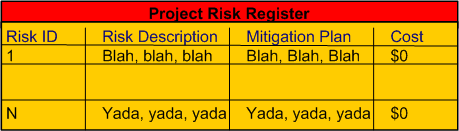
Why do managers and executives require project technical leaders to develop comprehensive “risk mitigation plans” while at the same time fully expecting the plans to cost nothing (no people, no time, no money). Formal and rigorously filled out risk registers (with no cost column) make it look like due diligence is being performed, but it’s all a ruse to sustain the illusion that management is “in control”. WTF?
Both Ends Of The Spectrum
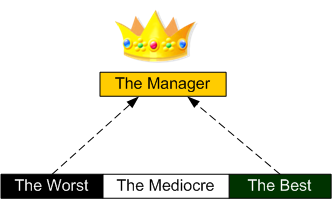
Why does it seem that both the best engineers and the worst engineers always gravitate towards becoming managers? Because of a lack of training in the art of humanistic influence and true leadership skills, they usually (but not always) end up turning into STSJ BMs. The real tragedy is the continuous loss of the best engineers into the ranks of corpo elitism. Why? Because the revenue generating products and services they leave in the dust for fame and fortune suffer the consequences of their departure. Thus, the whole company suffers. Bummer.
Door Boot
I write pretty much what comes to mind. If you read further into this post, you will discover (if you haven’t already) that because of this behavior pattern, I’m just a blathering idiot.
In high school (I think it actually started back in middle school), me and my superior clique of buddies used to squash words together to create a tribal language that we used to belittle other people and describe funky situations. It was sort of like speaking pigeon English or creating clever acronyms with vowels tucked within them. Some of our language constructs were subtle and hard to decode, especially the ones that collapsed M words into N words where N << M. My favorite of all time, and one of the rare ones that I couldn’t decode on my own was, “Door Boot”. I wish I created it.

Door Boot = “dick show-urr bathing suit”.
I think “door boot” came into existence before the “banana hammock” descriptor came into vogue.
A Unique Core Value
Unless they’ve been cleverly camouflaging their sinister ways from the world’s prying eyes, the people at Zappos.com truly do live and breathe their corporate values every day. My favorite, and perhaps most unique Zappos core value is number three: “Create Fun and a Little Weirdness“. Here’s how the Zappos team describes this precious gem from the viewpoint of their “Core Values Frog” (CVF):
Our CVF has a sense of humor; he knows that it’s good to laugh at yourself every once in a while. Work shouldn’t be synonymous with drudgery; CVF can find fun and weirdness even when the rubber meets the road and we’re getting lots done. Being a little weird requires being a little innovative, and CVF is always looking for a chance to fully engage in his work and bring out the fun and weird side of it.
In tribute to CV #3, the people at Zappos have held impromptu parades, hula hoop contests, head shavings, and all kinds of other weird events both on and off the company’s premises.
Of course, Zappos is just a lowly $1B retail shoe company and your business is much more different, respectful, and prestigious. Thus, it’s patently obvious that Zappos core value #3 can’t possibly work in your corpo palace. Right?

Accessible And Accessed
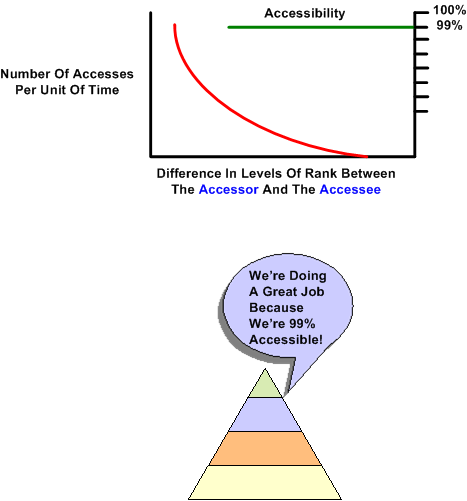
One of the metrics that a lot of corpo hierarchs assess themselves on is how accessible they are to their people. However, being accessible (textbook open door policy, walking the halls, e-mail, pseudo-mandated all hands meetings) doesn’t mean being accessed. For obvious reasons, they don’t measure themselves on this important metric, especially how frequently they are accessed (voluntarily and unsolicited) by their non-direct reports. In the vast majority of corpocracies, the number of accesses per unit of time goes down as the difference between caste levels of the accessor and accessee goes up. Just because that’s the way it’s always been doesn’t mean that’s the way it should or could be.
Spoiled And Lazy; Hungry And Energetic
A few years ago, I read an opinion piece regarding the demise of the US auto industry. The author stated that because they were spoon fed boatloads of money by the US government to design and build military hardware during WWII, the car companies morphed into spoiled and lazy sloths; they stopped innovating on their own nickel. Unless a sugar daddy (like the US government) was going to externally subsidize the effort, they weren’t gonna open the company coffers to develop new products or vastly improve their existing ones. Because of this overly conservative mindset (and the poo pooing away of Deming’s quality movement), the Japanese eventually blew right by the big three – even though their nation was decimated by the war and they had to start from scratch.
The same danger applies today, every day, to every company that builds things, especially big things, for government orgs. Understandably, since creating and continuously improving big complex systems requires big investments and big scary risks to be overcome, companies are loathe to pour money into what may eventually turn out to be an infinite rat hole. However, if all the competitors in the market space have the same welfare mindset, then no one will sprint out ahead of the pack and all participants may still prosper – until money gets tight. When the external dollar stream slows to a trickle, those (if any) competitors who’ve boldly invested in the future and successfully transformed their investments into product improvements and new product portfolio additions, rise to the top. It’s the hungry and energetic, not the spoiled and lazy, that continuously prosper through good times and bad.

Is your company spoiled and lazy, or hungry and energetic? If it’s the former, what actions does your company take when tough economic times emerge and the money stream slows?
We Don’t Want Yours
We want our group to be less conflict averse so that the best ideas can be forged within the crucible of debate and (sometimes) heated dialog. We also want passion from our people. As a matter of fact, we demand it of everyone in our group.
BUT!
We don’t approve of your over-the-top confrontational style and we don’t approve of the ways that you externalize your passion. Sadly, we don’t have any role models in our management ranks to lead the “conflict aversion reduction and passion elevation” initiative. Thus, we have no clue of how we want our people to initiate confrontation or express passion, but we’ll know it when we see it, of course.
WTF?

Recruitment
Surprisingly, in spite of my relentlessly continuous rants against a sea of CCHs, BMs, and STSJs as far as the eye can see, I’ve been contacted by a handful of recruiters probing into my availability for jumping ship. Either they don’t know this blog exists and they haven’t read any of my blasphemous blog posts, or they have read some of them and they still think I can help their clients make money. The former is most likely, but if it’s the latter, then I’m stunned and I hope their clients have the same 21st century mindset as they do.
Since I’m very happy where I am, I will only consider those proposals that satisfy the following requirements. Of course, they’re presented as a bland, linear, 1970’s list of “shalls”.
- The potential employer shall (R-1) offer me 2X my current 6 figure salary
- The potential employer shall (R-2) offer me an opportunity to work on a vast array of interesting new product developments or existing product enhancements. I reserve the right to decide what “interesting” means
- The potential employer shall (R-3) supply me with all the tools I need to do my job and allow me to work from home 90% of the time.
- The potential employer shall (R-4) pay all expenses for me to travel to and from the employer’s home base if the distance between my house and the home base is greater than 20 miles.
- The potential employer shall (R-5) entrust me with an unlimited training budget to allow me to continuously probe, sense, cut through the camouflage, and evaluate the applicability of new software technologies to the employer’s product portfolio.
- For the sole reason of getting people to listen more closely to what I have to say on matters within my scope of knowledge and expertise, the employer shall (R-6) endow me with some kind of BFT. More than one title would be preferable because it may be the tie-breaker amongst multiple, simultaneous employment offers.
What do you think? Outrageously arrogant and full of hubris? Reasonable and practical? Let me know if you think I should shit-can this post and hope that no internet archive crawlers get a hold of it. D’oh!


Why am I here?
WTF?
Meh!
D'oh!

My BTC Address



 Bulldozer00's Blog