Archive
DIC Revolt
From High-Frequency Programmers Revolt Over Pay – Forbes.com:
“Pity the programmers toiling away at Wall Street’s secretive high-frequency trading shops–places like Goldman Sachs, Citadel and Getco. They wrote algorithms that take advantage of fleeting trading opportunities and bring in up to $100,000 a day. In return, they received a fraction of the pay doled out to their bosses.”
Now some programmers feel used and are instigating a revolt. They are doing so by striking out on their own or forming profit-sharing arrangements.
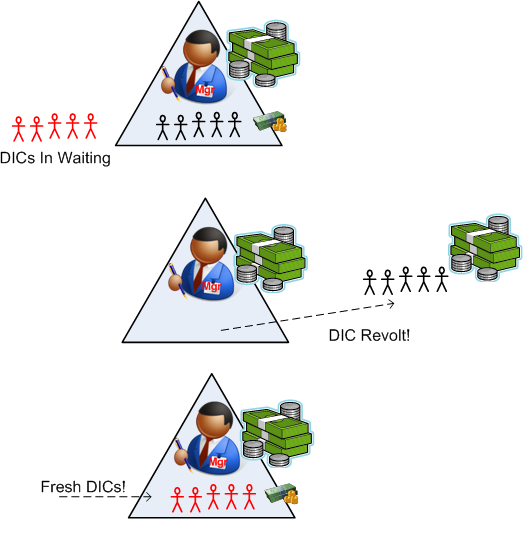
Wow! A sampling of DICs has risen above the talking, whining, complaining, poor-me stage. They’ve actually taken action toward their perception of justice. Of course, the holes they’ve created at their former Wall Street greed-masters will be filled by other willing slave-DICs who will revive the whining, complaining, poor-me tradition left behind.
Strategic And Cautious
At nights and on weekends we cry out for human rights and freedom of speech, and then we go to work and become strategic and cautious about our every word for fear we will be seen as disloyal or uncommitted. – Peter Block
The above quote reminds me of many meetings that I’ve attended. In one of these watch-out-what-you-say-or you’ll-be-in-deep-shit group fear fests, the topic of a long time dedicated and highly productive employee leaving the company popped up. The frustrating and sad thing about the experience was that even though virtually everyone knew who the person was, no one spoke his name – including wimpy me. It was like an unwritten taboo, as hinted by Block’s quote above. At the time, I thought of getting up and yelling:
“Damn it! His name is XXXX. Why can’t anyone freakin’ speak it? Even though I think most of you know who we’re talking about, what harm would befall us if we spoke his name to the ones who don’t know? Why so much fear and secrecy?”
Of course, I only thought the thought and I didn’t say squat….. preferring to remain strategic and cautious.

Wishful And Realistic
As software development orgs grow, they necessarily take on larger and larger projects to fill the revenue coffers required to sustain the growth. Naturally, before embarking on a new project, somebody’s gotta estimate how much time it will take and how many people will be needed to get it done in that guesstimated time.
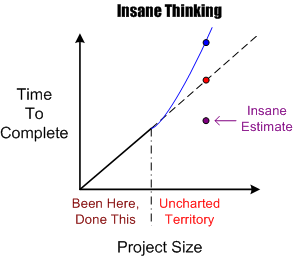
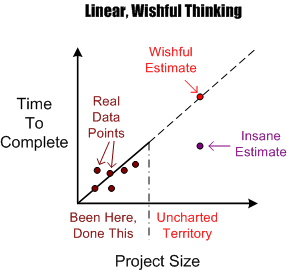
The figure below shows an example of the dumbass linear projection technique of guesstimation. Given a set of past performance time-size data points, a wishful estimate for a new and bigger project is linearly extrapolated forward via a neat and tidy, mechanistic, textbook approach. Of course, BMs, DICs, and customers all know from bitter personal experience that this method is bogus. Everyone knows that software projects don’t scale linearly, but (naturally) no one speaks up out of fear of gettin’ their psychological ass kicked by the pope du jour. Everyone wants to be perceived as a “team” player, so each individual keeps their trap shut to avoid the ostracism, isolation, and pariah-dom that comes with attempting to break from clanthink unanimity. Plus, even though everyone knows that the wishful estimate is an hallucination, no one has a clue of what it will really take to get the job done. Hell, no one even knows how to define and articulate what done means. D’oh! (Notice the little purple point in the lower right portion of the graph. I won’t even explain its presence because you can easily figure out why it’s there.)
 OK, you say, so what works better Mr. Smarty-Pants? Since no one knows with any degree of certainty what it will take to “just get it done” (<- tough management speak – lol!) nothing really works in the absolute sense, but there are some techniques that work better than the standard wishful/insane projection technique. But of course, deviation from the norm is unacceptable, so you may as well stop reading here and go back about your b’ness.
One such better, but forbidden, way to estimate how much time is needed to complete a large hairball software development project is shown below. A more realistic estimate can be obtained by assuming an exponential growth in complexity and associated time-to-complete with increasing project size. The trick is in conjuring up values for the constant K and exponent M. Hell, it requires trickery to even come up with an accurate estimate of the size of the project; be it function points, lines of code, number of requirements or any other academically derived metric.
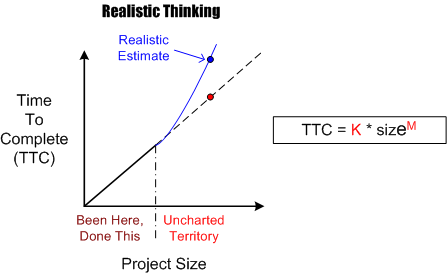
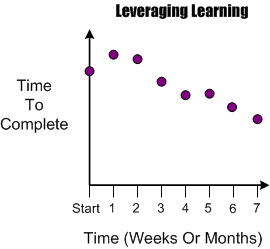
An even more effective way of estimating a more accurate TTC is to leverage the dynamic learning (gasp!) that takes place the minute the project execution clock starts tickin’. Learning? Leverage learning? No mechanistic equations based on unquantifiable variables? WTF is he talkin’ bout? He’s kiddin’ right?
Ego To Talent Ratio
In Scott Berkun‘s “Managing Breakthrough Projects” video, Scott concocts a metric called the Ego-To-Talent ratio (ETTR). Here’s my highly unscientific and speculative curve that plots ETTR versus position on the company org chart.
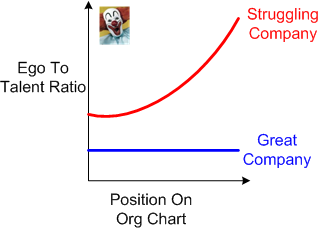
See that bozo on the chart? That’s me. Where are you?
Crisis?, What Crisis?
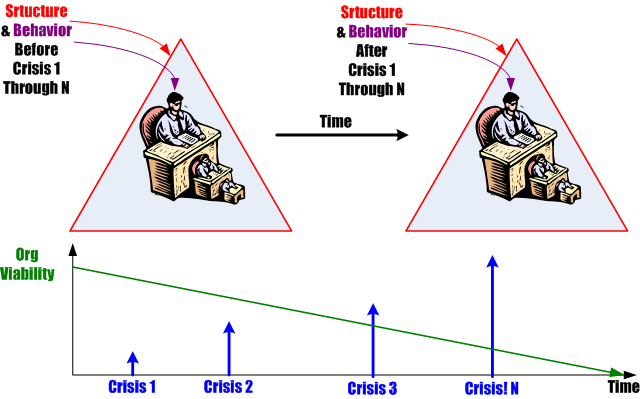
The other day, I heard a song on Pandora from one of my fave albums of the 70s (yes, they were called albums back then); Supertramp‘s “Crisis?, What Crisis“. The album title reminded me of orgs that emotionally panic “under the covers” when a crisis occurs, but outwardly behave as if there is no crisis. By “behaving like no crisis is occurring“, I mean that the SCOLs in charge apply whatever band aids they can in the short term to get through the crisis but don’t do anything of substance to stave off, or better handle, future crises.
When the crisis at hand passes, the heroes are congratulated and: the org structure stays the same, the people in the top roles stay the same, the operational business processes remain the same, and most ominously, the patriarchal CCH mindsets stay the same. It’s back to the same-old, same-old, business as usual.
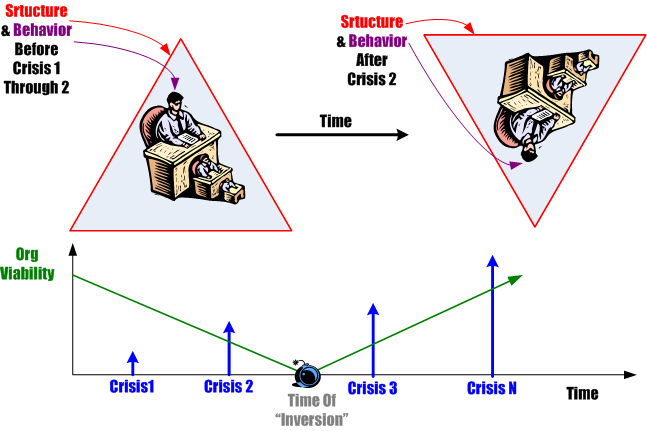
The figure below shows what maybe should happen when crises occur and learning takes place? Someone or some group willingly steps up to positively change the structures and behaviors so that the org can smoothly navigate through, and even thrive within, future crises. In the example below, it took 2 crises to stave off self destruction, right the course, and excel in the future. Alas, the problem with the previous sentence is the “someone or some group” phrase at the beginning.
Hurd Joins The Herd
I was considering writing a blog post about the downfall of Hewlett Packard’s CEO Mark Hurd, but I decided to back off. I figured that all the credentialed and highly respected tech columnists and bloggers have covered this horror story from all angles.
So, instead of my usual rag, rag, rag…… whine, whine, whine….. toll-u-so, toll-u-so, toll-u-sow verbage, I’ve written an empty husk of a blog post. The accompanying picture sux too….
 Nevertheless, I’ll be back on my high horse and raging against the machine soon.
Ray Of Light
Ray Leggiero was a great friend and work colleague of mine. Ray would stop by my cube every other day early in the morning to talk, joke, and commiserate for a few minutes about a variety of subjects. Ray was one of only two regular commenters on this ridiculous blog. Ray often challenged my views and beliefs and made me think twice about what the hell I was saying. Ray was a Yankee fan and I’m a Red Sox fan. Ray was a Republican and I am a pseudo-Democrat. Ray was passionate about all aspects of software development and so am I.
 After not hearing from, or seeing the ever-smiling Ray, trucking around the office for a week, I walked over to his cube to find out why. His cubie mate told me that Ray was sick and wouldn’t be back for awhile, so I called his house. His wife, Pat, came right out and shocked me with “Ray has cancer“. She said that he was too tired and sick to come to the phone.
A week later, I learned that Ray was gravely ill and in the intensive care unit of a local hospital. The same day we heard this stunning news, a couple of other work friends and I went to the hospital to see Ray during lunch break. We were floored and deeply disheartened when we saw the state he was in. We were so rattled and shaken by what we had seen, that instead of going back to work, we went to a bar and guzzled a few beers to calm our nerves. Ray died the next morning.
The suddenness of it all was incredibly jolting and earth shattering to many people, especially Pat and his three young boys: Anthony, Matthew, and Brandon. In the span of only one month, gentle Ray went from being a vibrant, positive, conscientious, helpful person to a very sick individual engulfed by cancer. I, and scores of other people, will deeply miss Ray’s luminescent presence in our lives.
So long my dear, dear friend.
Go, Go Go!
Rob Pike is the Google dude who created the Go programming language and he seems to be on a PR blitz to promote his new language. In this interview, “Does the world need another programming language?”, Mr. Pike says:
…the languages in common use today don’t seem to be answering the questions that people want answered. There are niches for new languages in areas that are not well-served by Java, C, C++, JavaScript, or even Python. – Rob Pike
In Making It Big in Software, UML co-creator Grady Booch seems to disagree with Rob:
It’s much easier to predict the past than it is the future. If we look over the history of software engineering, it has been one of growing levels of abstraction—and, thus, it’s reasonable to presume that the future will entail rising levels of abstraction as well. We already see this with the advent of domain-specific frameworks and patterns. As for languages, I don’t see any new, interesting languages on the horizon that will achieve the penetration that any one of many contemporary languages has. I held high hopes for aspect-oriented programming, but that domain seems to have reached a plateau. There is tremendous need to for better languages to support massive concurrency, but therein I don’t see any new, potentially dominant languages forthcoming. Rather, the action seems to be in the area of patterns (which raise the level of abstraction). – Grady Booch
I agree with Grady because abstraction is the best tool available to the human mind for managing the explosive growth in complexity that is occurring as we speak. What do you think?
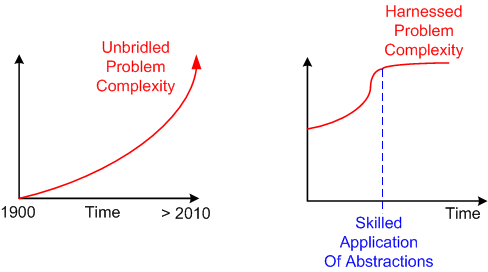
Abstraction is selective ignorance – Andrew Koenig
Fighting With The Present Moment
Scott Kiloby is the most recent spiritual teacher that I’ve been listening to. In “Love’s Quiet Revolution“, he says that people spend the vast majority of, if not all, their psychological time in one of three states:
- Regretting the past,
- Worrying about the future,
- Resisting/fighting with the present.
I’ve heard of the first two states, but the third one was depressingly new to me. To test out this assertion, I googled my horrendously inadequate memory to dig up several instances where I “fought” with the present moment yesterday:
- I got pissed when the dumb bell weights I use in my workout routine were missing from their slots.
- I got pissed off when the shower water turned scalding hot after someone flushed the terlet.
- I got pissed off when I spilled my bottle of Brute in the gym.
And these events happened within the space of just one hour at the gym! If I tried to recall all my bouts with the present moment yesterday, I’d probably need several more pages to recount them. How about you? How many fights with the present moment were you in yesterday?

If You Want To Write
Brenda Ueland’s “If You Want To Write” is not just about learning how to write. As Guy Kawasaki has noted, it’s a moving tribute to the human spirit and the innate ability to create that resides in each of us.
If you’re not into spirituality, you won’t buy into what I’m going to say next. IYWTW impacted me like some of the best spiritual works that I’ve read; but without using explicit, spiritual terms like “enlightenment, awakening, surrender, non-duality, universal consciousness“, etc. The best spiritual works are hard to describe and summarize in words. They must be felt and experienced via graceful tingles and enveloping shivers down your spine. They can’t be understood by the rational mind. IYWTW is one such work.
If you want to explore spirituality from an unusual and different point of view, then you may want check out IYWTW because it contains much more than its title suggests. The book brought, if only for a few brief moments, “the peace that passeth all understanding” to me, and it may for you.


Why am I here?
WTF?
Meh!
D'oh!

My BTC Address



 Bulldozer00's Blog