Archive
Me And My Stuff
Because it stirred up some internal energy, I intuitively navigated into this link from a recent, Mr. Creative Class, Richard Florida tweet (Pod People < PopMatters). The quote that opens the piece:
The problem in our culture is not so much that there is too much stuff but that we are afflicted with insatiable egocentricity, which the stuff merely reflects. – Rob Horning,
really zinged me. Reading that quote triggered a Vulcan mind-meld (Bzzzzzt!) in my head with a recent quote that I saw from someone else (whom I don’t remember, but wish I did): “when the last tree is gone and the last drop of water is undrinkable, maybe we’ll finally realize that we can’t eat money“.
Alright, alright. Call me a self-righteous, hippocritical-institutional-paycheck-eating, (blah, blah, blah), tree-hugger if you’d like, but that’s the way I felt in the moment; even if that’s the way I wasn’t supposed to feel – according to you.

Inability To Assimilate
In this Federal Computer Week magazine blog post, the author laments about the inability to hire talented people into the government borg:
- “The supervisors here are sycophants who are only interested in their careers.”
- “My experience is (more or less) a third of folks (management and labor) are amazing and functional well beyond pay and expectations. Another third are limited, work-reward clock-punchers. The last third are untrainable and unfireable.”
- “I’ve seen one too many occasions of “hiring teams” not hiring the best qualified but hiring friends that don’t meet the job requirements. “
- “The federal human resources processes do not necessarily match skills and education with job positions. “
- “We have more layers of management and more keep getting added without adding any workers.”
- “There are contracting personnel put in jobs who have not a clue about true contracting processes. These individual are put in position because of favoritism.”
- “Most middle-level managers want to demonstrate they are in control.”
Of course, the statements above only apply to government bloat-ocracies, no?

Ty Detmer
Remember Philadelphia Eagles quarterback Ty Detmer? The DETMER metric, which was introduced in yesterday’s post and stands for Decision-To-Meeting-Ratio, is named after Ty. Hah, hah – just joking. There’s no connection between Detmer and DETMER. DETMER is a bogus metric acronym that I concocted and, for some weird reason, Ty’s name repeatedly comes to my defective mind every time I think of it. Time for a straight jacket and meds?
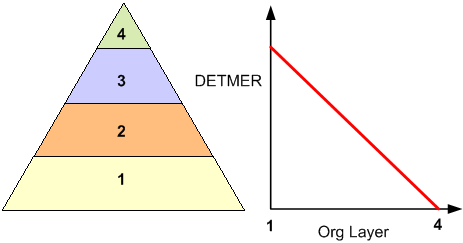
The figure below shows a madeup DETMER vs layer-of-importance curve for a typical corpricracy. The higher one moves up in the caste system, the more useless no-decision meetings one gets to attend. At these egofests, peer SCOLs psychologically duel with each other “under the covers” to prove “I’m great and you’re not“. It’s like a gaggle of peacocks struttin’ around in front of each other showing off how much prettier their plumes are. Of course, few if any important decisions are arrived at during these aristocratic social events. At the highest levels in the CCF, every hour of every day is booked with these “Dancing With The Czars” assemblies.
Meetings and Decisions
Orgs of people exist for a purpose. In order to continuously fulfill the org’s purpose in a changing external environment, its members need to make decisions regarding what to do and when to do it in order to counter unfavorable changes that are at odds with the org’s purpose. Since people need to know who will do what, when they’ll do it, and how they’ll coordinate with others to collectively counter external threats, decision-making meetings are held at all levels to decide such issues of importance.
The figure below introduces the Decision-To-Meeting-Ratio (DETMER) metric. It also shows the divergence of this metric for two competing orgs who initially had the same DETMER value at an arbitrary time, T=0. Assuming (and it’s a bad assumption) that all decisions made at each meeting are effective, as the DETMER goes to zero nothing changes for the good within the org walls. People do the same thing everyday, even as the environmental conditions outside the walls relentlessly change. Voila, a bureaucracy led by a cadre of Bozeltines emerges. Bummer.

Zero Time, Zero Cost
In “The Politics Of Projects“, Robert Block states that orgs “don’t want projects, they want products“. Thus, the left side of the graph below shows the ideal project profile; zero cost and zero time. A twitch of Samantha Stevens’s nose and, voila, a marketable product appears out of thin air and the revenue stream starts flowin’ into the corpo coffers.
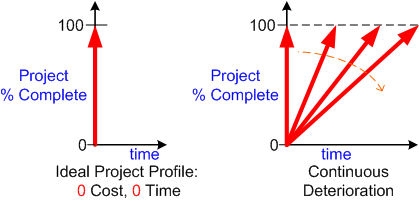
Based on a first order linear approximation, all earthly product development orgs get one of the performance lines on the right side of the figure. There are so many variables involved in the messy and chaotic process from viable idea to product that it’s often a crap shoot at predicting the slope and time-to-100-percent-complete end point of the performance line:
- Experience of the project team
- Cohesiveness of the project team
- Enthusiasm of the project team
- Clarity of roles and responsibilities of each team member
- Expertise in the product application domain
- Efficacy of the development tool set
- Quality of information available to, and exchanged between, project members
- Amount and frequency of meddling from external, non-project groups and individuals
- <Add your own performance influencing variable here>
To a second order approximation, the S-curve below shows real world project performance as a function of time. The slope of the performance trajectory (% progress per unit time) is not constant as the previous first order linear model implies. It starts out small during the chaotic phase, increases during the productive stage, then decreases during the closeout phase. The objective is to minimize the time spent in phases P1, P2, and P3 without sacrificing quality or burning out the project team via overwork.
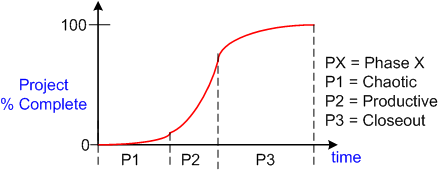 Assume (and it’s a bad assumption) that there’s an objective and accurate way of measuring “% complete” at any given time for a project. Now, assume that you’ve diligently tracked and accumulated a set of performance curves for a variety of large and small projects and a variety of teams over the years. Armed with this data and given a new project with a specific assigned team, do you think you could accurately estimate the time-to-completion of the new project? Why or why not?
Dissed By Someone “Important”
The impeccably credentialed and self-revered Ian Mitroff dissed me out of the blue via a private message on LinkedIn:
“You are an absolute relativist which is not very interesting or relevant.”
Based on the following quote, Mr. Mitroff might label Shakespeare as an uninteresting, absolute relativist too:
There is nothing either good or bad, but thinking makes it so. – William Shakespeare
Damn it Willie, nothing is relative! It’s not good or bad, it’s one or the other. Since my judgment is infallible, it’s whichever I say it is.
Feeling compelled to reply to the self-anointed “father of crisis management“, my bruised and battered ego retorted with:
“I’m sorry, oh exalted professor. Thanks for your irrelevant opinion.”
Me thinks that Ian may be one of those professors that Ken Robinson says: “solely uses his body to transport his head around“. I hate to prematurely judge people, but it sure feels good to be bad.
“A conscience is what feels bad when everything else feels so good.” – Steven Wright

Loop Of Disrespect
In most companies, “respect” is either an explicit or implicit core value. Is it respectful to repeatedly watch, and covertly condone, project teams working 50-60 hour, unpaid overtime weeks for years at a time to meet some schedule that they most likely had no hand in making? Since the overtime is not paid, it isn’t tracked and future schedule estimates derived from past performances don’t accurately reflect the effort needed to get the job done. Thus, the practice is a self-reinforcing loop of disrespect. But hey, since virtually all corpricracies operate that way, the practice must not be disrespectful, right?
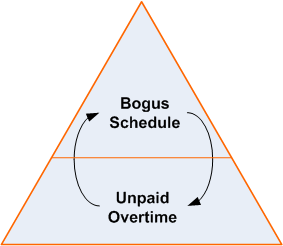
Demanding respect while not giving it, or pretending to give it, creates mediocracies. And since respect and loyalty are intimately coupled, demanding loyalty without giving respect doesn’t work too well either.
Delusions of Grandeur
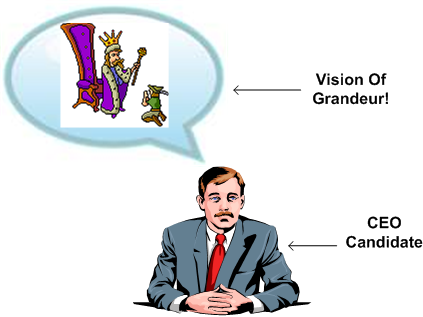
In “Founders At Work“, Jessica Livingston interviews a boatload of company founders about their personal experiences with regard to starting their companies from the ground up. Paul Graham, who co-founded “ViaWeb” and sold it to Yahoo 3 years later for a cool $45M, was asked about his search for a CEO in the early days. Here’s what he said:
The problem with all of them was that they had delusions of grandeur. This was the beginning of the Internet Bubble, remember, and I think all of these guys saw themselves as some kind of grand CEO, while we programmers labored in the kitchen cooking the food and washing the dishes. If the deal were simply that the business guy would be the public face of the company, but we would be allowed to do what we wanted and make sure everything worked right, that would have been OK. But we were worried about what might happen if one of these guys wanted to actually be the chief executive officer and tell us what our strategy should be. We’d be hosed, because they didn’t know anything about computer stuff. – Paul Graham
The Uselessness Of MBAs
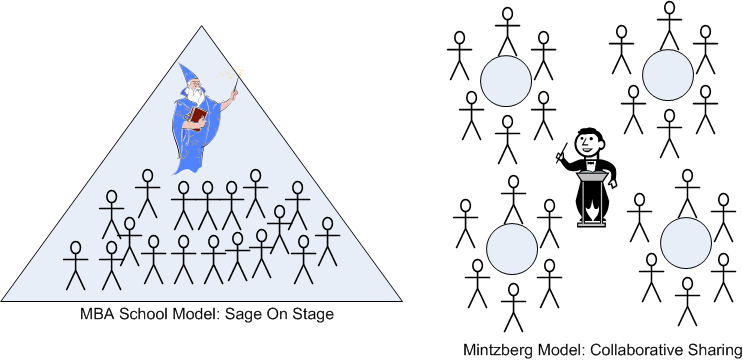
Two of my favorite management (or anti-management, if you prefer) thinkers and doers, Henry Mintzberg and Ricardo Semler, talk about the uselessness of MBA degrees for managing people in this MIT World video. In the video, Mr. Semler interviews Mr. Mintzberg shortly after the release of Mintzberg’s book, “Managers Not MBAs“, in 2005. The interview is conducted in front of a class full of MIT MBA students.
In case you’re interested, here are some of my notes:
This will work in practice, but will it work in theory 🙂
You can’t create a manager in a classroom. When you do that, all you do is create hubris.
MBA students are taught how to apply business skills in an assumed command-and-control hierarchy, not how to be a manager. B-schools don’t distinguish between the two.
Management is craft (rooted in experience), art (rooted in creativity) and analysis (rooted in science). It’s not just analysis – which is what B-schools exclusively teach.
Earn a management position first, then go to business school while you are a practicing newbie manager.
There are no naturally born surgeons, but there are many natural managers who never went to MBA school.
The problem with being in a rat race is that if you win, you’re still a rat 🙂
In a study of Harvard MBA gradutates, 10 of 19 were outright failures, 4 had questionable records, and 5 did fine.
The notion that a generic manager can parachute in and manage anything is crazy. There are exceptions like IBM’s cookie man, Lou Gerstner, but failure is the norm.
Many managers practice “Kiss up, kick down”. The dudes who receive the kisses don’t care or want to know about the “kick down” behavior.
Without action, nothing gets done. Without reflection, action is mindless. Thus, mindful action is required for success.
Watching Closely
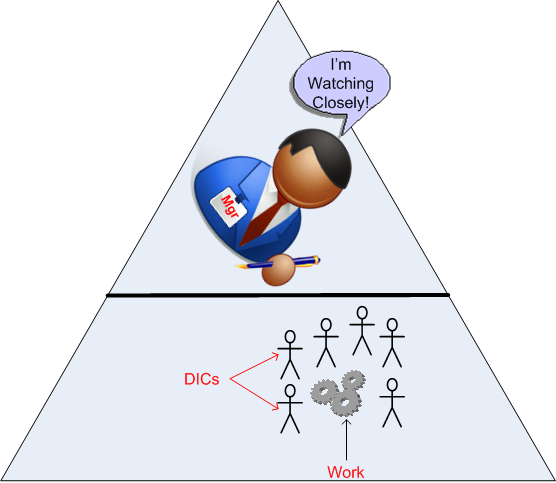
Please tell me what type of manager broadcasts statements like this one:
“Since there were no major accomplishments reported on this task last week, I’ll be watching this task closely.”
When I see or hear comic statements like this, I privately think to myself (but never publicly speak, of course):
- What are you gonna do to help if reported status is not up to your lofty but unarticulated expectations next week?
- Are you gonna issue more pointed and specific threats to the DICs assigned to the task?
- Are you gonna ratchet up the pressure even more so?
- Are you gonna roll up your sleeves, dive in and find out what is halting progress so you can directly or indirectly help?
What would you ask yourself?

Why am I here?
WTF?
Meh!
D'oh!

My BTC Address



 Bulldozer00's Blog