Archive
Is This A CEO Talking?
From Who’ll Catalyze Change: Us or Them? – Harvard Business Review, HCL Technologies CEO Vineet Nayar says:
We at HCL have embraced a philosophy that’s based on an inversion of the management pyramid, with managers becoming as responsible to employees as employees are to managers.
Vineet’s joking, right? Nah, he’s fibbing to cover up the reality that he rules with a Stalinistic iron fist at HCL, no? This joker follows up with an even bigger whopper:
Too many people caution us about acting on instinct and conviction. But we must surround ourselves with employees that dare to try new things in new ways. They may not achieve perfect results, but if they focus on getting better each day with one more attempt, they will solve many problems that appear unsolvable.
Acting on “instinct and conviction” and not on objectively measured scientific “proof” (that really camouflages subjective, random, self-serving, opinion)? WTF? This Vineet dude needs to be cast out of the guild of management and “put in his place“, no?

In The “Old Days”
In the “old days”, when companies fell upon hard times and had to let some DICs go, or when the DICforce went on strike, jobs were mechanized enough so that managers could fill the holes and keep the joint running until the situation improved. Of course, in most orgs, that is no longer true today since most managers, certainly those that are BMs, shed and conveniently forget their lowly “worker’s skills” as soon as they are promoted out of the cellar into the clique of elites. Thus, a company that cuts front line DICs without cutting some managers puts itself into a deeper grave. Not only does productivity go down because the holes of work expertise go unfilled, but the overhead cost rises because the same number of managers are left to “supervise” fewer DICs. On the other hand, if all or most of the jettisoned DICs were dead weight, the previous sentence may not be true – unless dead weight BMs were retained. But hey, in the minds of most managers (and all of those who fall into the BM category), fellow comrade managers are not dead weight.
 Update: Shortly after I queued this post up for publication, a friend(?) serendipitously sent me this link: Lockheed Martin press release. Notice the “delay” that took place from the time they shed 10000 DICs to the time they offered some 600 BOOGLs, CGHs, and SCOLs their (no doubt generous) “Voluntary Executive Separation Program“. Better late than never, right?
The executive reductions will help align the number of senior leaders with the overall decline of about 10,000 in the employee population since the beginning of last year, cut overhead costs and management layers, and increase the Corporation’s speed and agility in meeting commitments.
Nice corpo jargon, no?
I Found Another Gem
Whoo hoo! I’ve stumbled upon another rare gem in a massive pile of ugly rocks. As the graphic below shows, I’ve added HCL Technologies to my list of favorite companies. Led by their visionary CEO, Vineet Nayar, HCL is one of the few models for successful companies of the future. Since the vast majority of corpo Executive Teams are stuck in the mechanistic Sloan/Taylor mindset of the 1900s with no intention of changing the way they manage, err, impose control, it’s always refreshing and exciting to discover a new game changer.

So, how do I decide whether a company is a cut above the rest? Via subjective evaluation of external observations, of course. Financial performance, which is of course important, is of secondary concern. Here’s my unscientific list of “research” methods:
* Read third party accounts of experience given by former and current non-management employees.
* Read, listen, and watch interviews with CEOs and executives.
* Scour publicly available mission statements, visions, core values and cultural descriptions for authenticity, lack of corpo jargon, and attention to detail.
* Stay away from glossy annual reports – which are all clones of each other.
* Ignore whatever the hand picked company spokesperson(s) say – propaganda city.
Of course, my methods aren’t perfect, but do you know of any better ones?
Related Articles
- Why HCL Technologies puts employees ahead of customers (tech.fortune.cnn.com)
- HCL Technologies Annual Revenues up 24.1 % YoY; Quarterly Revenues up by 21.5% YoY and 7.7% Sequentially; Europe Annual Revenues up by 20.6% YoY in FY10 (prnewswire.com)
- Management Innovation: Extreme Management Makeover (petervan.wordpress.com)
- Indian outsourcer HCL Technologies quarterly profit up 6.9 percent to $74M on strong demand (taragana.com)
Two Paths
As a small group of people assembled for a purpose greater than each individual grows, some form of structure is required to prevent chaos from reigning. The top path shows the emergence of a group of integral coordinators while the bottom path shows a traditional, stratified CCH being born.
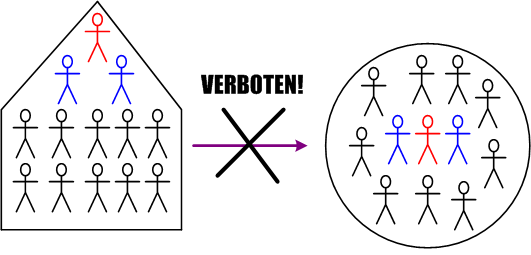
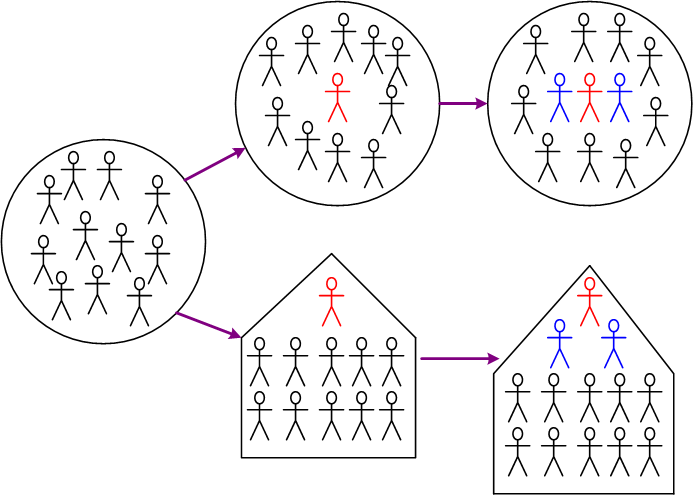 Which group would you rather be a part of? If you say you’d rather be a part of the “circular” group and you’re lucky enough to be a part of one, you’re still likely to get hosed down the road. You see, if your group continues to grow, it will naturally gravitate toward the pyramidal CCH caste system. That is, unless your natural or democratically chosen group leaders don’t morph into CGHs or BOOGLs and they actively prevent the subtle transformation from taking place.
 If you’re currently embedded in a CCH and one of its leaders bravely attempts to change the structure to a circular, participative meritocracy, fugg-ed-aboud-it. The change agent will get crushed by his/her clanthinking BOOGL and SCOL peers, who ironically espouse that they want circular behavior while still preserving the stratified CCH.
Where Is Point A?
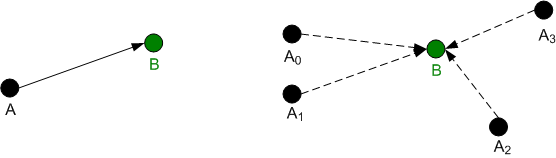
In the “Managing The Unmanageable” techonomy video discussion, HCL Technologies CEO Vineet Nayar says something like: “If your people don’t know where point A is, then they won’t know how to get to point B“. Vineet said this in response to a question regarding the concern that the more transparent your company is, the more your competitors can copy you. Vineet, along with the other two 21st century CEOs on the panel stated that the benefits of transparency far out weigh the risks of “giving away the family jewels“.
Look at the figure below. On the left side, through transparency and continuous full disclosure, your people know where you are (point A) and your people know where you and they want to be in the future (point B). Thus, you and your people can figure out what problems need to be solved and what new actions need to be taken. On the right side of the figure, everyone knows where point B is, but nobody (except for maybe a “select few” high up in the CCH) knows where they’re starting from. Where the frig is point A?
Related Articles
- Techonomy – Managing the Unmanageable: The New Empowered Workforce (nextbigfuture.com)
- Why HCL Technologies puts employees ahead of customers (tech.fortune.cnn.com)
- Techonomy: a new philosophy of progress (petervan.wordpress.com)
A Pencast
Checkout my “pencast” of the legendary Grady Booch talking about software architecture. In this notes+audio mashup, Grady expounds on the importance of patterns within elegant and robust architectures. Don’t mind my wife and dog’s barking, uh, I mean my dog’s barking and my wife’s talking, in a small segment of the pencast.

Related Articles
- Digital Pen Gives Boring Note Taking a Modern Kick (wired.com)
- Livescribe use models in special education (zdnet.com)
- The future of the pen? (building43.com)
- Livescribe Introduces Next Generation Hardware and Software Smartpen System – Review (geardiary.com)
Alignment
You can supply your own words for this post…..

Deterministic, Animated, Social
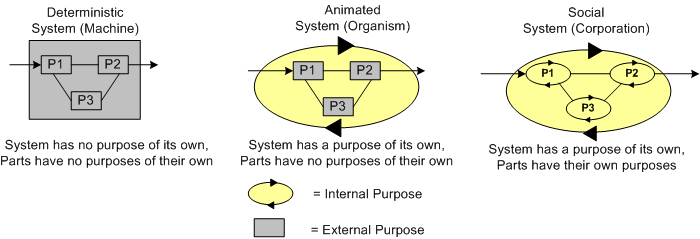
Unless you object, of course, a system can be defined as an aggregation of interacting parts built by a designer for a purpose. Uber systems thinker Russell Ackoff classified systems into three archetypes: deterministic, animated, and social. The main criterion Ackoff uses for mapping a system into its type is purpose; the purpose of the containing whole and the purpose(s) of the whole’s parts.
The figure below attempts to put the Ackoff “system of system types” 🙂 into graphic form.
Deterministic Systems
In a deterministic system like an automobile, neither the whole nor its parts have self-purposes because there is no “self”. Both the whole and its parts are inanimate objects with fixed machine behavior designed and assembled by a purposeful external entity, like an engineering team. Deterministic systems are designed by men to serve specific, targeted purposes of men. The variety of behavior exhibited by deterministic systems, while possibly being complex in an absolute sense, is dwarfed by the variety of behaviors capable of being manifest by animated or social systems.
Animated Systems
In an animated system, the individual parts don’t have isolated purposes of their own, but the containing whole does. The parts and the whole are inseparably entangled in that the parts require services from the whole and the whole requires services from the parts in order to survive. The non-linear product (not sum) of the interactions of the parts manifest as the external observable behavior of the whole. Any specific behavior of the whole cannot be traced to the behavior of a single specific part. The human being is the ultimate example of an animated system. The heart, lungs, liver, an arm, or a leg have no purposes of their own outside of the human body. The whole body, with the aid of the product of the interactions of its parts produces a virtually infinite range of behaviors. Without some parts, the whole cannot survive (loss of a functioning heart). Without other parts, the behavior of the whole becomes constrained (loss of a functioning leg).
Social Systems
In a social system, the whole and each part has a purpose. The larger the system, the greater the number and variety of the purposes. If they aren’t aligned to some degree, the product of the purposes can cause a huge range of externally observed behaviors to be manifest. When the self-purposes of the parts are in total alignment with whole, the system’s behavior exhibits less variety and greater efficiency at trying to fulfill the whole’s purpose(s). Both internal and external forces continually impose pressure upon the whole and its parts to misalign. Only those designers who can keep the parts’ purpose aligned with the whole’s purpose have any chance of getting the whole to fulfill its purpose.
System And Model Mismatch
Ackoff states that modeling a system of one type with the wrong type for the purpose of improving or replacing it is the cause of epic failures. For example, attempting to model a social system as a deterministic system with an underlying mathematical model causes erroneous actions and decisions to be made by ignoring the purposes of the parts. Human purposes cannot be modeled with equations. Likewise, modeling a social system as an animated system also ignores the purposes of the many parts. These mismatches assume the purposes of the parts align with each other and the purpose of the whole. Bad assumption, no?
What’s Your ITAR?
A recent personal discovery that revealed itself to me is that “inquiring more and asserting less” is more effective than vice versa. Nonetheless, even after discovering this insight, I’m having a hard time increasing my Inquiry To Assertion Ratio (ITAR).
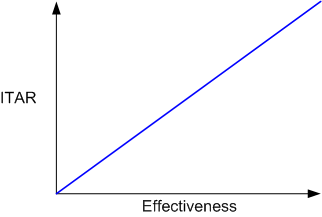
As you probably know, it’s difficult to change ingrained, long term behavior. When a social situation pops up in which the choice to inquire or assert appears, there often is no choice for me. In order to appear “in the know“, I automatically pull the trigger and make an assertion without asking any questions beforehand. However, I think I’ve made some progress. I can now often detect what I did after the fact. To improve even further, I’m hoping to reach the point where I can detect my transgression instantaneously, in the moment, so that I actually can choose to inquire or assert before I act. Ahhh, that would be nirvana, no?
In patriarchical CCH orgs, the ingrained mindset is such that the higher one moves up in the hierarchy, the lower the ITAR. That’s because BOOGLs and SCOLs unconsciously feel the need to appear infallible in front of the DICforce. Adding fuel to the fire, the DICsters fuel this behavior by expecting patriarchs to be infallible and have all the answers. It’s a self-reinforcing loop of ineffective behavior.
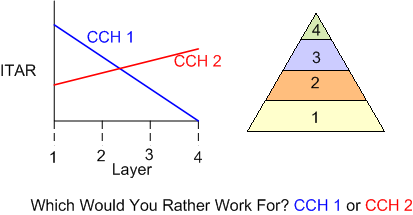 What’s your ITAR? As you age, do you find it rising – or sinking?
Yes I do! No You Don’t!
“Jane, you ignorant slut” – Dan Ackroid
In this EETimes post, I Don’t Need No Stinkin’ Requirements, Jon Pearson argues for the commencement of coding and testing before the software requirements are well known and recorded. As a counterpoint, Jack Ganssle wrote this rebuttal: I Desperately Need Stinkin Requirements. Because software industry illuminaries (especially snake oil peddling methodologists) often assume all software applications fit the same mold, it’s important to note that Pearson and Gannsle are making their cases in the context of real-time embedded systems – not web based applications. If you think the same development processes apply in both contexts, then I urge you to question that assumption.
I usually agree with Ganssle on matters of software development, but Pearson also provides a thoughtful argument to start coding as soon as a vague but bounded vision of the global structure and base behavior is formed in your head. On my current project, which is the design and development of a large, distributed real-time sensor that will be embedded within a national infrastructure, a trio of us have started coding, integrating, and testing the infrastructure layer before the application layer requirements have been nailed down to a “comfortable degree of certainty”.
The simple figures below show how we are proceeding at the current moment. The top figure is an astronomically high level, logical view of the pipe-filter archetype that fits the application layer of our system. All processes are multi-threaded and deployable across one or more processor nodes. The bottom figure shows a simplistic 2 layer view of the software architecture and the parallel development effort involving the systems and software engineering teams. Notice that the teams are informally and frequently synchronizing with each other to stay on the same page.
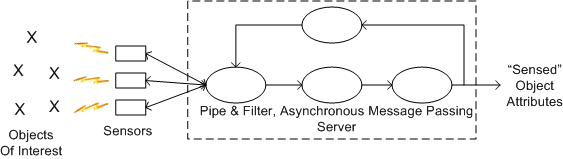
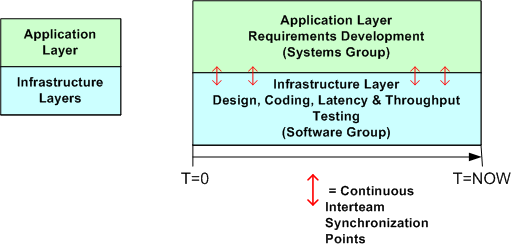 The main reason we are designing and coding up the infrastructure while the application layer requirements are in flux is that we want to measure important cross-cutting concerns like end-to-end latency, processor loading, and fault tolerance performance before the application layer functionality gets burned into a specific architecture.
So, do you think our approach is wasteful? Will it cause massive, downstream rework that could have been avoided if we held off and waited for the requirements to become stable?

Why am I here?
WTF?
Meh!
D'oh!

My BTC Address



 Bulldozer00's Blog