Out With The Old And In With The New
Nancy Leveson has a new book coming out that’s titled “Engineering A Safer World” (the full draft of the book is available here: EASW). In the beginning of the book, Ms. Leveson asserts that the conventional assumptions, theory, and techniques (FMEA == Failure Modes and Effects Analysis, Fault Tree Analysis == FTA, Probability Risk Assessment == PRA) for analyzing accidents and building safe systems are antiquated and obsolete.
The expert, old-guard mindset in the field of safety engineering is still stuck on the 20th century notion that systems are aggregations of relatively simple, electro-mechanical parts and interfaces. Hence, the steadfast fixation on FMEA, FTA, and PRA. On the contrary, most of the 21st century safety-critical systems are now designed as massive, distributed, software-intensive systems.
As a result of this emerging, brave new world, Ms. Leveson starts off her book by challenging the flat-earth assumptions of yesteryear:
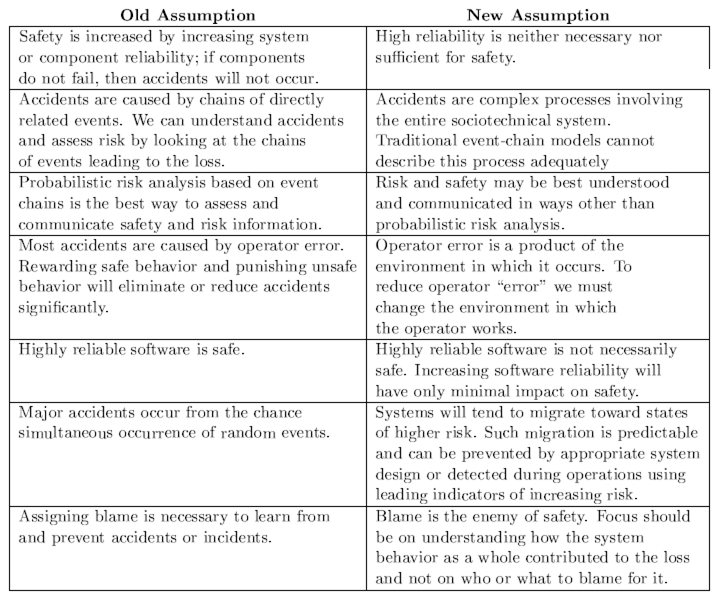 Note that Ms. Leveson tears down the former truth of reliability == system_safety. After proposing her set of new assumptions, Ms. Leveson goes on to develop a new model, theory, and set of techniques for accident analysis and hazard prevention.
Since the subject of safety-critical systems interests me greatly, I plan to write more about her novel approach as I continue to progress through the book. I hope you’ll join me on this new learning adventure.

Why am I here?
WTF?
Meh!
D'oh!

My BTC Address



 Bulldozer00's Blog