Defect Diaries
Once again, I’ve stolen a graphic from Watts Humphrey and James Over’s book, “Leadership, Teamwork, and Trust“:
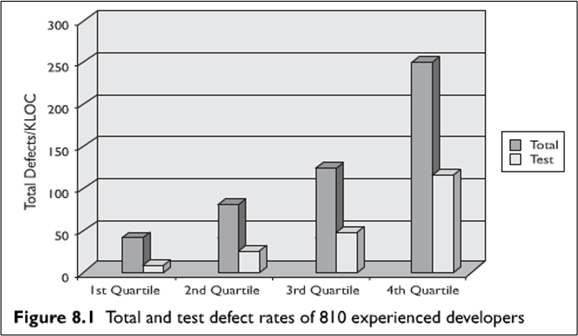
According to this performance chart, the best software developers (those in the first quartile of the distribution) “injected” on average less than 50 bugs (Watts calls them defects) per 1000 lines of code over the entire development effort and less than 10 per 1000 lines of code during testing. Assuming that the numbers objectively and fairly represent “reality“, the difference in quality between the top 25% and bottom 25% of this specific developer sample is approximately a factor of 250/50 = 5.
What I’d like to know, and Humphrey/Over don’t explicitly say in the book (unless I missed it), is how these numbers were measured/reported and how disruptive it was to the development process and team? I’d also like to know what the results were used for; what decisions were made by management based on the data. Let’s speculate…
I picture developers working away, designing/coding/compiling/testing against some requirements and architecture artifacts that they may or may not have had hand in producing. Upon encountering each compiler, linker and runtime error, each developer logs the nature of the error in his/her personal “demerit diary” and fixes it. During independent testing: the testers log and report each error they find; the development team localizes the bug to a module; and the specific developer who injected the defect fixes it and records it in his/her demerit diary.
What’s wrong with this picture? Could it be that developers wouldn’t be the slightest bit motivated to measure and record their “bug injection rates” in personal demerit diaries – and then top it off by periodically submitting their report cards lovingly to their trustworthy management “superiors“? Don’t laugh, because there’s quite a body of evidence that shows that Mr. Humphrey’s PSP/TSP process, which requires institutionalization of this “defection injection rate recording and reporting” practice, is in operation at several (many?) financially successful institutions. If you’re currently working in one of these PSP/TSP institutions, please share your experience with me. I’m curious to hear personal stories directly from PSP/TSP developers – not just from Mr. Humphrey and the CMU SEI.


Why am I here?
WTF?
Meh!
D'oh!

My BTC Address



