Tested And Untested
Being the e-klepto that I am, I stole this kool graphic from Humphrey and Over’s book “Leadership, Teamwork, And Trust“:

It represents the tested-to-untested (TU) region ratio of a generic, big software system. Humphrey/Over use it to prove that the ubiquitous, test-centric approach to quality doesn’t work very well and that by focusing on defect prevention via upfront review/inspection before testing, one can dramatically decrease the risk for any given TU ratio. Hard to argue with that, right?
The point I’d like to make, which is different than the one Humphrey/Over focus on in their book (to sell their heavyweight PSP/TSP methodology, of course), is that when a software system is released into the wild, it most likely hasn’t been tested in the wacky configurations and states that can cause massive financial loss and/or personal injury. You know, those “stressful” system states on the edge of chaos where transient input overloads occur, or hardware failures occur, or corrupted data enters the system. I think building the test infrastructure that can duplicate these doomsday scenarios – and then actually testing how the system responds in these rare but possible environments is far more effective than just adding political dog-and-pony reviews/inspections to one’s approach to quality. Instead of decreasing the risk for a fixed TU ratio, which reviews/inspections can achieve (if (and it’s a big if) they’re done right), it increases the TU ratio itself. However, since system-specific test tools are unglamorous and perceived as unnecessary costs by scrooge managers more concerned about their image than other stakeholders, scarily untested software is foisted upon the populace at an increasing rate. D’oh!
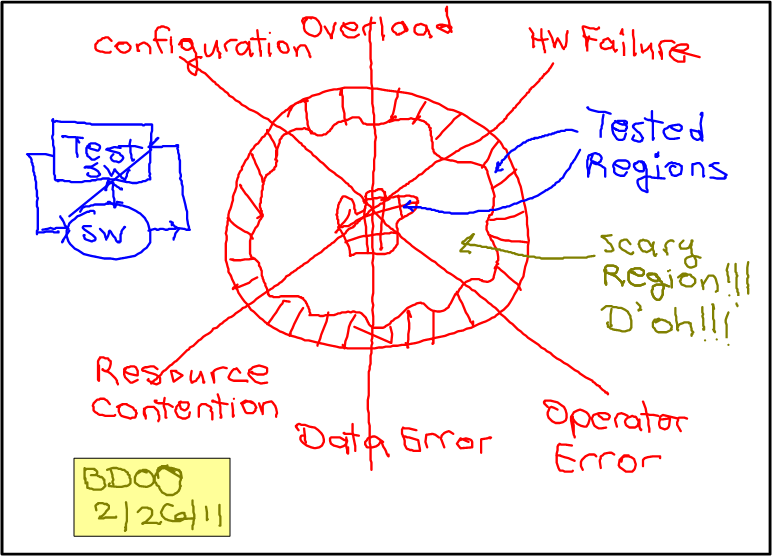
Note: The dorky hand made drawing above is the first one that I created with the $14.99 “Paper Tablet” app for my Livescribe Echo smartpen. “Paper Tablet” turns a notebook page into a surrogate computer tablet. When I run an “ink aware” app like Microsoft Visio, and then physically draw on a notebook page, the output goes directly to the computer app and it shows up on the screen – in addition to being stored in the pen. Thus, as I was drawing this putrid picture with my pen, it was being simultaneously regenerated on a visio page in real-time (see clip below). Kool, eh? Maybe with some practice……

Leave a reply to bulldozer00 Cancel reply

Why am I here?
WTF?
Meh!
D'oh!

My BTC Address



 Bulldozer00's Blog
Hi Tony,
I know this is off subject, but I found a very nice example of a multi-producer/consumer using shared memory and semaphores. No reason not to put a nice C++ template wrapper around this.
Here is the link:
http://techtadka.net/articles/programming/198-producer-consumer-problem-in-c-using-semaphores-and-shared-memory.html
Enjoy!
-pdn
Nice find Phil. Thanks!