Money, Tools, Materials, Know-How, Products
Since you’ve stopped by, check out the company-centered, system loop diagram below. The model is composed of three interdependent parts: the company, the customers, and the suppliers. In equilibrium, when all is well:
- The company produces products that are paid for, and consumed by, customers.
- The company purchases tools and materials from suppliers.
- The company uses the tools, materials, and the knowledge of its workforce to create the products that sustain the viability of the company.
- The company’s cash inflow exceeds it’s cash outflow
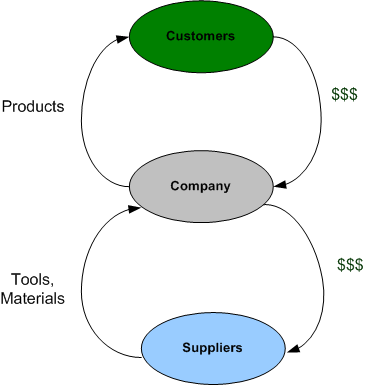
Note that if any of the links in the system get severed, the company collapses. If the products stop flowing out of the company, the life-giving cash stops flowing in. If the cash stops flowing in, the products stop flowing out. If the tools and materials stop flowing in, the products stop flowing out. From the company’s perspective, products lead to cash and cash leads to more products in a positive, self-reinforcing, feedback loop.
Using the diagram below, let’s look in more depth at the company’s cash inflows and outflows. In stable, steady-state operation, the cash inflow is managed competently by the executive team. After taking their cut of the action, the executives push some cash downward through the patriarchy to keep the operation humming and they approve of all outflows to suppliers.
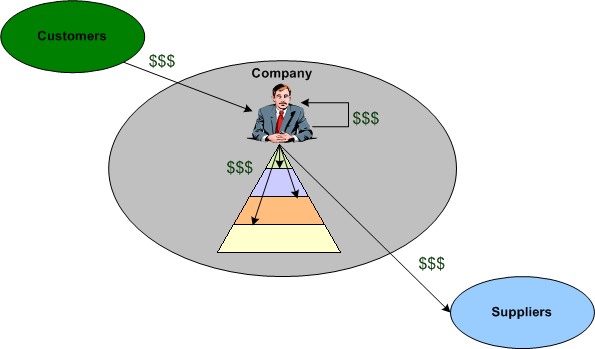
What the picture doesn’t show, is the indirect source of the customer cash – the company’s product set. Lets augment the diagram above and close the loops:
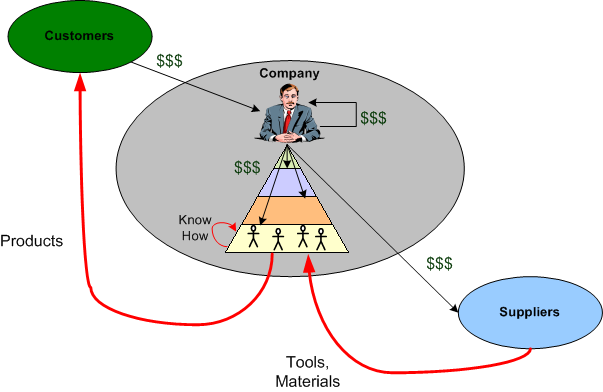
There are a bazillion external, and especially, internal threats to system viability. Externally, customers can run out of cash and suppliers can go bust. Internally, bureaucratic little Hitlers, byzantine processes, lack of investments in tools and people, inequities in status and pay, silo-to-silo infighting, and poor hiring practices are among the myriad of threats that can contribute to corpo implosion. Of course, the purpose of management is to gracefully overcome the threats. But hey, regardless of whether executives and their management appointees are the cause of success or failure, they still have the right to high status and high compensation because…. well, just because.

Why am I here?
WTF?
Meh!
D'oh!

My BTC Address



 Bulldozer00's Blog