Archive
Temporary Guilt Trip
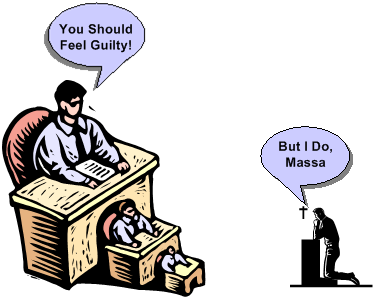
After reflecting on the content of many of my recent blog posts, I’ve come to the conclusion that I’m on a temporary (all things are temporary) guilt trip. I can’t put my finger on any one specific event or situation that ignited this trip, but I’m experiencing the feeling frequently. I think the reason may be because most of my writings are diatribes against powerful institutional norms that never seem to get questioned. Oh well, “this too shall pass“.
Bone Rattlers

Peter Senge is a colleague of dear, departed Russell Ackoff. Peter recently wrote a passionate tribute to his friend on the Ackoff Center Weblog and he rang my bell with these bone-rattling quotes:
So long as people think in fragmented ways they will act similarly – Peter Senge
The inherited traditions over generations toward patriarchy, authoritarian views of leadership, and rigid systems of institutional power will not change in a generation – Peter Senge
How long will we preserve the belief that power comes from institutional position versus connection to the creative flow of the universe? – Peter Senge
The forces for change come from “life’s longing for itself,” not from ego-based human striving – Peter Senge
That last quote is really a zinger because I’ve been wrestling with my ego ever since I finally came to the realization that it dominates my (and the vast majority of other people’s) thinking and external behavior. Sadly, I (the real self) don’t have the upper hand on the “I” (the imposter) thought, but some day I hope to do so. Hence, my spiritual quest continues in a seemingly self-referential infinite looping attempt to use the ego to beat the ego into submission.
How about you? Do you realize that you’re not living up to your full potential because your ego is in charge? Do you care, or is everything just peachy keen for you the way you are?
Managers And Leaders
Naturally, everyone has their own personal opinion regarding the difference between a leader and a manager. Of course, I have one too:
Manager = Status Taker and Schedule Jockey (STSJ)
Leader = People Helper and Obstacle Remover (PHOR) first, and STSJ second
Of course, the STSJ function is necessary (but not sufficient) to stay in business, but the PHOR function is required to increase profitability, instill trust, and build a joyful workplace. In order to grow into a PHOR, a candidate for leadership has got to communicate, and frequently. Hell, if a leadership candidate doesn’t communicate with his/her people, how’s he/she going to know what they need and what socio-technical obstacles must be removed for them to excel? All non-communicators are STSJs – which means the number of STSJs (a.k.a BMs) pervading corpo America is HUGE-UH.
If you have more managers than leaders in your organization, then you’re most likely not having any fun during your daily stint within the halls of your institution. If you have zero leaders in your organization, then your work life is probably horrific. If you have all leaders in your organization then you’re most likely in heaven.
If any organism fails to fulfill its potentialities, it becomes sick. – William James
What’s the Manager-To-Leader ratio (MTL) in your organization? If you’re “in charge” of a group of people, are you a manager or a leader according to my unscientific, concocted (I like to make stuff up) criteria ?

Unlike In Love
Unlike in love, in business “absence does not make the heart grow fonder“. When there are long stretches of silence between supervisor-to-supervisee, vendor-to-customer, and/or supplier-to-vendor communications, the receiving party in each case will sooner or later start thinking that the transmitting party doesn’t care about them. Worse, if communication solely occurs when the transmitter “wants something” from the receiver, the relationship deteriorates further. Trust and respect, difficult to acquire but ridiculously easy to lose, go right down the tubes and mutually beneficial collaboration comes to a stand still.
So, is all lost when the transmit-receive communication channel is intact but the transmitter stops transmitting? Hell no, but it takes awareness, sincerity, persistence, initiative and, most importantly, willingness on the transmitter’s part to repair the damage. Why should the transmitter be the lead in re-establishing communication? Because the transmitter is the source of information that the receiver needs to perform its function. No transmission, no information. No information, no mutually beneficial results.

Flippin’ The Bozo Bit
I first encountered the concept of the “Bozo bit” (BB) while reading a software engineering book penned by Jim McCarthy many years ago. The BB is a tri-state, enumerated attribute that can be used by immature people like BD00, but not you, to judge people. The BB’s 3 mutually exclusive states are defined as:
- Is-Not-A-Bozo (INAB)
- May-Be-A-Bozo (MBAB)
- Is-A-Bozo (IAB)
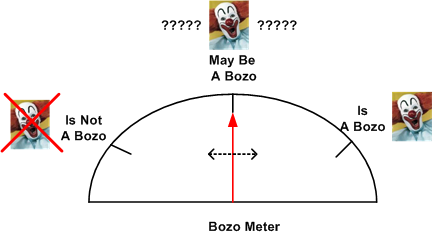
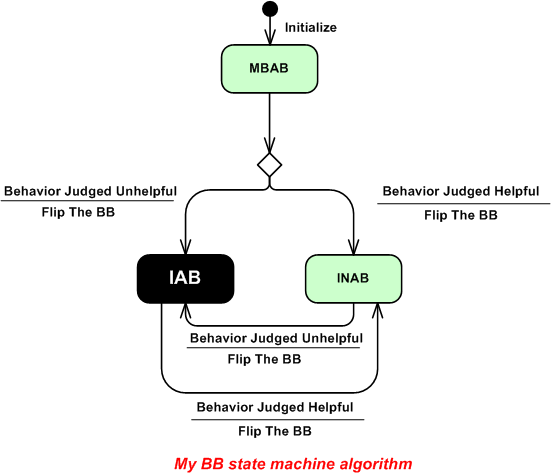
When working with new colleagues and managers in the workplace, I always initialize the BB to the MBAB state. Over time, after observing a candidate’s behavior and interacting with him/her, I consciously decide to flip the BB to either the IAB or INAB state. In my experience, way more managers fit the criterion for the BB=IAB state than peers.
As the state machine below shows, I’m flexible in that my initial judgment may change. However, once the BB transitions into the IAB state, I rarely decide to subsequently flip it into the INAB state; but I’m delighted when it does miraculously happen.
How about you? Do you use the BB to judge people? Of course not. Being an infallible person of high integrity and impeccable moral character (like the “former” Tiger Woods, Eliot Spitzer, Bill Clinton, Gary Hart, Mark Hurd, Ken Lay, the executive team at HSBC Bank, General Patreus, yada-yada-yada), you don’t employ such childish tactics. Right?
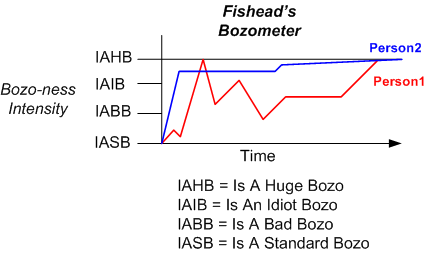
 Fishead’s Bozometer
Don’t Say It!
One of Paul Graham’s brilliant essays in “Hackers and Painters” is titled “What You Can’t Say“. In it, he analyzes the question: “How do people in power determine what you can’t say in a given historical time period?” He goes back to the Galileo era and cites the fact that what was taboo to say in one generation became trivially “OK” to say in subsequent generations. It’s sad because over the ages many people were persecuted, tortured, and killed because of what they said in one generation, only to have their deaths become senseless in the subsequent generation(s).
I think Paul’s answer to the “what you can’t say” question is pretty much right on:
“The statements that make people mad are the ones they worry might be believed. I suspect the statements that make people maddest are those they worry might be true.” – Paul Graham
How do I know that Paul is close to ground zero? Because when I get mad those are the reasons that trigger the madness. Mr. Graham’s conclusion aligns closely with the following GBS assessment.
“All great truths begin as blasphemies.” – George Bernard Shaw
If I was GBS, I would have stated it as: “All great truths begin as blasphemies that, when stated before it’s appropriate to do so, will get you censured, fired, tortured, killed, or all of the above.”

Line, Dot, Cone
My friend and mentor from afar (if you’ve looked around your local environment, there’s an incredible dearth of mentors from a-near), William L. Livingston, is about to hatch his fourth book: “Design For Prevention“. I’m happy to say that I’ve served as a reviewer and a source of feedback for D4P. I’m sad to say that it won’t become a New York Times bestseller because it’s one of those blasphemous books that goes against the grain and will be rejected/ignored by those it could help the most – institutional leaders.
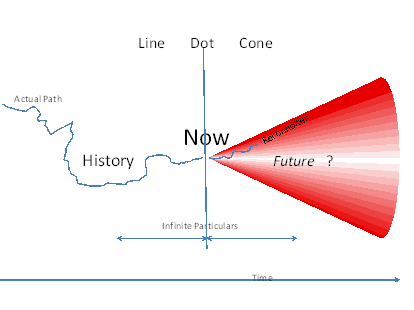
One of the graphics in DfP that I’ve fixated on is the “Line Dot Cone” drawing. As shown below, the path to “now” is not smooth and deterministic. It’s non-linear and quite haphazard. Likewise, the future holds an infinite cone of possibilities. The only way to narrow the cone of future uncertainty is to perform continuous reconnaissance via sensing/probing/simulating and then intelligently acting upon the knowledge gained from the effort, where intelligence = appropriate selection (W. Ross Ashby) and not academic knowlege.
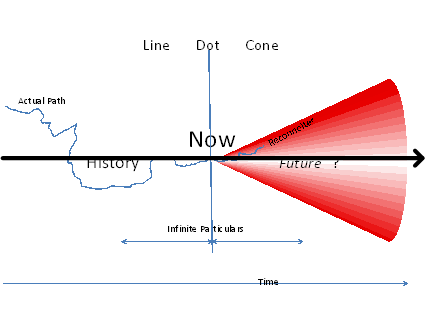
CCH corpocracies don’t acknowledge the existence of the Line-Dot-Cone reality. It would undermine the carefully crafted illusion that the dudes in the penthouse have projected about their ability to make the future happen. In their fat heads, as the overlay below shows, progress always occurs linearly in accordance with their infallible control actions. Thus, no reconnaissance is needed and all will be well for as long as they rule the roost.
Hold The Details, Please
When documenting software designs (in UML, of course) before, during, or after writing code, I don’t like to put too much detail in my models. By details, I mean exposing all public/protected/private data members and functions and all intra-member processing sequences within each class. I don’t like doing it for these reasons:
- I don’t want to get stuck in a time-busting, endless analysis paralysis loop.
- I don’t want a reviewer or reader to lose the essence of the design in a sea of unnecessary details that obscure the meaning and usefulness of the model.
- I don’t want every little code change to require a model change – manual or automated.
I direct my attention to the higher levels of abstraction, focusing on the layered structure of the whole. By “layered structure”, I mean the creation and identification of all the domain level classes and the next lower level, cross-cutting infrastructure and utility classes. More importantly, I zero in on all the relationships between the domain and infrastructure classes because the real power of a system, any system, emerges from the dynamic interactions between its constituent parts. Agonizing over the details within each class and neglecting the inter-class relationships for a non-trivial software system can lead to huge, incoherent, woeful classes and an unmaintainable downstream mess. D’oh!

How about you? What personal guidelines do you try to stick to when modeling your software designs? What, you don’t “do documentation“? If you’re looking to move up the value chain and become more worthy to your employer and (more importantly) to yourself, I recommend that you continuously learn how to become a better, “light” documenter of your creations. But hey, don’t believe a word I say because I don’t have any authority-approved credentials/titles and I like to make things up.
The Bad Person
At my company, unlike the legions of others who are afraid of what they might discover, we have a web-based portal that enables anyone to post questions to management. Fittingly, the answers to most of the questions get publicly posted along with the questions themselves from someone in the management group. Again, unlike the legions of companies littering the landscape who’s upper management layers don’t “get involved” with such trivia from the DICforce, my company’s questions are often answered by our CEO.
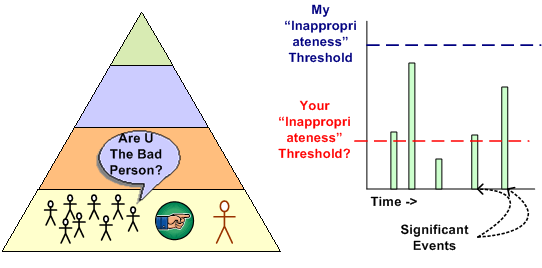
As you might surmise, some of the submitted questions could be judged as hurtful and hostile by many, if not the majority, of people in the organization. Nevertheless, everyone has a different threshold of “inappropriateness“, and as you might guess, mine is pretty high.
Because:
- of my high personal inappropriateness threshold,
- I like to continuously skirt the edge of inappropriateness to feel alive and perhaps influence other people’s thinking,
- I think (but am not sure) that quite a few people have at least judged me to be perpetually disrespectful,
I often get asked “Did you submit this question?” regarding some potentially controversial submittals. The interesting thing is, I’ve only been asked that by fellow DICs, and never by anyone in the management group. Is that both cool and weird, or what?
Every time I get asked the “Did you submit this question?” question by a fellow DICster, a slight twinge of guilt courses through my being even though I didn’t ask the question and even though I have judged it “appropriate” according to my subjective inappropriateness threshold setting. I suspect that I experience the discomfort because I feel like the asker is searching for “the bad person” who would ask such a thing. When that happens, the following quotes pop into my head to help me move past the icky and uncomfortable feeling associated with dancing on the edge of the abyss:
“It is only by risking our persons from one hour to another that we live at all.” – William James
“Do one thing everyday that scares you.” – Baz Luhrmann
How about you? Are you always on the hunt for “bad people“? Do you like to skirt the edge of inappropriateness? Do you like to sit in the lazy boy, munch on popcorn, watch the show, and remain on the sideline?
Academic Authors
I read quite a few books penned by science authors. Those that I can actually understand are very informative and entertaining. Every single one of the books always has one or more great stories regarding historical confrontations between different warring factions over who’s theory and experimental data are more “truthful“. If you believe what’s written, some of those confrontations were really nasty.
Isn’t it ironic that people who are deemed so intelligent often resort to (so-called) childish tactics in order to discredit others and prove themselves right? Nah, because underneath the veneer of revered intelligence they’re just regular freakin’ people like you and me. They’re human beings with feelings, egos, and the instinct to survive and prosper no matter what the cost. Gasp!
Science books written for laymen always seem to include words like “prestigious”, “world reknowned”, “Nobel laureate”, and “respected” in order to influence the readers beliefs via appeals to authority. The more compliments that I read, the more cautious I become in evaluating the subject matter. Being the closet non-conformist that I am, I tend to cast those words aside and gravitate toward those arguments and logic that appeal to my inner soul in the form of resonant feelings. How un-scientific of whacky me.
Anyone who conducts an argument by appealing to authority is not using his intelligence; he is just using his memory. – Leonardo daVinci
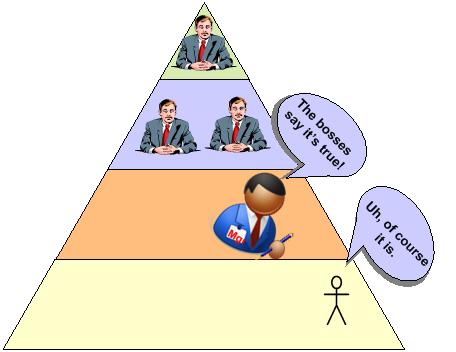
In case you haven’t noticed, I’m a total hypocrite. I appeal to authority all the time in feeble attempts to promote my views. I do it by inserting quotes from respected people into a lot of my blog posts, uh, like this one. Of course, I’m not using my intelligence. I’m using google.

Why am I here?
WTF?
Meh!
D'oh!

My BTC Address



 Bulldozer00's Blog