The Rise Of The “ilities”
The title of this post should have been “The Rise Of Non-Functional Requirements“, but that sounds so much more gauche than the chosen title.
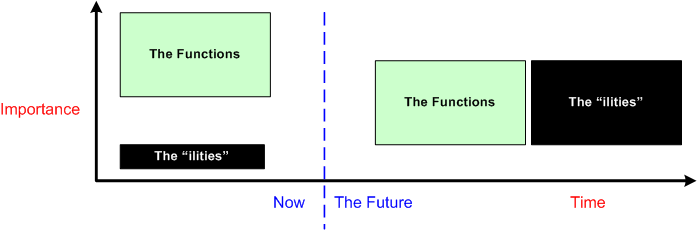
As software-centric systems get larger and necessarily more complex, they take commensurately more time to develop and build. Making poor up front architectural decisions on how to satisfy the cross-cutting non-functional requirements (scalability, distribute-ability, response-ability (latency), availability, usability, maintainability, evolvability, portability, secure-ability, etc.) imposed on the system is way more costly downstream than making bad up front decisions regarding localized, domain-specific functionality. To exacerbate the problem, the unglamorous “ilities” have been traditionally neglected and they’re typically hard to quantify and measure until the system is almost completely built. Adding fuel to the fire, many of the “ilities” conflict with each other (e.g. latency vs maintainability, usability vs. security). Optimizing one often marginalizes one or more others.
When a failure to meet one or more non-functional requirements is discovered, correcting the mistake(s) can, at best, consume a lot of time and money, and at worst, cause the project to crash and burn (the money’s gone, the time’s gone, and the damn thang don’t work). That’s because the mechanisms and structures used to meet the “ilities” requirements cut globally across the entire system and they’re pervasively weaved into the fabric of the product.
If you’re a software engineer trying to grow past the coding and design patterns phases of your profession, self-educating yourself on the techniques, methods, and COTS technologies (stay away from homegrown crap – including your own) that effectively tackle the highest priority “ilities” in your product domain and industry should be high on your list of priorities.
Because of the ubiquitous propensity of managers to obsess on short term results and avoid changing their mindsets while simultaneously calling for everyone else to change theirs, it’s highly likely that your employer doesn’t understand and appreciate the far reaching effects of hosing up the “ilities” during the front end design effort (the new age agile crowd doesn’t help very much here either). It’s equally likely that your employer ain’t gonna train you to learn how to confront the growing “ilities” menace.

Why am I here?
WTF?
Meh!
D'oh!

My BTC Address



 Bulldozer00's Blog