Archive
Open Kimono
I continue to be enamored and awed by the way the leadership at zappos.com operates the company. I’m convinced that they’re the real deal. They’ve obtained a level of business nirvana that balances altruism with profitability which is perhaps unmatched by any other company on earth – except for maybe Semco.
Sadly, even though Zappos continuously and willingly opens its kimono to all those who care to learn about how they nurture and sustain their success, the Zappos operational model probably won’t go very far. The endless sea of power-obsessed dinosaurs that rule the corpo roost are too clever (cleverness is how they got into the protected nest in the first place).
The most common refrain for rejecting any attempt to emulate Zappos “best practices” will be: “none of that stuff will work here because our business is totally different“. These will be the words of wisdom uttered from the same moo-herd potty mouths that repetitively proclaim “customers are number one and our employees are our most valuable asset“. Blah, blah, blah. Yawn, yawn, yawn. BS, BS, BS.
Best Of The Best
The breadth of variety of companies, markets, customers, industries, products, and services in the world is so wide and diverse that it can be daunting to develop objectively measurable criteria for “best in class” that cuts across all of the variability.
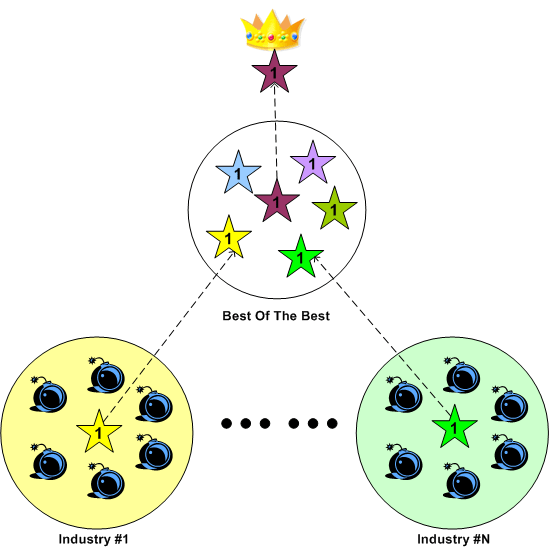
Being a simpleton, my pseudo-measurable criteria for a “best in class” company is:
- Everybody (except for the inevitable handful of malcontents (like me?) found in all organizations) who works in the company sincerely feels good about themselves, their co-workers, the products they build, their customers, and the company leadership.
That’s it. That’s my sole criterion (I told you I was a simpleton). Of course, the classical financial measures like year-over-year revenue growth, profitability, yada, yada, yada, matter too, but in my uncredentialed and unscholarly mind, those metrics are secondary. They’re secondary because good numbers are unsustainable unless the touchy-feely criterion is continuously satisfied.
The dilemma with any kind of “feel good” criteria is that there aren’t many good ways of measuring them. Nevertheless, one of my favorite companies, zappos.com, has conjured up a great way of doing it. Every year, CEO Tony Hsieh sends an e-mail out to all of his employees and solicits their thoughts on the Zappos culture. All the responses are then integrated and published, unedited, in a hard copy “Zappos Culture Book”.
The Zappos culture book is available free of charge to anyone who emails Tony (tony@zappos.com). Earlier this year, I e-mailed Tony and asked for a copy of the book. Lo and behold, I received the 400+ page tome, free-of-charge, four days later. I poured through the 100’s of employee, executive, and partner testimonials regarding Zappos’s actual performance against their espoused cultural values. I found no negative entries in the entire book. There were two, just two, lukewarm assessments of the company’s cultural performance. Of course, skeptics will say that the book entries were censored, and maybe they were, but I doubt it.
How would your company fare if it compiled a yearly culture book similar to Zappos’s? Would your company even entertain the idea? Would anyone feel comfortable proposing the idea? Is the concept of a culture book only applicable to consumer products companies like Zappos.com, or could its value be industry-independent?
Note: Zappos.com was recently bought out by Amazon.com. It should be interesting to see if the yearly Zappos culture book gets squashed by Jeff Bezos et al.
Amazappos.com

This morning, I stumbled upon a New York Times article announcing that purchase of Zappos.com by the behemoth that is Amazon.com (I’ve owned shares in Amazon.com for over 10 years). From the article:
- “Amazon initially sought to pay cash, but Zappos asked for an all-stock deal, this person said.The extra cash and restricted stock for employees is meant to keep them on board and preserve the company’s culture, the person said. The deal is expected to close in the fall.”
- “Zappos appears to engender friendly feelings even among some of its smaller competitors. Korey Buzzell, who runs the independent site Shoe-Store.net, said Zappos had been an amicable competitor in the past, sending customers to his site when it could not fulfill their orders.”
Since (because of its totally unique and far out culture) Zappos is currently my favorite company to externally watch and follow, I was initially bummed. However after reading Zappos CEO Tony Hsieh’s down-to-earth, understandable, and jargon-less letter to employees, I’m actually excited about the future potential of Amazappos.com.
Here are some snippets from Hsieh’s letter that rang my bell and changed my feelings toward the deal. Notice how many times the word “culture” is used.
- “For Zappos, our vision remains the same: delivering happiness to customers, employees, and vendors. We just want to get there faster.”
- “Amazon supports us in continuing to grow our vision as an independent entity, under the Zappos brand and with our unique culture.“
- “Our culture at Zappos is unique and always evolving and changing, because one of our core values is to Embrace and Drive Change. What happens to our culture is up to us, which has always been true. Just like before, we are in control of our destiny and how our culture evolves.“
- “They are not looking to have their folks come in and run Zappos unless we ask them to. That being said, they have a lot of experience and expertise in a lot of areas, so we’re very excited about the opportunities to tap into their knowledge, expertise, and resources, especially on the technology side.“
- “We learned that they truly wanted us to continue to build the Zappos brand and continue to build the Zappos culture in our own unique way. I think “unique” was their way of saying “fun and a little weird.” 🙂 “
- “Amazon focuses on low prices, vast selection and convenience to make their customers happy, while Zappos does it through developing relationships, creating personal emotional connections, and delivering high touch (“WOW”) customer service.“
- “Jeff Bezos (CEO of Amazon) made it clear that he had a great deal of respect for our culture and that Amazon would look to protect it.“
- “Our mission remains the same: delivering happiness to all of our stakeholders, including our employees, our customers, and our vendors.“
- “We do not have any plans to move any departments, nor does Amazon want us to because they recognize that our culture is what makes the Zappos brand special.”
- “This is not a cash transaction. This is a stock exchange. Our shareholders and option holders will be issued approximately 10 million Amazon shares on a fully converted basis.“
I was also stunned by the disclosure that Zappos.com, which grew into a $1B company over 10 years selling a commodity product – shoes, only has (had?) 100 shareholders. I wish I was one, but now I am!
BTW, Hsieh’s e-letter has a really great video of Amazon CEO Jeff Bezos’ intro to Zappos employees embedded within it. He describes his values, and more interestingly, how Amazon got started. He also unembarassingly and openly shares some of the stupid mistakes that he made in piloting Amazon to where it is today.

Why am I here?
WTF?
Meh!
D'oh!

My BTC Address



 Bulldozer00's Blog