Archive
Monkey Mind
For ego-dominated people like me, “I-thoughts” run rampant through the mind. Buddhists call this malady the “monkey mind“, with thoughts jumping randomly to and fro in chaotic happenstance.
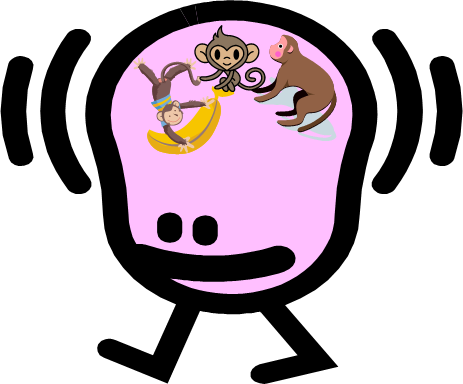
Psychological discord arises because, as one wise man has said, “we can’t bear to sit still with ourselves for one minute“.
The Null Set
Few would argue that Martin Luther King and Albert Einstein didn’t change the world for the betterment of the human race. These two stunningly similar quotes unveil one of the keys to their hard won success:
Many people fear nothing more terribly than to take a position which stands out sharply and clearly from prevailing opinion. – Martin Luther King
Few people are capable of expressing with equanimity opinions which differ from the prejudices of their social environment. Most people are even incapable of forming such opinions. – Albert Einstein
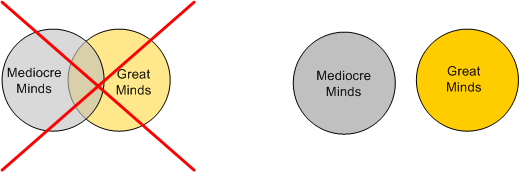
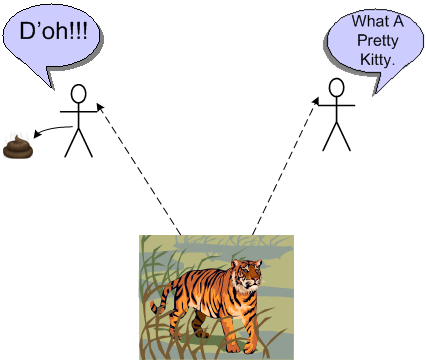
Something tells me that this is an ironic twist on the cliche that “great minds think alike“. Great minds think alike, but so do mediocre minds. It’s just that on matters of importance, great minds don’t think like mediocre minds. D’oh!
Growing Wings On The Way
If you don’t have wings and you jump off a cliff, you better hope to grow a pair before you go splat. With this lame ass intro, I introduce you to the title of the latest systems thinking book that I finished reading: “Growing Wings On The Way“.

GWOTW is yet another terrific systems thinking book from small British publishing house “Triarchy Press“. The book defines and explains a myriad of tools/techniques for coming to grips with, understanding, and improving, socio-technical “messes“. Through numerous examples, including a very personal one, Rosalind Armson develops the thought processes and methods of inquiry that can allow you to generate rich pictures, influence diagrams, system maps, multiple-cause diagrams, and human activity system diagrams for addressing your “messes“. If you want a solid and usable intro to soft systems thinking, then this may be your book.
Renunciation
I was listening to an Eckhart Tolle talk the other day (via an mp3 file deposited on a USB stick plugged into my new Subaru WRX audio system). He started talking about the key to inner peace. In order to prepare his audience for the bombshell he was about to launch, he asked them to “please don’t be shocked“. Eckhart then said, in his characteristically slow, deliberate, and relaxed tone, that the key to awakening and inner peace is….. the renunciation of thought. D’oh, and WTF?
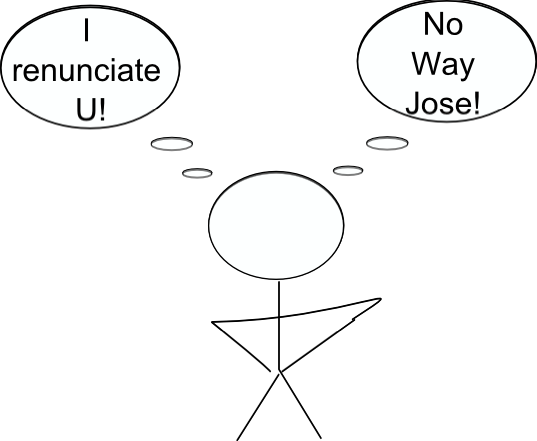
Years ago, when I was more lost than I am today, I would have thought that Mr. Tolle was a charlatan on the level of Jimmy Swaggart and Jim Bakker. Today, knowing what I know, but can’t express in words, I think he is wise. How about you? What do you think?
Note: I usually use Microsft Visio to generate the dorky diagrams on this blog. The pic in this post is my first one using the freely downloadable Inkscape package.
Sarcastic Epiphany
During a multi-technology product development project that I worked on in the past, a non-software engineer stated: “it’s all about the software“. When I heard this, I temporarily entered a dream world where the sky is pink. I thought: “this dude gets it – she’s had the epiphany“. A millisecond later, I exited my delusion and returned to the world where the sky is blue (this one?). That initial, self-serving thought was quickly replaced by: “she said that sarcastically“. D’oh!

Cradle To Grave Indoctrination
“Few people are capable of expressing with equanimity opinions which differ from the prejudices of their social environment. Most people are even incapable of forming such opinions.” – Albert Einstein
To me, the second sentence is the most insightful part of this quote. My subjective interpretation is that Einstein discovered that the cradle-to-grave indoctrination of most individuals teaches them to become subservient to the herd mindset prevailing during their time on earth. This indoctrination is so effective and so complete that they don’t have a clue that their capacity to think afresh has been vastly constrained by their social environment. What do you think Einstein meant when he said the words? Your interpretation is as invalid as mine.
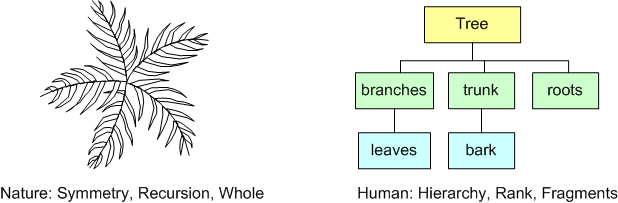
I don’t think there’s any conspiracy theory here, it’s just the natural course of development in any society that has been “trained” to revere human-concocted hierarchical structures of governance. I say “human-concocted” because there are no hierarchies in nature. We automatically and impulsively impose hierarchies on everything we observe because that’s the only way we know how to make sense of, understand, and (attempt to) control the world. Building command and control hierarchies and requiring unquestioning subservience to those arbitrarily placed “above” you in the caste system is the way of the human race – today. Do you think this situation will remain that way for your lifetime? How about, forever?
Thought Recognition
Do you ever find yourself in the throes of an ego-tantrum, and then recognize that your monster ego is in charge, and then still continue feeding your ego with the negative energy it requires to stay viable? I do it all the freakin’ time and it always leads to feelings of post-tantrum guilt. The reason guilt invades my psyche is because of the fact that thought recognition has taken place. If that didn’t happen, then there would be no guilt. In the “old days” prior to starting my search for spiritual advancement, I had no thought recognition skill. Not one iota. Thus, there was no post-tantrum guilt.

So, in this case, is ignorance bliss? Would you rather be ignorant of when your ego is wreaking havoc, or would you rather be cognizant of the fact? Assuming that you chose the latter, do you think you could stop the ego-tantrum dead in its tracks when (external?) thought recognition occurs? If so, what’s your secret?

Data-Meaning-Information
When raw data acquires meaning to someone or some group, it becomes actionable information. Otherwise, it’s just noise.
While reading Melanie Mitchell’s “Complexity: A Guided Tour”, one of the tantalizing questions raised by the author is: “how does raw data acquire meaning?“. I think that’s a cool question and I think the author’s answer is cool too: “data acquires meaning when, after processing, it is perceived by the observer to be connected with the observer’s survival or well being“. Ergo, because all perception is subjective, one man’s meaningless data is another man’s meaningful information. More interestingly, one man’s meaningful information is another man’s different meaningful information.
CCP
Relax right wing meanies, it’s not CCCP. It’s CCP, and it stands for Context, Content, and Process. Context is a clear but not necessarily immutable definition of what’s in and what’s out of the problem space. Content is the intentionally designed static structure and dynamic behavior of the socio-technical solution(s) to be applied in an attempt to solve the problem. Process is the set of development activities, tasks, and toolboxes that will be used to pre-test (simulate or emulate), construct, integrate, post-test, and carefully introduce the solution into the problem space. Like the other well-known trio, schedule-cost-quality, the three CCP elements are intimately coupled and inseparable. Myopically focusing on the optimization of one element and refusing to pay homage to the others degrades the performance of the whole.
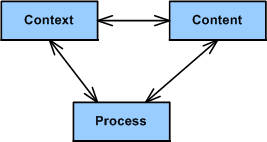
I first discovered the holy trinity of CCP many years ago by probing, sensing, and interpreting the systems work of John Warfield via my friend, William Livingston. I’ve been applying the CCP strategy for years to technical problems that I’ve been tasked to solve.
You can start using the CCP problem solving process by diving into any of the three pillars of guidance. It’s not a neat, sequential, step-by-step process like those documented in your corpo standards database (that nobody follows but lots of experts are constantly wasting money/time to “improve”). It’s a messy, iterative, jagged, mistake discovering and correcting intellectual endeavor.
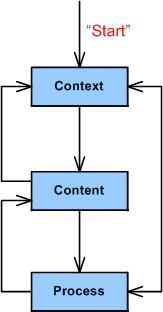
I usually start using CCP by spending a fair amount of time struggling to define the context; bounding, iterating and sketching fuzzy lines around what I think is in and what is out of scope. Next, I dive into the content sub-process; using the context info to conjure up solution candidates and simulate them in my head at the speed of thought. The first details of the process that should be employed to bring the solution out of my head and into the material world usually trickle out naturally from the info generated during the content definition sub-process. Herky-jerky, iterative jumping between CCH sub-processes, mental simulation, looping, recursion, and sketching are key activities that I perform during the execution of CCP.
What’s your take on CCP? Do you think it’s generic enough to cover a large swath of socio-technical problem categories/classes? What general problem solving process(es) do you use?
RIP, Dear Syd
From an acquaintance on LinkedIn.com, I just found out that Sydney Banks died in May. Syd was a simple and under-educated man who didn’t strive for fame and fortune. He was the first spiritual teacher whose words of truth penetrated my thick Newtonian thinking skull. I’m very sad to see him go.
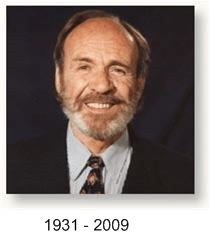
Over ten years ago, I stumbled upon obscure Syd’s work while reading Richard Carlson’s not-so-obscure “Don’t Sweat The Small Stuff — And It’s All Small Stuff”. When I read that small tome, the hairs on the back of my neck kept rising up and I found myself experiencing multiple simple, indescribable, and joyful moments of being. It was weird because the words were so simple, yet they were also very profound to me. I kept saying “WTF?” to myself as I turned the pages.
After finishing “Sweat“, I devoured all of the rest of Carlson’s books and they all had the same endearing effect on me. Curious as hell, I scoured the footnotes and bibliographies to find out where Carlson came up with such impactful and profound thoughts and words. Through at least one level of indirection, I discovered that Syd Banks was at the root of a whole ecosystem that revolved around his work: “The Three Principles – Mind, Consciousness, Thought“. Stunningly, West Virginia University, a stereotypical academic bastion of logical and mechanistic thinking, paid tribute to Syd’s spiritual work by initially naming the West Virginia Initiative for Innate Health after him.
I’m really thankful that I serendipitously discovered the work of Sydney Banks. Rest in peace my dear friend from afar.

Why am I here?
WTF?
Meh!
D'oh!

My BTC Address



 Bulldozer00's Blog