Archive
Money, Tools, Materials, Know-How, Products
Since you’ve stopped by, check out the company-centered, system loop diagram below. The model is composed of three interdependent parts: the company, the customers, and the suppliers. In equilibrium, when all is well:
- The company produces products that are paid for, and consumed by, customers.
- The company purchases tools and materials from suppliers.
- The company uses the tools, materials, and the knowledge of its workforce to create the products that sustain the viability of the company.
- The company’s cash inflow exceeds it’s cash outflow
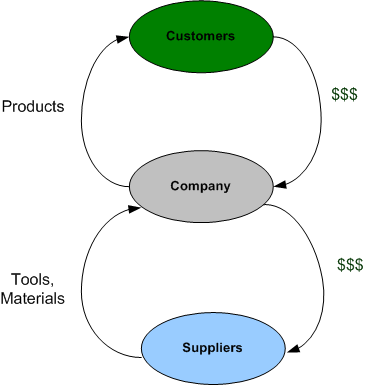
Note that if any of the links in the system get severed, the company collapses. If the products stop flowing out of the company, the life-giving cash stops flowing in. If the cash stops flowing in, the products stop flowing out. If the tools and materials stop flowing in, the products stop flowing out. From the company’s perspective, products lead to cash and cash leads to more products in a positive, self-reinforcing, feedback loop.
Using the diagram below, let’s look in more depth at the company’s cash inflows and outflows. In stable, steady-state operation, the cash inflow is managed competently by the executive team. After taking their cut of the action, the executives push some cash downward through the patriarchy to keep the operation humming and they approve of all outflows to suppliers.
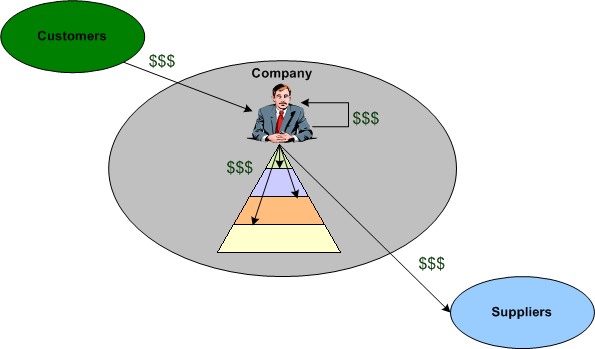
What the picture doesn’t show, is the indirect source of the customer cash – the company’s product set. Lets augment the diagram above and close the loops:
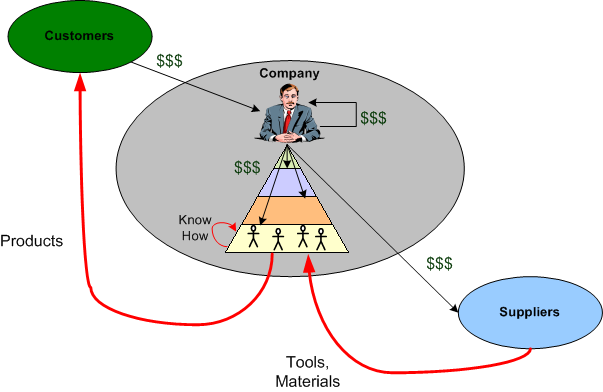
There are a bazillion external, and especially, internal threats to system viability. Externally, customers can run out of cash and suppliers can go bust. Internally, bureaucratic little Hitlers, byzantine processes, lack of investments in tools and people, inequities in status and pay, silo-to-silo infighting, and poor hiring practices are among the myriad of threats that can contribute to corpo implosion. Of course, the purpose of management is to gracefully overcome the threats. But hey, regardless of whether executives and their management appointees are the cause of success or failure, they still have the right to high status and high compensation because…. well, just because.
Small, Loose, Big, Tight
This Tom DeMarco slide from his pitch at the Software Executive Summit caused me to stop and think (Uh oh!):
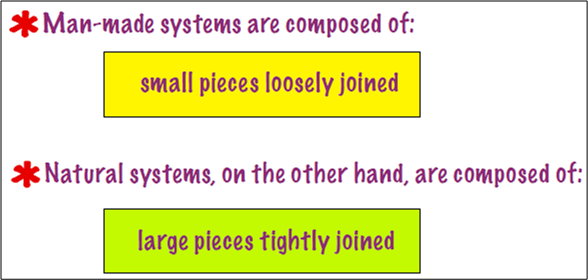
I find it ironic (and true) that when man-made system are composed of “large pieces tightly joined“, they, unlike natural systems of the same ilk, are brittle and fault-intolerant. Look at the man-made financial system and what happened during the financial meltdown. Since the large institutional components were tightly coupled, the system collapsed like dominoes when a problem arose. Injecting the system with capital has ameliorated the problem, but only the future will tell if the problem was dissolved. I suspect not. Since the structure, the players, and the behavior of the monolithic system have remained intact, it’s back to business as usual.
Similarly, as experienced professionals will confirm, man made software systems composed of “large pieces tightly joined” are fragile and fault-intolerant too. These contraptions often disintegrate before being placed into operation. The time is gone, the money is gone, and the damn thing don’t work. I hate when that happens.
On the other hand, look at the glorious human body composed of “large pieces tightly joined“. It’s natural, built-in robustness and tolerance to faults is unmatched by anything man-made. You can survive and still prosper with the loss of an eye, a kidney, a leg, and a host of other (but not all) parts. IMHO, the difference is that in natural systems, the purposes of the parts and the whole are in continuous, cooperative alignment.
When the individual purposes of a system’s parts become unaligned, let alone unaligned with the purpose of the whole as often happens in man made socio-technical systems when everyone is out for themselves, it’s just a matter of time before an internal or external disturbance brings the monstrosity down to its knees. D’oh!
Feedback Insertion
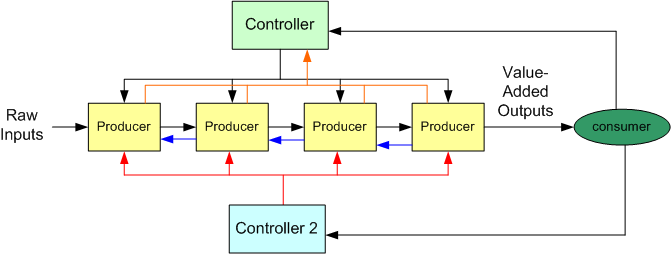
Let’s say that you come up with a great product idea that is both wanted and needed by a large market (ka-ching!). Let’s also say that your product is non-trivial and it requires specialized expertise to produce it from raw inputs to its value-added end state. After mustering up enough courage and scrounging up enough money, you become an entrepreneur – whoo hoo! So, you design the system below, hire the expertise you need, and kick off the enterprise. Of course, you rightly put yourself in the controller position and serve as the system coordinator.
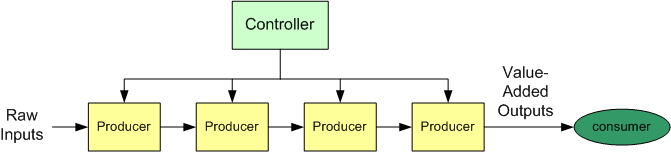
Uh, what’s missing from your design? Does the next picture below help? Still can figure it out?
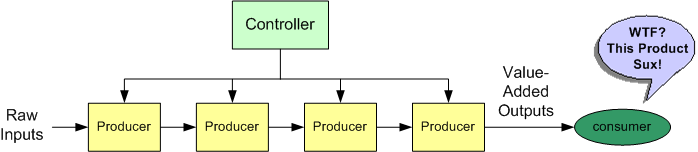
Is feedback missing? Even though your customers need and want and buy your product, how do you know when/if your quality goes down hill and/or your customers want and need new features? Voila! You figure it out and design/install a feedback channel from your customers to you, and only you:
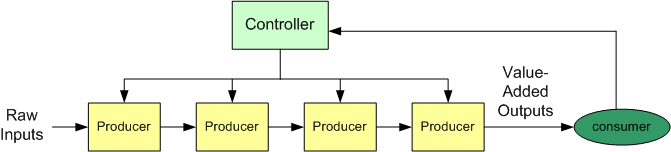
By responsively acting on customer inputs on your new feedback channel, you steer, guide, and direct your team back on track – until the complaints on the feedback channel start rising again. What’s wrong with your system now? Does the system augmentation below answer the question?
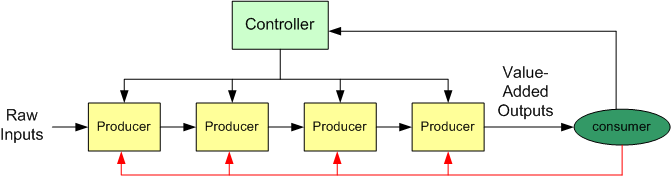
Because of increasing product complexity and your lack of in depth knowledge of it, (if you’re not an egomaniacal control freak,) you own up to the possibility that you could be misunderstanding and filtering out some customer feedback and you could be directing your team poorly. Accepting your humility, you set up a second feedback channel from your customers directly to your development team.
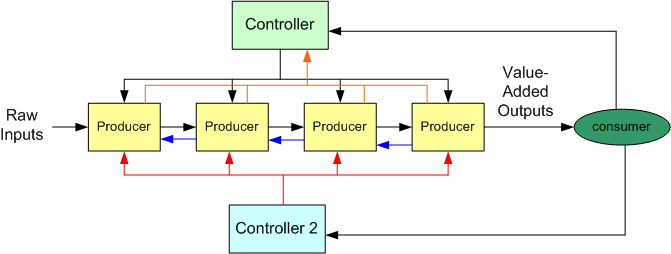
Now you’re back on track again – whoo hoo! But wait, something goes awry again and the customer complaint rate starts rising again. Since feedback solved your problems before, you set up additional feedback channels between yourself and your producer team and between your sub-teams:

Will this latest system enhancement work? Hell, I don’t know. Complexity begets complexity. Your increasingly complex system design might implode because of all the communication channels in the system and the fragmentation of contradictory messages that flow at high rates within the channels. If it doesn’t work, you could keep experimenting with changes to fine tune the system for stability and robustness.
The figure below shows yet another system enhancement possibility – the addition of another controller to ensure that the production sub teams receive coherent and filtered info from your customers. It may work, but it will fail if your second controller issues guidelines, advice, commands, and orders to your production team that contradict yours.
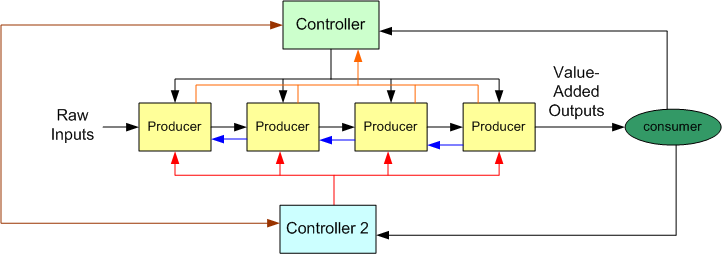
To solve your cross-management problem, you can setup a two way channel between yourself and your second controller to resolve contradictions and ambiguities:
So, what’s the point of this long and boring, multi-picture post? Geez, I don’t know. I wrote it on the fly, in a stream of consciousness with no pre-planned point in mind.
But wait, a possible answer to the question just popped into my head out of nowhere. The point of this post is to keep adapting and trying new things when your external environment keeps changing – which it always will. One thing is for sure: don’t design your operation like the very first picture in this post – open loop. Ensure that feedback channel(s) from your customers are in place and the information that flows on it (them) is acted upon to keep your product in synch with your customers.
Sheesh, I’m finally done!
Get Your Beer Here!
The table below shows a mapping of 10 systems thinking approaches into 4 types based on primary “purpose“. I extracted this table from Michael C. Jackson‘s terrific “Systems Thinking: Creative Holism For Managers“.
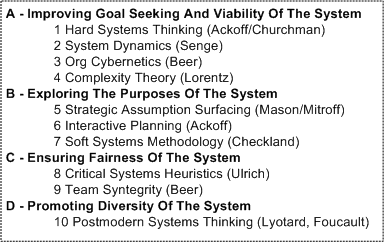
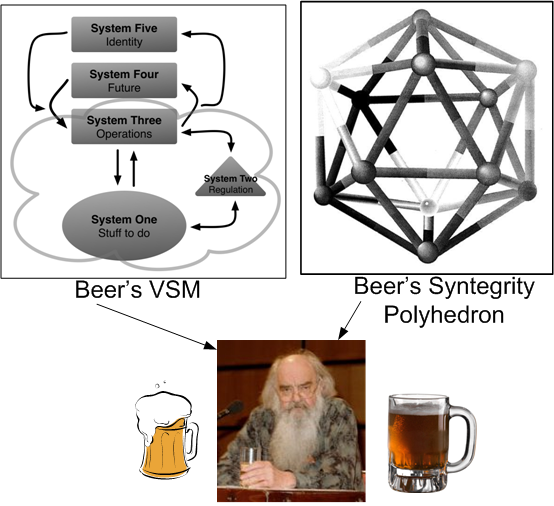
Did you notice that the brilliant Stafford, awesome-last-name, Beer is listed twice and his “Team Syntegrity” approach falls under the “ensuring fairness of the system category“? In Jackson’s opinion, Beer created his cybernetics-based, recursive 5 subsystem, Viable System Model (VSM) for the purpose of improving the goal seeking performance of complex social systems. Beer, both a tasty drink and a staunch anti-hierarchy champion, got so pissed when BMs, BOOGLs, BUTTs, SCOLs and dudes with BFTs interpreted his VSM as just another way of implementing a CCH with omnipotent and omniscient bosses at levels 2-5, that he developed his wildly innovative, polyhedron-based, “Team Syntegrity” approach to ensure fairness in org governance. In his design of the VSM, even though Beer articulated that the sole purpose of subsystems 2-5 is to support the operations of system 1 at the bottom (you know, the DICforce where you and I dwell), people of importance still kept their self-serving UCB blinders on and interpreted his system of management to be hierarchical.
As the figure below shows, the VSM appears to be hierarchical on the surface and, since most (not all) managers operate on the “surface” because they no longer roll up their sleeves to dive into anything difficult to understand, they internalize it as a better way to run their CCH psychic prisons as instruments of domination. However, when one studies Beer’s VSM approach to org management, it’s a self sufficient system of collaboration and intergroup support with each subsystem playing a key role in the holarchy.
Improving, Exploring, Ensuring, Promoting
In Michael C. Jackson‘s rich and engrossing “Systems Thinking: Creative Holism For Managers“, Mr. Jackson describes 10 holistic systems thinking approaches designed to solve complex social managerial problems. As the tables below illustrate, Mr. Jackson allocates the approaches to four classes depending on the main purpose of the approach. For example, he asserts that Stafford Beer‘s “Team Syntegrity” approach is employed primarily to ensure fairness during the process of solving a complex social systems problem.
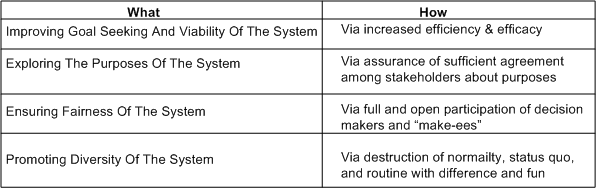
I really like Jackson’s book because of its breadth, vocabulary, and the way he covers each of the 10 systems approaches from its philosophical roots, to theory, to methods. He also supplies a real application example for each approach. In the final part of the book, Jackson integrates all of the approaches into a supra-holistic (?) approach that advocates mixing and matching elements of each approach and tailoring the “Creative Holism” meta-methodology to the specific “mess” at hand.
The last book that I read twice in a row was the brilliant Quantum Enigma by Fred Kuttner and Bruce Rosenblum. I’m gonna do the same with this masterpiece.
Science, Philosophy, Systems Thinking
In Michael C. Jackson‘s rich and engrossing “Systems Thinking: Creative Holism For Managers“, Mr. Jackson describes 10 holistic systems thinking approaches designed to solve complex social managerial problems. As he progressed from the earlier, purely science based, hard-systems thinking approaches to the modern, soft-systems approaches that attempt to fuse science with philosophy, I composed the two pictures below to help clarify my understanding. As usual, I felt an internal urge to externally express my discombobulated thoughts on the topic; so here are the pics.
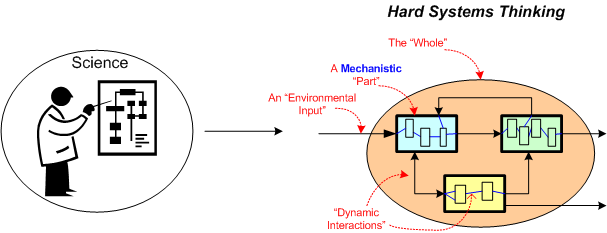
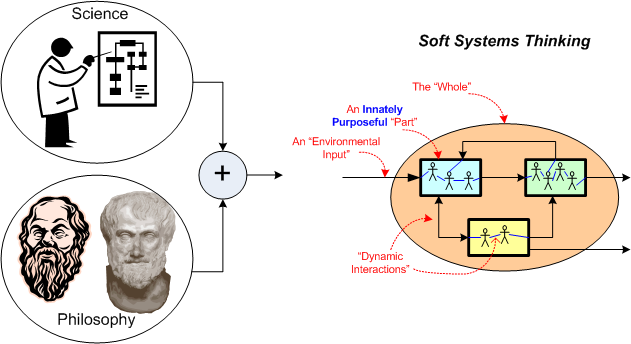 The main distinguishing difference that I see between the hard/soft models is the way that internal system “parts” are characterized. In the hard systems approaches, the system parts are conveniently assumed to have no self-purposes. This, as some people know from experience, is a horribly wrong assumption for systems composed of individual persons – social organizations.
Social org BOOGLs, SCOLs, and BUTTs are forever mired in the hard systems thinking mindset of yesteryear. Their simplistic solution for suppressing any externalization of self-purpose that is at odds with their own is to either consciously or unconsciously apply force to extinguish it. History has shown that this ubiquitously applied technique works – temporarily.
Alignment
You can supply your own words for this post…..

Deterministic, Animated, Social
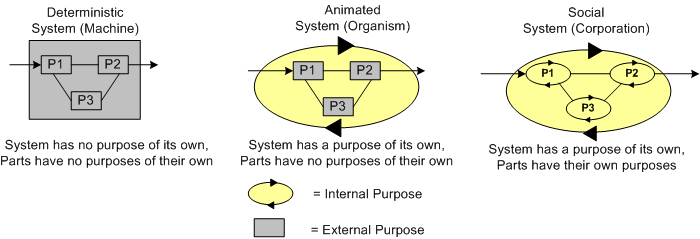
Unless you object, of course, a system can be defined as an aggregation of interacting parts built by a designer for a purpose. Uber systems thinker Russell Ackoff classified systems into three archetypes: deterministic, animated, and social. The main criterion Ackoff uses for mapping a system into its type is purpose; the purpose of the containing whole and the purpose(s) of the whole’s parts.
The figure below attempts to put the Ackoff “system of system types” 🙂 into graphic form.
Deterministic Systems
In a deterministic system like an automobile, neither the whole nor its parts have self-purposes because there is no “self”. Both the whole and its parts are inanimate objects with fixed machine behavior designed and assembled by a purposeful external entity, like an engineering team. Deterministic systems are designed by men to serve specific, targeted purposes of men. The variety of behavior exhibited by deterministic systems, while possibly being complex in an absolute sense, is dwarfed by the variety of behaviors capable of being manifest by animated or social systems.
Animated Systems
In an animated system, the individual parts don’t have isolated purposes of their own, but the containing whole does. The parts and the whole are inseparably entangled in that the parts require services from the whole and the whole requires services from the parts in order to survive. The non-linear product (not sum) of the interactions of the parts manifest as the external observable behavior of the whole. Any specific behavior of the whole cannot be traced to the behavior of a single specific part. The human being is the ultimate example of an animated system. The heart, lungs, liver, an arm, or a leg have no purposes of their own outside of the human body. The whole body, with the aid of the product of the interactions of its parts produces a virtually infinite range of behaviors. Without some parts, the whole cannot survive (loss of a functioning heart). Without other parts, the behavior of the whole becomes constrained (loss of a functioning leg).
Social Systems
In a social system, the whole and each part has a purpose. The larger the system, the greater the number and variety of the purposes. If they aren’t aligned to some degree, the product of the purposes can cause a huge range of externally observed behaviors to be manifest. When the self-purposes of the parts are in total alignment with whole, the system’s behavior exhibits less variety and greater efficiency at trying to fulfill the whole’s purpose(s). Both internal and external forces continually impose pressure upon the whole and its parts to misalign. Only those designers who can keep the parts’ purpose aligned with the whole’s purpose have any chance of getting the whole to fulfill its purpose.
System And Model Mismatch
Ackoff states that modeling a system of one type with the wrong type for the purpose of improving or replacing it is the cause of epic failures. For example, attempting to model a social system as a deterministic system with an underlying mathematical model causes erroneous actions and decisions to be made by ignoring the purposes of the parts. Human purposes cannot be modeled with equations. Likewise, modeling a social system as an animated system also ignores the purposes of the many parts. These mismatches assume the purposes of the parts align with each other and the purpose of the whole. Bad assumption, no?
Busy Doing Nothing
The British created a civil service job in 1803 calling for a man to stand on the Cliffs of Dover. The man was supposed to ring a bell if he saw Napolean coming….. The job was abolished in 1945. – Robert Townsend.
The battle of Waterloo, in which Napolean’s army was routed, was fought in 1815. Thus, the series of dudes who stood guard for 130 years after the fall of the egotistical French emperor were busy doing nothing but pissing and pooping off the cliffs every few hours – and gettin’ paid for it.

In “Ackoff’s Best: His Classic Writings On Management“, uber systems thinker Russell Ackoff rails against bureaucracies:
A bureaucracy is an organization whose principle objective is to keep people busy doing nothing. They are preoccupied with what we call make-work…. The problem created by people who are busy doing nothing is that they frequently obstruct others who have real work to do. They impose unproductive requirements on others…. Bureaucracies obstruct development. They retard improvement of quality of life…. Bureaucrats want all parts of an organization to conform to one set of rules and regulations…. Conformity is treated as good in itself, an ultimate good. – Russell Ackoff
Mr. Ackoff not only rages against the machine, he advises on how to beat the system with a bevy of hilarious real-life examples in which individuals successfully “fought city hall” and won. He follows each ditty with a moral. Buy the book and read it for the delicious details of every battle.
Arbitrary Boundaries
The Generic Template

My Arbitrarily Defined Boundary

Your Arbitrarily Defined Boundary

Why am I here?
WTF?
Meh!
D'oh!

My BTC Address



 Bulldozer00's Blog