Archive
G-Spot
In chapter 3 of “In The Plex“, Steven Levy describes the culture within Google. Check out these “behaviors“…
The highlight of the TGIFs is always the no-holds-barred Q and A. Using an internal program called Dory, employees rate questions submitted online, with the more popular ones rising to the top. Brin and Page respond to even seemingly hostile questions with equanimity, answering them in all seriousness with no offense taken. In a typical session, someone asked why the newly hired chief financial officer had gotten such a big contract. Sergey patiently explained that the marketplace had set salaries high for someone filling that role and Google couldn’t fill it with a quality person if it underpaid.
Even more time is saved by Google’s ubiquitous “tech stops” spread about the buildings: these are, in essence, tiny computer shops, indicated by neon markers. When a piece of equipment fails or there is a sudden need for a new mouse or phone charger, all a Googler needs to do is walk no more than a few hundred feet to one of those locations, and almost instantly he or she will be made whole.
What are some of the behaviors, or (maybe more importantly) lack thereof, that your company exhibits that characterize its culture? Fuggedaboud what is espoused. What is actually “visible and feelable” that sets your company apart from the mooo-herd?
If you were an employee who saw evidence every single day that your company valued your presence, would you not be more loyal? The Montessori kids who started Google thought about those questions and asked, Why? Why? Why? If Google ever hits really hard times, it will be telling to see whether the sushi quality falls and the power chargers disappear from the conference rooms.

Don’t Be Evil

If you don’t know that Google’s informal corporate motto is “Don’t Be Evil“, then either you were born yesterday or you shouldn’t be reading this ridiculously inane blog – or both.
While reading Stephen Levy‘s well written, informative, and entertaining book, “In The Plex“, Mr. Levy tells the story of how the controversial and tough-to-live-up-to Google war cry came into existence. Here, he describes the first triggering event:
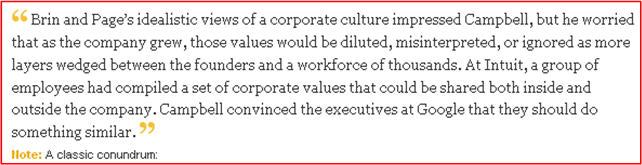
Mr. Levy goes on to say:

Note that 15 employees were assembled from across a broad swath of the company. Do you notice something amiss? Uh, how about the fact that the two founders, Sergey Brin and Larry Page weren’t involved?
As the group debated the motto, here’s what one group member said:

Note that everyone had a chance to weigh in, and thus, “Don’t Be Evil” was internalized by the whole org. It wasn’t handed down from on high by a politburo or junta or God-like individual that “obviously knows what’s best for all the children in the borg“.
Did, or do, you have the chance to provide feedback on your corpo values or philosophy? Are they authentic like Google’s and Zappos.com’s, or are they a copy-and-paste job from a 1970’s vintage management book? If they’re a copy-and-paste job, have you suggested revisiting them? If so, how was your suggestion received?
No Golf?
While reading about the rise of the Google juggernaut in Steven Levy‘s “In The Plex“, I stumbled upon this jaw dropping passage:

WTF? No sponsored golf? Bummer.

Note: The main purpose of this post wasn’t really to joke about the lack of golf outings sanctioned at Google. It was to make sure that you, dear readers, saw the “coddling” sentence. In CLORGs and DYSCOs that have lost their way, and Google may eventually morph into one of these monstrosities; salesman, marketers and managers coddle themselves and their incest-born kin more than the bottom line wealth and value creators; be they artists, ad-creators, plumbers, electricians, doctors, nurses, system engineers, software engineers, test engineers, and/or hardware engineers. But hey, don’t listen to me. I have an ego-maniacal agenda – just like the roles I condemn.
Montessori School
While reading Steven Levy‘s riveting “In The Plex“, I discovered the Maria Montessori teaching method:
“It’s really ingrained in their personalities,” she said. “To ask their own questions, do their own things. To disrespect authority. Do something because it makes sense, not because some authority figure told you. In Montessori school you go paint because you have something to express or you just want to do it that afternoon, not because the teacher said so. This is really baked into how Larry (Page) and Sergey (Brin) approach problems. They’re always asking ‘Why should it be like that?’ It’s the way their brains were programmed early on.”
“Discipline must come through liberty…. We do not consider an individual disciplined only when he has been rendered as artificially silent as a mute and as immovable as a paralytic. He is an individual annihilated, not disciplined. We call an individual disciplined when he is master of himself.”
To the non-managers out there: Have you been “rendered artificially silent as a mute and as immovable as a paralytic“…….. without being aware of it?

A Valiant Try
Google recently re-appointed Larry Page as it’s CEO after a 10 year hiatus. From the following blurb in “The Product Shakeup At Google Begins”, it seems like Google is valiantly trying to return to its roots:
(Larry) Page famously has a low opinion of managers, especially product managers who try to tell engineers what to do. “People don’t want to be managed,” he is quoted in Steven Levy’s new book, In the Plex. Page is a big believer in self-management. At one point early on in the company’s history, he and Brin tried to get rid of all managers.
Even though it is certainly impractical to get rid of all managers once an org grows to a certain size, ya gotta love the irony of anti-management CEOs like Page, Nayar, and Semler, no? With guys like that watching over an org, you can be confident that they’ll be vigilant in keeping the manager-to-worker ratio low and that they’ll make sure managers do more than just plan, watch, control, command, and evaluate others. Of course, this philosophy doesn’t guarantee success, but it sure does make working for a company more enjoyable for the majority of people who work there – not just the management minority.


Why am I here?
WTF?
Meh!
D'oh!

My BTC Address



 Bulldozer00's Blog