Archive
Amity and Enmity I
If you’re looking to tax your mind to the fullest and explore a novel and rigorous approach to sociological science, check out Dr. Rudolf Starkermann’s new web site, “Amity and Enmity”. The site was recently placed online by e-colleague Byron Davies and the wonderful story behind the site’s creation deserves its own separate, forthcoming blog post (Amity and Enmity II).
By syntegrating social concepts (e.g. willpower, consciousness, attitude, the unconscious, goal-seeking) with the concepts and mathematics from the engineering discipline of automatic control theory (e.g. amplification, error signal, feedback, transfer functions, stability, homeostasis, PID control), Dr. Starkermann models a living social “unit” as a self-realization seeking loop that is influenced by other social units via conscious observations/actions and subconscious “attitudes“. A social unit can represent a person, group, institution, or even a nation.
The first figure below shows a simplified first order model of the Starkermann social dualism. The second figure exposes the model’s intricately dense complexity. If you painstakingly trace out and count the number of loops in the socially coupled system, you’ll find that there are 12 of them. D’oh!
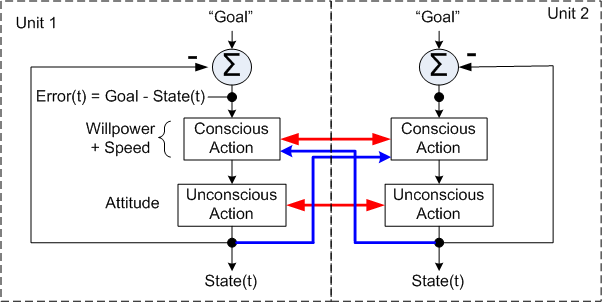

Did you have trouble finding the loops in the dualism? Well, don’t fret because here they are:
 Double D’oh!
Even if you’re not an engineer who’s taken a course in automatic controls theory, you may get something out of “Amity And Enmity“. Dr. Starkermann valiantly tries to make his work accessible to the non-mathematical layman via many careful and empathic explanations throughout the treatise.
By fixing some parameters and varying others, Rudy has “calculated the behavior” of the dualism in a multitude of scenarios in order to discover what his models reveal about amity and enmity. Here’s a sample list of his “stark” conclusions:
- Nature favors enmity and sets amity second.
- Hostility is fast, consent is slow.
- The faster a “unit” thinks, acts, the larger its willpower can be before it runs into instability and the better and faster it reaches its goal.
- The probability is almost non-existent that a hate-relation changes into a friendship.
- Hostility is solid. Friendship is fragile.
While sloowly making my way through the dense thicket that is “Amity And Enmity“, the following quote keeps coming to mind:
All models are wrong, but some are useful – George Box


Why am I here?
WTF?
Meh!
D'oh!

My BTC Address



 Bulldozer00's Blog