Archive
Quantum Consciousness
In their wonderful book “Quantum Enigma” (I just finished reading it twice in a row, back-to-back), physicists Kuttner and Rosenblum assert that quantum theory is the most battle-tested scientific theory of all time. In its 80 year existence, it has never failed any experimental test hurled at it by the most brilliant academic minds, past and present.
If my understanding is correct, and it might not be because of the nature of the subject matter, quantum theory says that nothing material exists until it is consciously observed. Hmmm, that sounds like the same thing spiritual teachers have been asserting for thousands of years before the development of quantum theory.
On the extremely small scale of sub-atomic sizes, that assertion has been proven many times over by employing the scientific way – experimentation. One classic example is that depending on which experiment you consciously choose to perform, you can prove that light is either a mass-less continuous wave or a stream of discrete and separate particles of mass. The reason why we can’t recreate paradoxical experiments similar to that with large macro-sized objects like people is because the technology needed to do it is not available, yet. Bummer.
Another assertion quantum theory makes is that two entangled objects can instantaneously influence one another, regardless of how far apart they are spaced. This assertion effectively voids Einstein’s proof that no physical entity can travel faster than the speed of light in a vacuum. Einstein called this “spooky action at a distance” and he spent a good deal of time trying to poke holes into quantum assertions like entanglement. Hmmm, sounds like quantum theory says everything is connected with everything else. More spiritual heresy?
The figure below shows a stack that hypothetically connects science to spirituality. It’s an expanded version of the science only, psychology-to-quantum physics stack presented in Kuttner’s and Rosenblum’s book. I subjectively added the non-scientific thoughts, feelings, and behavior layers to the top, and the consciousness, awareness, and no-thing layers to the bottom.
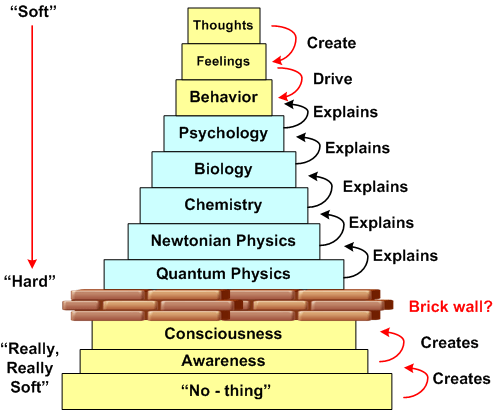
Because quantum theory butts up against consciousness, and they seem to be separated by an unexplainable brick wall, Kuttner and Rosenblum explore the seemingly mysterious connection between them in their book. As they say, “when experts don’t agree, you can pick your own expert to believe in“.
Thinking Your Way To Enlightenment
Virtually every spiritual teacher that I know has stated that you can’t “think” your way to enlightenment. I consider myself a heavy thinkaholic and because of my personal experience I know that they’re right. I’ve tried to think my way into an enlightened and awakened state so hard, so many times, that the effort has led to the exact opposite result of what I intended. Reading, viewing, and listening to spiritual material can get you to the bus stop of awakening, but it doesn’t guarantee that the bus will arrive on time. It doesn’t even guarantee that the bus will arrive at all.
So, what’s a thinkaholic who wants to discover his/her true root of being supposed to do? You can’t stop thinking because, like flying is innate to birds, thinking is innate to the human condition. Thus, I’m stuck in an endless repetitive cycle of gathering more and more thought-based spiritual knowledge even though I know that it doesn’t work.
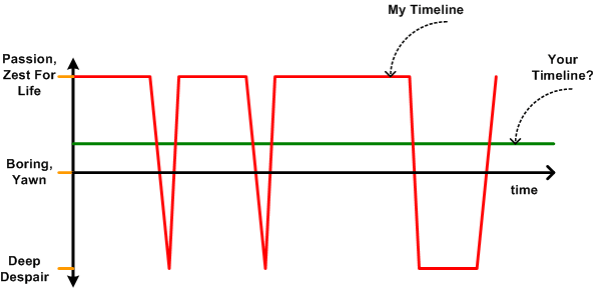
Flatliner?
Given a choice, which trajectory would you select? If neither, what would your preferred trajectory be?
Past Present Future
How do you “allocate” your thinking time? Do you spend the largest percentage of your time fearing the future? Regretting the past? Constantly switching between worrying about the future and regretting the past? Experiencing and feeling the wonders that are happening in the present moment?

Let’s say that you are self-aware enough to realize that your thinking state is dominated by circular rumination over what has happened in the past. What techniques/practices can one employ to redirect more of your thinking time to the present moment? Can one actually “control” their thinking state?
In my case, I tend to spend most of my “thinking time” regretting the past and missing out on the grace and glory of the present moment. In the cases where I do recognize that I’m continuously spinning on the stale past, just the act of “thought recognition” brings me back into the present moment. However, just as soon as I transition into the present moment, I unconsciously switch out of that tranquil state and go back to the same old, same old. I’ve made, and continue to make, many half-assed attempts at meditation in order to spend more time in the present moment, but I’ve frustrated myself out of diligently practicing this ancient art of self-actualization.
Too Late!
As a result of studying the works of many spiritual teachers , I try hard to be consciously aware of my thoughts as they occur in real-time. I try to be simultaneously both the observer and the observee. However, I’m always too late in recognizing self-defeating behaviors triggered by negative thoughts. I have a negative thought, spout out some toxic verbal diarrhea , and then recognize my stupidity after the fact. It almost seems like I’d be better off if I stayed blissfully unconscious and unaware of my thoughts and behavior.
Internal thoughts produce internal feelings, and internal feelings drive external behavior. You can’t control which thoughts magically appear in your head, but if you’re vigilantly aware and awake, you can consciously choose to let hurtful thoughts naturally float away without taking action. The more ego-dominated you are, the less likely you are to release the negative thoughts and preempt stupid behavior. Having said that, I realize that I’m totally dominated by ego. How about you?
Battle Of The Blahs

Awareness, pure consciousness, egoless, no self, spirit, god, the peace that passeth all understanding, universal energy, eternal essence, eternal bliss, universal intelligence, mind, formless energy….. (add your own favorite word or phrase here).
All these words and phrases point to the same thing (or no-thing?) and attempt to describe what’s indescribable via words or thoughts. People argue endlessly over which is “right” or “correct” and miss the whole purpose of using them to communicate. It reminds me of the famous spiritual (Buddhist?) saying that goes something like this: “I’m pointing at the moon but you’re looking at my finger.”
As E. Tolle has said: “The analysis of pointers is pointless.”
What’s your favorite word or phrase that describes the indescribable?
A Shift In Perspective
At birth, everyone is egoless. We are pure awareness, a manifestation of universal consciousness. We have no agenda and no desire to make ourselves look good at the expense of others. We don’t get into zero-sum games and our outer purpose is directly synchronized with our inner purpose. When we get labeled with a name, start accumulating “credentials” and “expertise”, and we begin to internalize the human-made concepts of “I” and “me”, our heads expand in order to accommodate ego growth. As ego expands, consciousness contracts and we lose touch of the infinite source of energy that comprises our inner core. Our behaviors and actions become increasingly dominated by the artificial need to selfishly accumulate “things out there” and consume way more than we need. How do I know this? Because like you, I’m a perfect example of ego-domination. Give “me” more, “I” need more, it’s all about “me”, “I’m” smarter than “you”, “I’m” better looking than “you”, “I” have more and nicer things than “you”, “you” should want to be like “me”, to hell with “you” and to heaven with “me”. Duality and separation settle in.

As the lower graph in the above figure shows, some people may, by an unknown and humanly-uncontrollable act of grace, experience a shift in perspective at some point in their lives. The ego starts to deflate, consciousness starts rising, and the artificial mode of good/bad, dual thinking starts dissolving. For some people, the slope of the ego curve instantaneously flips to negative infinity at the point of transition and an “epiphany” occurs. Jill Bolte Taylor, Eckhart Tolle, Byron Katie, Sydney Banks, and the Buddha come to mind as examples of people who’ve experienced epiphanies.
Becoming aware that one is ego-dominated is not enough to trigger a transformation back to our true nature and a realignment of our outer purpose with our inner purpose. How do I know this? Because I’m aware of the fact that I’m dominated by the constraining, finite, and toxic force of the ego. The ego is brilliant in that it can argue with anything at any time and rationalize any action, no matter how horrendous the end result is.
So here “I” am, recognizing the fact that I’m a slave to “my” ego and hoping that an instantaneous shift in perspective will happen to “me”. Since I don’t have a clue on how to trigger the shift, I’m on a constant intellectual search for enlightenment. However, feverishly accumulating intellectual understanding is not the way to realize and experience “the peace that passeth ALL understanding”. Bummer.
Lost In Thought
The Space Between Thoughts
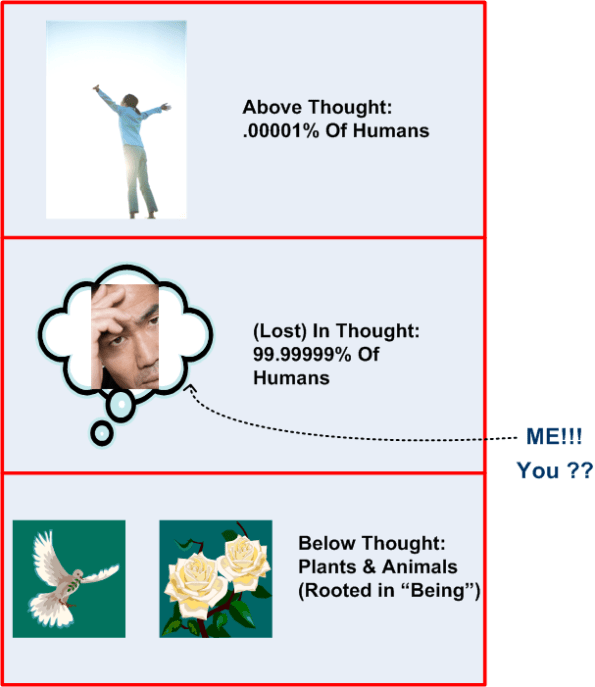
Bing, bing bing. One thought after another arises out of somewhere (do you know where?) and manifests as an image or string of associated words in our head. Where do thoughts come from, and why does someone think the specific thoughts that they do? What determines the frequency of thought production? Is it good to be engulfed in a state of high frequency thought production? How is wisdom related to thinking?
As the figure below shows, I think that wisdom arises out of the space between thoughts. If you agree with me, then being ensconced in a high rate of thought production is in general, not a good thing. There’s no time for wisdom to shine through the continuous train of thought.

How does one lower the frequency of thought so that we can experience wisdom? I think that we can lower the frequency and create holes to appear in the thought train by not attaching any emotion to each thought. Since we’re human, we all attach meaning to each thought and we experience the feeling that accompanies the thought. If we don’t amplify that feeling into a personal emotion, we perform a 180 degree turn and look inward at our true nature . We then experience what we really are at our core – the pure awareness; the nothingness out of which all objects are created. The glorious process of creation itself.
Wisdom is not intellectual understanding, it’s experiencing/realizing. It’s “the peace that passeth all understanding”. By creating gaps in our thought train, we give ourselves opportunities for wisdom to arise.
Filtering And Distortion
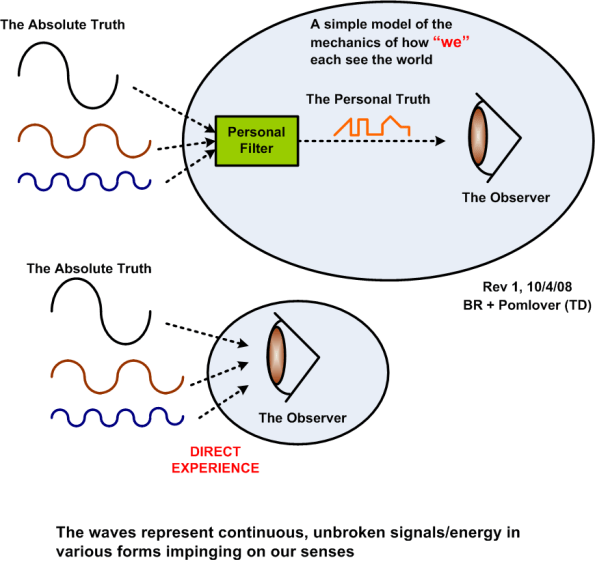
Virtually everyone sees “life” as an integrated, filtered, and distorted stream of continuous analog input. Each filter is person-specific and tends to get narrower as we supposedly grow-up. The designer of the filter is the personal ego and if you’re not aware of this, it can severely degrade and limit your experience of life. My goal is to remove my personal filter so that I can experience the glorious full spectrum of life. I may not attain this goal, but I’m going to try to achieve it until my last breath. Please wish me luck.

Why am I here?
WTF?
Meh!
D'oh!

My BTC Address



 Bulldozer00's Blog