Archive
Background Daemons
Assume that you have to build a distributed real-time system where your continuously communicating application components must run 24×7 on multiple processor nodes netted together over a local area network. In order to save development time and shield your programmers from the arcane coding details of setting up and monitoring many inter-component communication channels, you decide to investigate pre-written communication packages for inclusion into your product. After all, why would you want your programmers wasting company dollars developing non-application layer software that experts with decades of battle-hardened experience have already created?
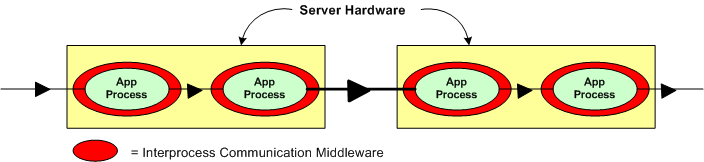
Now, assume that the figure below represents a two node portion of your many-node product where a distributed architecture middleware package has been linked (statically or dynamically) into each of your application components. By distributed architecture, I mean that the middleware doesn’t require any single point-of-failure daemons running in the background on each node.
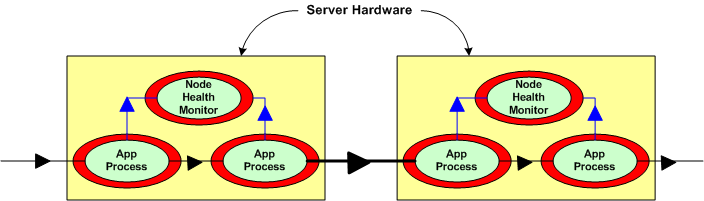
Next, assume that to increase reliability, your system design requires an application layer health monitor component running on each node as in the figure below. Since there are no daemons in the middleware architecture that can crash a node even when all the application components on that node are running flawlessly, the overall system architecture is more reliable than a daemon-based one; dontcha think? In both distributed and daemon-based architectures, a single application process crash may or may not bring down the system; the effect of failure is application-specific and not related to the middleware architecture.
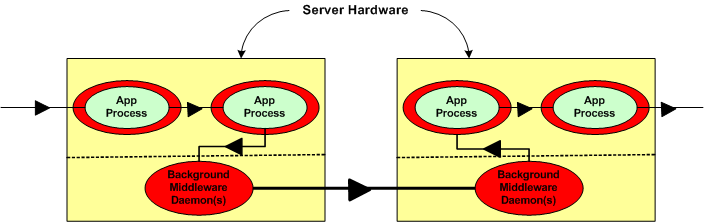
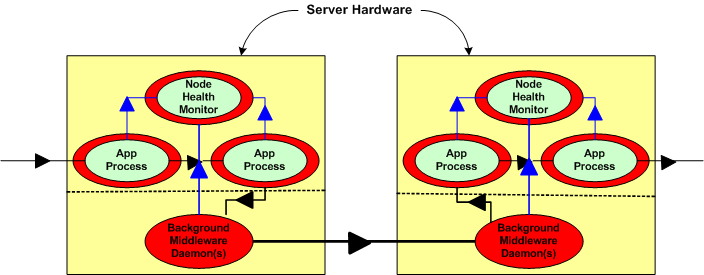
The two figures below represent a daemon-based alternative to the truly distributed design previously discussed. Note the added latency in the communication path between nodes introduced by the required insertion of two daemons between the application layer communication endpoints. Also note in the second figure that each “Node Health Monitor” now has to include “daemon aware” functionality that monitors daemon state in addition to the co-resident application components. All other things being equal (which they rarely are), which architecture would you choose for a system with high availability and low latency requirements? Can you see any benefits of choosing the daemon-based middleware package over a truly distributed alternative?
The most reliable part in a system is the one that is not there – because it isn’t needed.
What The Hell’s A Unit?
- CSCI = Computer Software Configuration Item
- CSC = Computer Software Component
- CSU = Computer Software Unit
In my industry (aerospace and defense), we use the abstract, programming-language-independent terms CSCI, CSC, and CSU as a means for organizing and conversing about software architectures and designs. The terms go way back, and I think (but am not sure) that someone in the Department Of Defense originally conjured them up.
The SysML diagram below models the semantic relationships between these “formal” terms. An application “contains” one or more CSCIs, each of which which contains one or more CSCs, each of which contains one or more CSUs. If we wanted to go one level higher, we could say that a “system” contains one or more Applications.
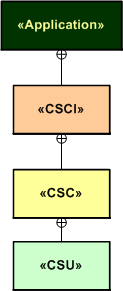
In my experience, the CSCI-CSC-CSU tree is almost never defined and recorded for downstream reference at project start. Nor is it evolved or built-up as the project progresses. The lack of explicit definition of the CSCs and, especially the CSUs, has often been a continuous source of ambiguity, confusion, and mis-communication within and between product development teams.
“The biggest problem in communication is the illusion that it has taken place.” – George Bernard Shaw.
A consequence of not classifying an application down to the CSU level is the classic “what the hell’s a unit?” problem. If your system is defined as just a collection of CSCIs comprised of hundreds of thousands of lines of source code and the identification of CSCs and CSUs is left to chance, then a whole CSCI can be literally considered a “unit” and you only have one unit test per CSCI to run (LOL!)
In preparation for an idea that follows, check out the language-specific taxonomies that I made up (I like to make stuff up so people can rip it to shreds) for complex C++ and Java applications below. If your app is comprised of a single, simple process without any threads or tasks (like they teach in school and intro-programming books), mentally remove the process and thread levels from the diagram. Then just plop the Application level right on top of the C++ namespace and/or the Java package levels.

To solve, or at least ameliorate the “what the hell’s a unit?” problem, I gently propose the consideration of the following concrete-to-abstract mappings for programs written in C++ and Java. In both languages, each process in an application “is a” CSCI and each thread within a process “is a” CSC. A CSU “is a” namespace (in C++) or a package (in Java).
I think that adopting a map such as this to use as a standard communication tool would lead to fewer mis-communications between and among development team members and, more importantly, between developer orgs and customer orgs that require design artifacts to employ the CSCI/CSC/CSU terminology.


As just stated, the BD00 proposal maps a C++ namespace or a java package into the lowest level element of abstract organization – the CSU. If that level of granularity is too coarse, then a class, or even a class member function (method in Java), can be designated as a CSU (as shown below). The point is that each company’s software development organization should pick one definition and use it consistently on all their projects. Then everyone would have a chance of speaking a common language and no one would be asking, “what the hell’s a freakin’ unit?“.

So, “What the hell’s a unit?” in your org? A member function? A class? A namespace? A thread? A process? An application? A system?

Why am I here?
WTF?
Meh!
D'oh!

My BTC Address



 Bulldozer00's Blog
