Archive
Ultimately And Unsurprisingly
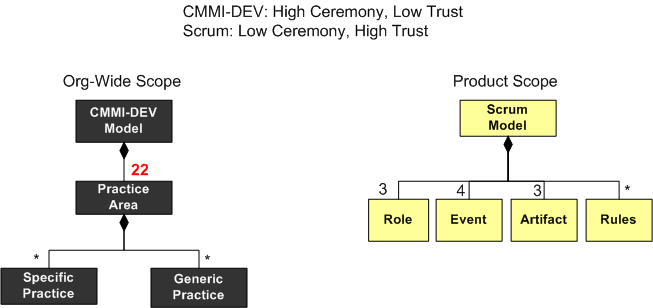
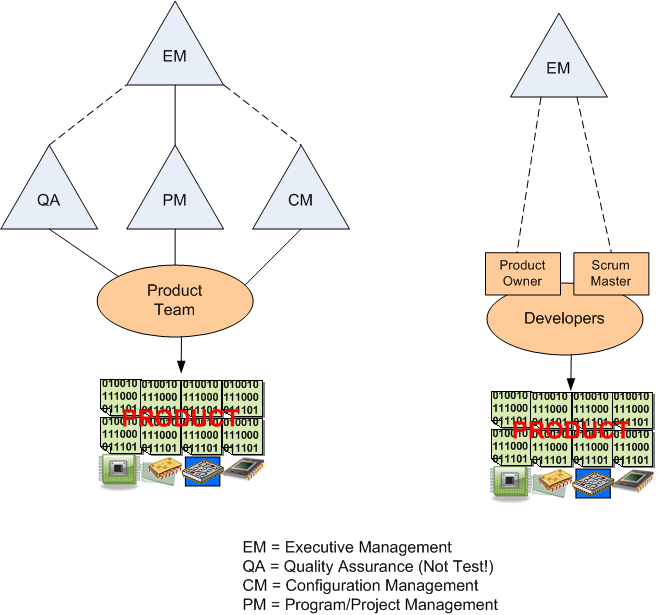
Take a look at the latest, dorky, BD00 diagram below. The process model on the left is derived from the meaty, 482 page CMMI-DEV SEI Technical Report. The model on the right is derived from the lean, 16 page Scrum Guide.
Comparing CMMI-DEV and Scrum may seem like comparing apples to oranges, but it’s my blog and I can write (almost) whatever I want on it, no?
Don’t write what you know, write what you want to know – Jerry Weinberg
The overarching purpose of both process frameworks is to help orgs develop and sustain complex products. As you can deduce, the two approaches for achieving that purpose appear to be radically different.
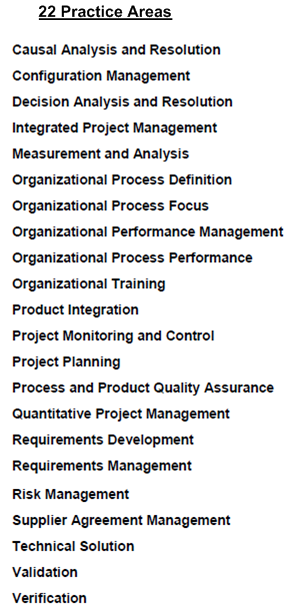
The CMMI-DEV model is comprised of 22 practice areas, each of which has a number of specific and generic practices. Goodly or badly, note that the word “practice” dominates the CMMI-DEV model.
Unlike the “practice” dominated CMMI-DEV model, the Scrum model elements are diverse. Scrum’s first class citizens are roles (people!), events, artifacts, and the rules of the game that integrate these elements into a coherent socio-technical system. In Scrum, as long as the rules of the game are satisfied, no practice is off limits for inclusion into the framework. However, the genius inclusion of time limits for each of Scrum’s 4 event types implicitly discourages heavyweight practices from being adopted by Scrum implementers and practitioners.
Of course, following either model or some hybrid combo can lead to product quality/time/budget success or failure. Aficionados on both sides of the fence publicly tout their successes and either downplay their failures (“they didn’t understand or really follow the process!“) or they ignore them outright. As everyone knows, there are just too many freakin’ metaphysical factors involved in a complex product development effort. Ultimately and unsurprisingly, success or failure comes down to the quality of the people participating in the game – and a lot of luck. Yawn.
Hurry! Hurry!
Lots of smart and sincere software development folks like Ron Jeffries, Jim Coplien, Scott Ambler, Bob Marshall, Adam Yuret, etc. have recently been lamenting the dumbing-down and commercialization of the “agile” brand. Since I get e-mails like the one below on a regular basis, I can deeply relate to their misery.

Hurry! Hurry! After just 2 days of effort and a measly 1300 beaners of “investment“, you’ll be fully prepared to lead your next software development project into the promised land of “under budget, on schedule, exceeds expectations“.
Whoo Hoo! My new SCRUM Master certificate is here! My new SCRUM Master certificate is here!

Scrum Cheat Sheet
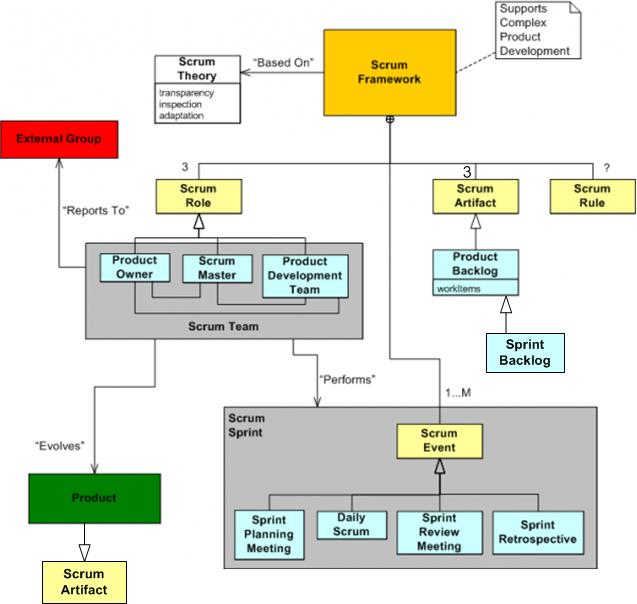
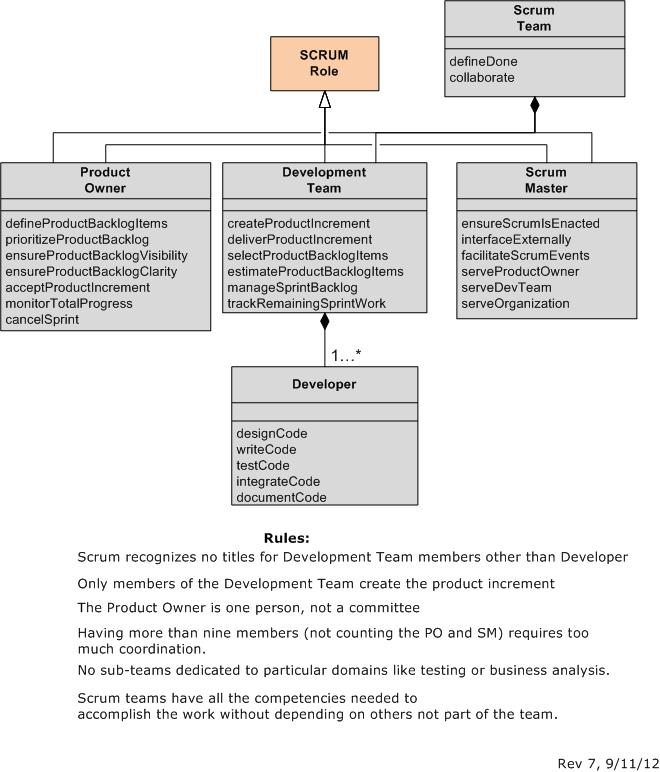
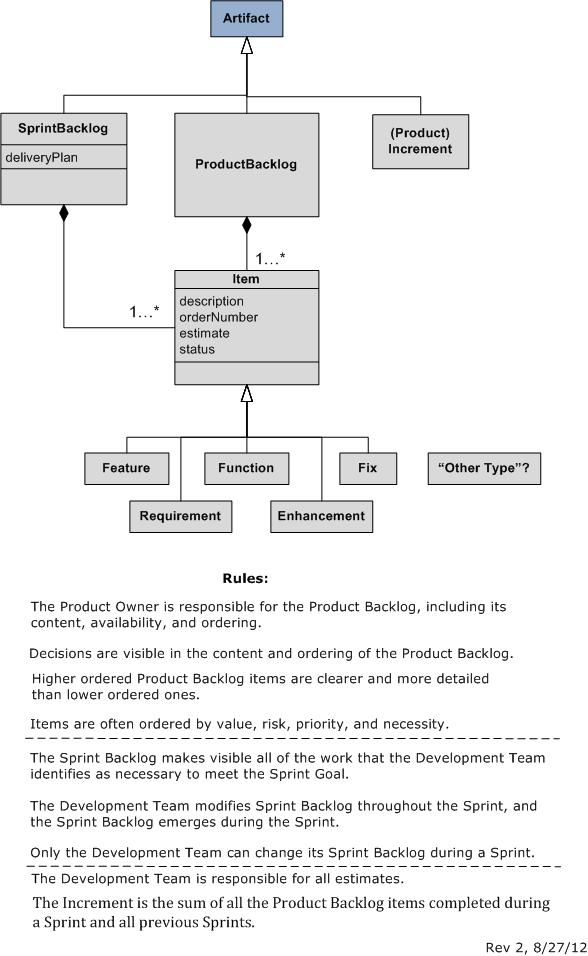
While reading Schwaber and Sutherland’s official Scrum Guide, I decided to concoct a graphical UML-heavy cheat sheet of the monstrously famous agile framework.
Scrum Framework Components
System Class Diagram
Scrum Roles
Scrum Events

Scrum Artifacts
Marginalizing The Middle
Because they unshackle development teams from heavyweight, risk-averse, plan-drenched, control-obsessed processes promoted by little PWCE Hitlers and they increase the degrees of freedom available to development teams, agile methods and mindsets are clearly appealing to the nerds in the trenches. However, in product domains that require the development of safety-critical, real-time systems composed of custom software AND custom hardware components, the risk of agile failure is much greater than traditional IT system development – from which “agile” was born. Thus, a boatload of questions come to mind and my head starts to hurt when I think of the org-wide social issues associated with attempting to apply agile methods in this foreign context:
Will the Quality Assurance and Configuration Management specialty groups, whose whole identity is invested in approving a myriad of documents through complicated submittal protocols and policing compliance to existing heavyweight policies/processes/procedures become fearful obstructionists because of their reduced importance?
Will penny-watching, untrusting executives who are used to scrutinizing planned-vs-actual schedules and costs in massive Microsoft Project and Excel files via EVM (Earned Value Management) feel a loss of importance and control?
Will rigorously trained, PMI-indoctrinated project managers feel marginalized by new, radically different roles like “Scrum Master“?
Note: I have not read the oxymoronic-titled “Integrating CMMI and Agile Development” book yet. If anyone has, does it address these ever so important, deep seated, social issues? Besides successes, does it present any case studies in failure?
… there is nothing more difficult to carry out, nor more doubtful of success, nor more dangerous to handle, than to initiate a new order of things. For the reformer makes enemies of all those who profit by the old order, and only lukewarm defenders in all those who would profit by the new order… – Niccolo Machiavelli
Scrumming For Dollars
“Systems Engineering with SysML/UML” author Tim Weilkiens recently tweeted:

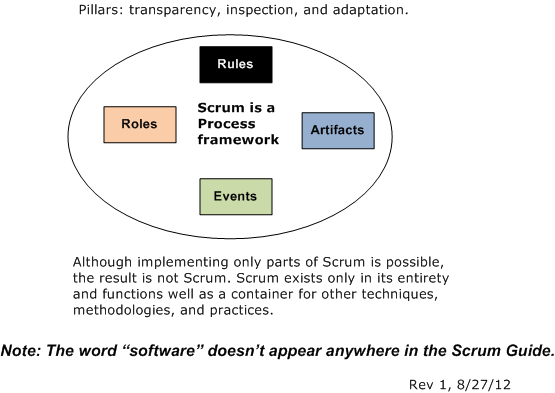
Tim’s right. Check it out yourself: Scrum Guide – 2011.
Before Tim’s tweet, I didn’t know that “software” wasn’t mentioned in the guide. Initially, I was surprised, but upon further reflection, the tactic makes sense. Scrum creators Ken Schwaber and Jeff Sutherland intentionally left it out because they want to maximize the market for their consulting and training services. Good for them.
As a byproduct of synthesizing this post, I hacked together a UML class diagram of the Scrum system and I wanted to share it. Whatcha think? A useful model? Errors, omissions? Does it look like Scrum can be applied to the development of non-software products?

The Elephants In The Room
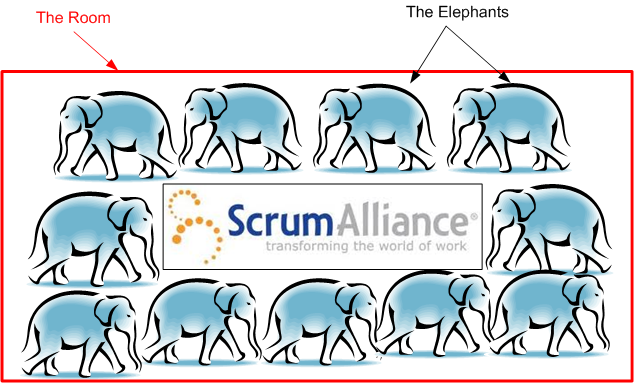
One of the originators of RUP and the creator of the 4+1 view modeling approach, Phillippe Kruchten, has written a terrific article on the “twenty elephants in the room” that haunt the agile movement. Here’s a subset of his infamous list that resonates with me:
- Commercial interests censoring failures (tell me about the failures).
- Failure to dampen negative behaviours (no analysis of failures).
- Context and contextual applicability of practices (can you say “safety-critical systems“?)
- Anarchism (preventing a more systematic organization of the body of knowledge).
- Elitism (blame failure on the “unenlightened” others)
- Certification (effective tool to assess maturity for individuals and organization, or commercial ploy from trainers and consultants to rake in the dough?)
- Role of architecture and design (they are still often equated to BUFD, and rapidly brushed aside with claims of YAGNI, or “we’ll refactor it later”)
- Scaling naïveté (with a bit of imagination all agile practices scale up, and if this does not work it is because you have not tried hard enough).
- Technical debt (while agile practices could help control technical debt, they are also often at the root, the cause of massive technical debt).
- Effective ways of discovering information without writing source code (uh, can you say “modeling“?).
Of course, because of his involvement in the development of the perceived horrible, heavyweight, RUP process, extreme agilistas will not even listen to Phillippe’s ideas – let alone ponder the validity of any of them.

Why am I here?
WTF?
Meh!
D'oh!

My BTC Address



 Bulldozer00's Blog