Archive
More Effective Than, But Not As Scalable As
If you feel you have something to offer the world, the best way to expose and share your ideas/experiences/opinions/knowledge/wisdom is to release it from lock down in your mind and do the work necessary to get it into physical form. Write it down, or draw it up, or record it. Then propagate it out into the wild blue yonder through the greatest global communication system yet known to mankind: the internet.
You are not personally scalable, but because of the power of the internet, the artifacts you create are. Fuggedabout whether anybody will pay attention to what you create, manifest, and share. Birth it and give it the possibility to grow and prosper. Perhaps no one’s eyeballs or ears other than yours will ever come face to face with your creations, but your children will be patiently waiting for any and all adopters that happen to come along.
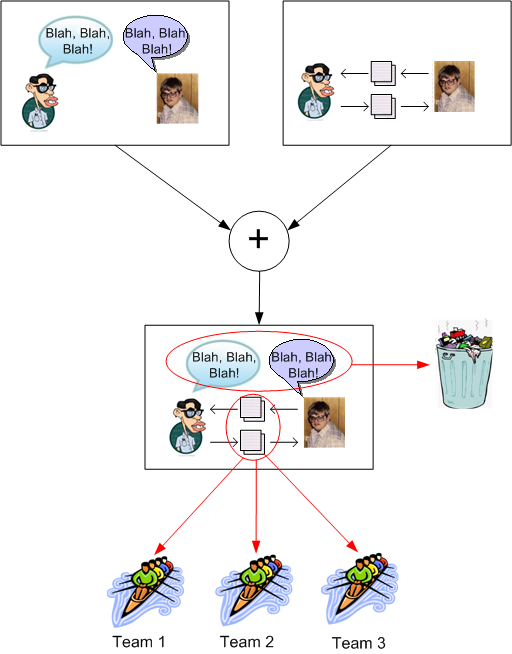
The agilista community is fond of trashing the “traditional” artifact-exchange method of communication and extolling the virtues of the effectiveness of close proximity, face-to-face, verbal exchange. Alistair Cockburn even has some study-backed curves that bolster the claim. BD00 fully agrees with the “effectiveness” argument, but just like the source code is not the whole truth, face-to-face communication is not the whole story. As noted in the previous paragraph, a personal conversation is not scalable.
Face to face, verbal communication may be more effective than artifact exchange, but it’s ephemeral, not archive-able, and not nearly as scalable. And no half-assed scribblings on napkins, envelopes, toilet paper, nor index cards solve those shortcomings on anything but trivial technical problems.
Scalability: The Next Buzzword
Since I’m currently in the process of trying to help a team re-design an existing software-intensive system to be more scalable, the title of this book caught my eye:
It’s just my opinion (and you know what “they” say about opinions) but stay away from this stinker. All the authors want to do is to jump on the latest buzzword of “scalability” and make tons of money without helping anybody but themselves.
Check this self-serving advertisement out:
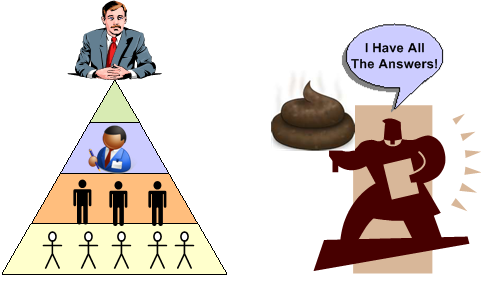
“The Art of Scalability addresses these issues by arming executives, engineering managers, engineers, and architects with models and approaches to scale their technology architectures, fix their processes, and structure their organizations to keep “scaling” problems from affecting their business and to fix these problems rapidly should they occur.”
Notice how they try to cover the entire hierarchical corpo gamut from bozo managers at the peak of the pyramid down to the dweebs in the cellar to maximize the return on their investment. Blech and hawk-tooey.
 BTW, I actually did waste my time by reading the first BS chapter. The rest of the book my be a Godsend, but I’m not about to invest my time trying to figure out if it is.

Why am I here?
WTF?
Meh!
D'oh!

My BTC Address



 Bulldozer00's Blog