Archive
Complexity Explosion
I’m in the process of writing a C++ program that will synthesize and inject simulated inputs into an algorithm that we need to test for viability before including it in one of our products. I’ve got over 1000 lines of code written so far, and about another 1000 to go before I can actually use it to run tests on the algorithm. Currently, the program requires 16 multi-valued control inputs to be specified by the user prior to running the simulation. The inputs define the characteristics of the simulated input stream that will be synthesized.
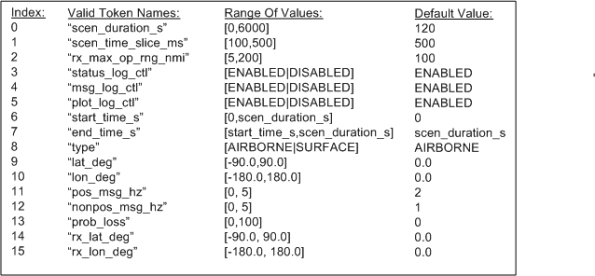
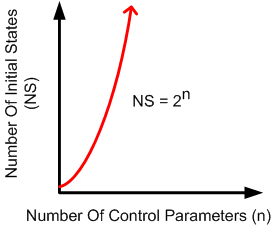
Even though most of the control parameters are multi-valued, assume that they are all binary-valued and can be set to either “ON” or “OFF” . It then follows that there are 2**16 = 65536 possible starting program states. When (not if) I need to add another control parameter to increase functionality, the number of states will soar to 131,072, if, and only if, the new parameter is not multi-valued. D’oh! OMG! Holy shee-ite!
Is it possible to setup the program, run the program, and evaluate its generated outputs against its inputs for each of these initial input scenarios? Never say never, but it’s not economically viable. Even if the setup and run activities can be “automated”, manually calculating the expected outputs and comparing the actual outputs against the expected outputs for each starting state is impractical. I’d need to write another program to test the program, and then write another program to test the program that tests the program that tests the first program. This recursion would go on indefinitely and errors can be made at any step of the way. Bummer.
No matter what the “experts” who don’t have to do the work themselves have to say, in programming situations like this, you can’t “automate” away the need for human thought and decision making. Based on knowledge, experience, and more importantly, fallible intuition, I have to judiciously select a handful of the 65536 starting states to run. I then have to manually calculate the outputs for each of these scenarios, which is impractical and error-prone because the state machine algorithm that processes the inputs is relatively dense and complicated itself. What I’m planning to do is visually and qualitatively scan the recorded outputs of each program run for a select few of the 65536 states that I “feel” are important. I’ll intuitively analyze the results for anomalies in relation to the 16 chosen control input values.
Got a better way that’s “practical”? I’m all ears, except for a big nose and a bald head.
“Nothing is impossible for the man who doesn’t have to do it himself.” – A. H. Weiler

Why am I here?
WTF?
Meh!
D'oh!

My BTC Address



 Bulldozer00's Blog