Archive
Rising Inequity
While stumbling along the jagged trail of life, I tripped over this FastCompany.com post: Infographic of the Day: 15 Facts About America’s Income Inequality.
For instance, did you know that the average CEO’s pay is 1,039 times more generous than that of the average worker? And it’s not as if we’ve always lived that way. Forty years ago, CEOs were only being paid 39 times that of the average worker. Some companies these days are tying CEO pay to the pay of the least compensated employee at the same company. Clearly not that many.

And though GDP has risen, wages have remained stagnant (except for those CEOs), which has contributed to the top 10% of the wealthiest Americans controlling nearly three-quarters of all the money in America.
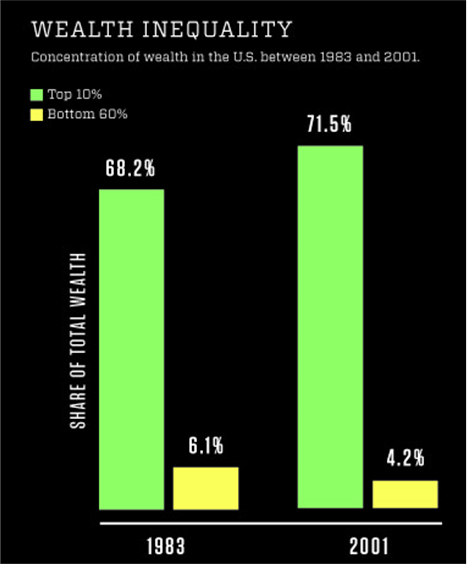
Note that over the decades between the inequity measurements, control of the federal government has flip-flopped back and forth between the democratic and the republican parties. So much for blaming one side over the other. The only equity in this post is that both parties are equally inept at running the country, no?
It doesn’t have to be yours, of course, but BD00’s opinion is that no matter what type of “ism” system of governance is used to tie people together, when some critical threshold of top-to-bottom inequity is exceeded, a revolution by the governees against the governors is sure to follow. In the grand ole USA, do you think we are close to the precipice?
Sarcastic Epiphany
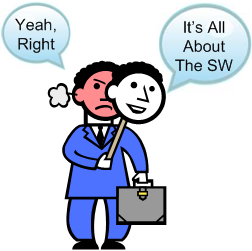
During a multi-technology product development project that I worked on in the past, a non-software engineer stated: “it’s all about the software“. When I heard this, I temporarily entered a dream world where the sky is pink. I thought: “this dude gets it – she’s had the epiphany“. A millisecond later, I exited my delusion and returned to the world where the sky is blue (this one?). That initial, self-serving thought was quickly replaced by: “she said that sarcastically“. D’oh!
Increased Cost And Increased Time
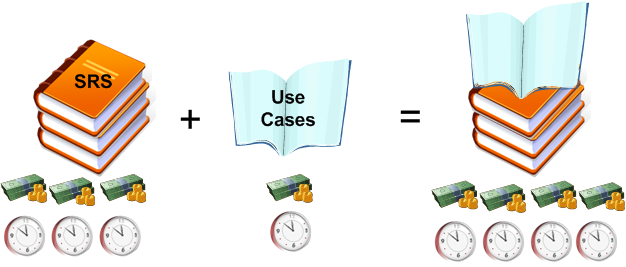
Before the invention of the formal “Use Case“, and the less formal “User Story“, the classic way of integrating, structuring, and recording requirements was via the super-formal Software Requirements Specification (SRS). Like “agile” was a backlash against “waterfall“, the lightweight “Use Case” was a major diss against the heavyweight “SRS“.
However, instead of replacing SRSs with Use Cases, I surmise that many companies have shot themselves in the foot by requiring the expensive and time consuming generation and maintenance of both types of artifacts. Instead of decreasing the cost/time and increasing the quality of the requirements engineering process, they most likely have done the opposite – losing ground to smarter competitors who do one or the other effectively. D’oh! Is your company one of them?
No Obvious Deficiencies
While perusing my favorite quotes page for blog post seedlings, this one spoke to me:
“There are two ways of constructing a software design: One way is to make it so simple that there are obviously no deficiencies, and the other way is to make it so complicated that there are no obvious deficiencies. The first method is far more difficult.” – C.A.R. Hoare.
Being the mangler, distorter, and exaggerator that I am, here’s my version:
“There are two ways of camouflaging crappy work: One way is to present it so simply that there are no obvious deficiencies, and the other way is to make the presentation so complicated that there are no obvious deficiencies. Both ways are equally effective.” – C.A.R. Hoare + Bulldozer00.

Idioticon
When I first saw the word “idioticon“, I thought it was a concatenation of the two words “idiot” and “icon“. You know, something like this:

Here’s what it really means:

The fine folks at Triarchy Press have started writing an online idioticon of systems thinking ideas. The first two fascinating entries are titled “The Edge of Chaos” and “The Accursed Share“. Go check them out.

Purpose And Maturity
The purpose of life is to fight maturity – Dick Werthimer
Being a quote lover, the above one-liner somehow keeps popping into my head. After reflecting upon why it auto-magically keeps manifesting within the consciousness that is “me“, I think I’ve figured out why. It’s because I don’t have to “fight” to stay immature. I’ve been blessed (cursed?) with an uncanny talent for remaining immature without having to expend any energy whatsoever. How do I know this? Because people tell me. D’oh!

What about you, what’s your story? Are you prim and proper at all times; a paragon of virtue and impeccable integrity; a shining example for the world to emulate? If so, then why – and doesn’t it sap the life out of you like Mr. Werthimer suggests?
Ambivalence
Prominent and presidentially decorated software process guru Watts Humphrey passed away last year. Over the years, I’ve read a lot of his work and I’ve always been ambivalent towards his ideas and methods. On the one hand, I think he’s got it right when he says Peter-Drucker-derived things like:
Since managers don’t and can’t know what knowledge workers do, they can’t manage knowledge workers. Thus, knowledge workers must manage themselves.
On the other hand, I’m turned off when he starts promoting his arcane and overly-pedantic TSP–PSP methodology. To me, his heavy, right wing measurement and prescriptive planning methods are an accountant’s dream and an undue burden on left leaning software development teams. Also, in at least his final two books, he targets his expert TSP-PSP way at “executives, senior managers, coaches and team leaders” while implying that knowledge workers are “them” in the familiar, dysfunctional “us vs. them” binary mindset (that I suffer from too).
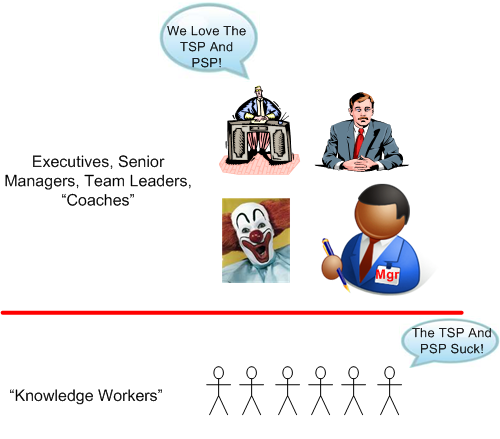 I really want to like Watts and his CMMI, TSP-PSP babies, but I just can’t – at least at the moment. How about you? It would be kool if I received a bunch of answers from a mixture of managers and “knowledge workers“. However, since this blog is read by about 10 people and I have no idea whether they’re knowledge workers or managers or if they even heard of TSP-PSP or Watts Humphrey, I most likely won’t get any. 🙂
Doing More With Less
Zappos.com core value number 8 is: “Do more with less“. Assume that you miraculously experience an epiphany and eagerly subscribe to this noble value. Using the figure below as a reference, how would you go about increasing profits while simultaneously flattening the “Resource Consumption” trace? Can it be done in your org?

To Prevent Asking, Simply Don’t Ask
One of the dudes that I follow on Twitter is Don Harkey. His handle is “LeaderBook“, and he’s got a neat gig going on. When he tweets, it’s always a phrase or sentence from a book on leadership:

If you have a culture where your employees don’t even think about asking for, let alone actually asking for, a projector, a white board, a second computer monitor, a professional membership, a training class, or (heaven forbid) a tool that costs money, you get what you deserve.
So, how do you get a culture of “non-asking“? It’s so easy it comes naturally. There’s no work required – and that’s a good thing for work-averse managers. All ya gotta do is “lead by example” by never asking your employees what they need to do their jobs better. To really discourage the practice of employees from asking for things to help them do their jobs better (because employees can’t be trusted and they’ll take advantage of your goodwill, of course), you can ensure that the acquisition process is an unknowable labyrinth littered with approvals required by bureaucratic little Hitlers. See, I said it was easy.
Required Pretentiousness
“We grow up being afraid of our own ignorance and terrified that our ignorance may show. Over time, we’re conditioned to appear as “knowledgeable” as we can, while carefully concealing the limits of our understanding.”
Does the above quote, snipped from Peter Ralston’s “The Book Of Not Knowing“, ring as true for you as it does for me? I think it’s one of the top reasons why I spend a lot of time trying to keep abreast of developments in my field and advancing my programming and design skills.
You see, I often feel uncomfortable when someone starts talking about a topic that I’m ignorant of. I used to (and still do, but much less frequently) “pretend” that I understood what was being said so that I wouldn’t appear “stupid“. Now, I rarely hesitate to say sentences like “you lost me in the dust” or “I have no idea what you’re talking about” – regardless of the social consequences. I’ve realized that “not knowing” is the natural state of being – which means that we can’t avoid dwelling in it no matter how hard we try. Trying to fight spending one second in the state of not knowing is as ludicrous as a bird trying not to fly or a fish trying not to swim. Fighting one’s natural state of being always has a cost; psychological, physical, or both.
“Pretending to know” is a full time activity in hierarchically structured organizations that work with, and create, non-physical knowledge. Since knowledge is king, the higher one moves up in a hierarchy, the more pressure one feels to delude oneself into omniscience (e.g. when was the last time you asked a question that a superior didn’t whip out an answer to?). This unnatural behavior is exacerbated by the fact that all members in a hierarchy are either conscious or unconscious co-conspirators in the comedy.
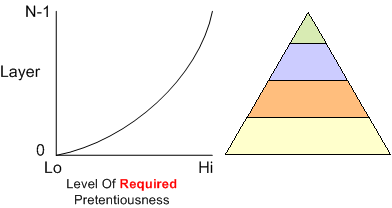
I’m a conscious and willing co-conspirator. How about you?

Why am I here?
WTF?
Meh!
D'oh!

My BTC Address



 Bulldozer00's Blog