Archive
Renunciation
I was listening to an Eckhart Tolle talk the other day (via an mp3 file deposited on a USB stick plugged into my new Subaru WRX audio system). He started talking about the key to inner peace. In order to prepare his audience for the bombshell he was about to launch, he asked them to “please don’t be shocked“. Eckhart then said, in his characteristically slow, deliberate, and relaxed tone, that the key to awakening and inner peace is….. the renunciation of thought. D’oh, and WTF?
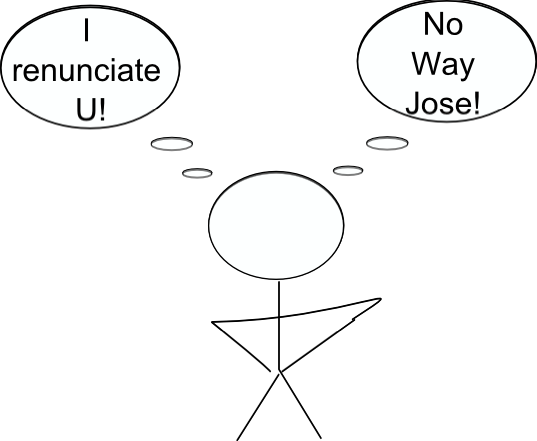
Years ago, when I was more lost than I am today, I would have thought that Mr. Tolle was a charlatan on the level of Jimmy Swaggart and Jim Bakker. Today, knowing what I know, but can’t express in words, I think he is wise. How about you? What do you think?
Note: I usually use Microsft Visio to generate the dorky diagrams on this blog. The pic in this post is my first one using the freely downloadable Inkscape package.
One Size Fits All
On Bjarne Stroustrup’s FAQ page, he state’s his opinion on the utility of object oriented programming:
The strength of OOP is that there are many problems that can be usefully expressed using class hierarchies – the main weakness of OOP is that too many people try to force too many problems into a hierarchical mould. Not every program should be object-oriented. As alternatives, consider plain classes, generic programming, and free-standing functions (as in math, C, and Fortran).
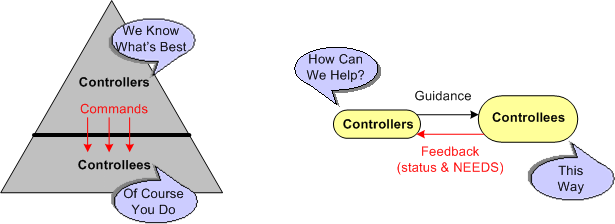
The same could be said of organizations of people, no? Of course, in a purposeful org of people and machines, the goal is to produce and distribute material wealth to all stakeholders: products/services to its customers and financial well-being to its employees and owners. Thus, some sort of controller-controllee structure is required to keep the org from deviating too far from its purpose. There are alternative structures to hierarchy but, as Bjarne sez, “too many people try to force too many problems into a hierarchical mould“. Bummer.
A Missing Core Value?
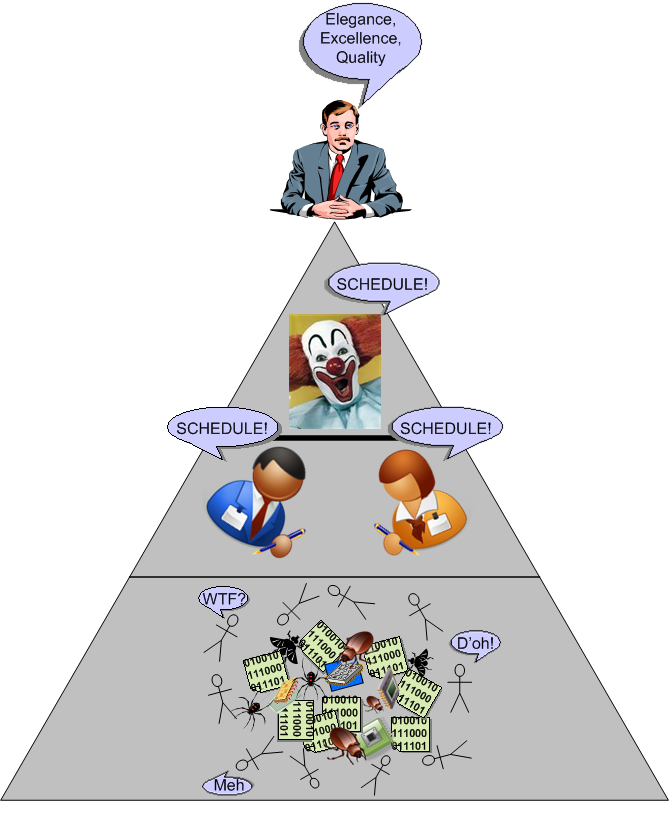
I’d venture to say that every technology company has phrases similar to “elegant products“, “technical excellence“, “innovative solutions“, and “quality first” smartly written in its mission and/or core values statements. I’d also venture to say that “schedule is king” is not explicitly inscribed in those WORN documents.
Regardless of what is espoused in their cutesy mission and core values statements, all mediocre and underperforming corpricracies operate day-to-day as if “schedule is king” is their top priority. How many times have you heard managers say the words “quality“, “elegance“, or “excellence” when discussing or reviewing a project? Now, how many times have you heard the word “schedule” uttered by managers?
If “quality“, “elegance“, or “excellence” are never mentioned because they’re “auto-assumed” to be present in all project endeavors, then why write them down? If “meeting schedule at all costs” is really what drives day-to-day behavior in the DYSCO, then why not write it down and put it at the top of the list?
Cool Text
Cool Text is a FREE graphics generator for web pages and anywhere else you need an impressive logo without a lot of design work. Simply choose what kind of image you would like. Then fill out a form and you’ll have your own custom image created on the fly.
Checkout what you can do at cooltext.com in the blink of an eye:

Learn To Estimate?
Item number 50 in “97 Things Every Programmer Should Know” is titled:

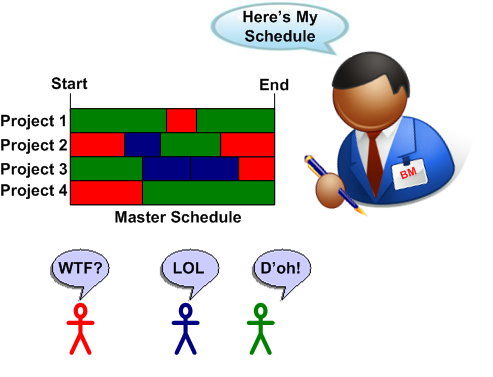
Since most schedules magically appear from the heavens without any input from below, why is there a need to learn how to estimate? If, by chance, schedule inputs ARE solicited from those who will do the work, they’re often ignored since heavenly commitments have already been made behind the scenes.
Zero Revenue, Zero Cost
Since my cafepress.com T-shirt shop, “The Frontal Assault Idiot“, opened to rave reviews earlier this month, the dough has been rolling in. Check out the orders report below (especially the notice in red) for the fiscal month of July 2011. LOL!

I guess I’ll have to bring in some hot shot consultants to help me get my expenses down and fend off my creditors. But wait! There are no expenses. I can stay in business. Whoo Hoo!

Botted?
I’ve been blogging for over 2 years now. Until a few days ago, the maximum number of hits that this blog had absorbed in one day was 149. On 07/29/11, my blogs stats chart zoomed to 291 hits:

After zeroing in on the July 29 date, I discovered that 231 of the hits came from Google:
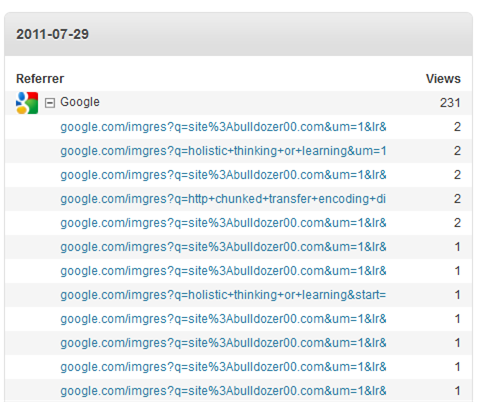
From looking at the content of the referral links, I’ve concluded that a google bot had crawled the site and extracted/stored a bunch of the dorky images that I post daily. Do you think that’s what happened?
Childlike Humility
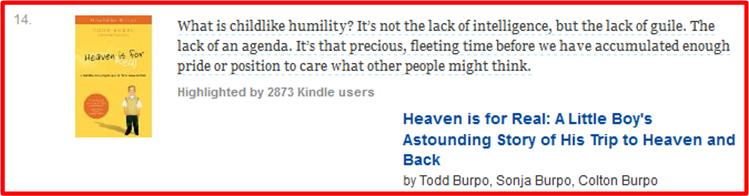
This quote from Amazon Kindle: Most Highlighted Passages of All Time really socked me in the jaw. Does it do anything for you?
“As-Built” Vs “Build-To”
The figure below shows one (way too common) approach for developing computer programs. From an “understanding” in your head, you just dive into the coding state and stay there until the program is “done“. When it finally is “done“: 1) you load the code into a reverse engineering tool, 2) press a button, and voila, 3) your program “As-Built” documentation is generated.
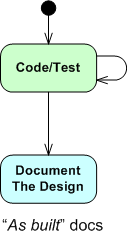
For trivial programs where you can hold the entire design in your head, this technique can be efficient and it can work quite well. However, for non-trivial programs, it can easily lead to unmaintainable BBoMs. The problem is that the design is “buried” in the code until after the fact – when it is finally exposed for scrutiny via the auto-generated “as-built” documentation.
With a dumb-ass reverse engineering tool that doesn’t “understand” context or what the pain points in a design are, the auto-generated documentation is often overly detailed, unintelligible, camouflage in which a reviewer/maintainer can’t see the forest for the trees. But hey, you can happily tick off the documentation item on your process checklist.
Two alternative, paygo types of development approaches are shown below. During development, the “build-to” design documentation and the code are cohesively produced manually. Only the important design constructs are recorded so that they aren’t buried in a mass of detail and they can be scrutinized/reviewed/error-corrected in real-time during development – not just after the fact.

I find that I learn more from the act of doing the documentation than from pushing an “auto-generate” button after the fact. During the effort, the documentation often speaks to me – “there’s something wrong with the design here, fix me“.
Design is an intimate act of communication between the creator and the created – Unknown
Of course, for developers, especially one dimensional extreme agilista types who have no desire to “do documentation” or learn UML, the emergence of reverse engineering tools has been a Godsend. Bummer for the programmer, the org he/she works for, the customer, and the code.
No Reflection
In “Seeing Your Company as a System“, uber systems thinker Russell Ackoff is quoted as saying:
“Experience is not the best teacher; it is not even a good teacher. It is too slow, too imprecise, and too ambiguous.” Organizations have to learn and adapt through experimentation, which he (Ackoff) said “is faster, more precise, and less ambiguous. We have to design systems which are managed experimentally, as opposed to experientially.” – Russell Ackoff
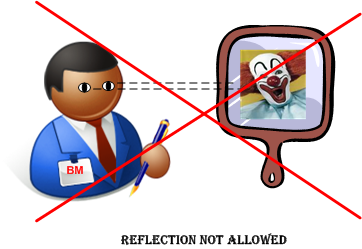
Judging whether an experiment is a success, failure, or something in between, requires the ability to pause and reflect on the results (or lack thereof) being achieved while the experiment is in operation.
In borgs run by self-perceived infallible popes, there is no experimentation and there is no reflection. Orders from above are assumed to be “right” and their execution is never perceived to be an experiment. They are undoubtedly based on an unquestioned, proven theory (usually Theory X) that’s underpinned by a set of rock solid axioms. If success doesn’t manifest as a result of carrying out papal orders, it’s auto-assumed to be the fault of the congregation, or (in less borgy institutions) mysterious supernatural forces beyond papal control. It’s unconscionable to think that the orders themselves were the cause of failure. Why? Because pauses during, and reflection after, execution are not allowed.

Why am I here?
WTF?
Meh!
D'oh!

My BTC Address



 Bulldozer00's Blog