Archive
Salesmen And Accountants
No one has ever failed to find the facts they are looking for. – Peter Drucker
Mr. Drucker may have gotten it wrong, at least in BD00’s case. It seems like the “facts” that I desperately need to continuously confirm my distorted world view come right up to me out of hiding and bite me in the bumpkiss. (If they don’t, I simply make some pseudo-facts up to feed the need).
Here’s one of the latest confirmations, and it’s in the form of another quote:
“It is difficult to get a man to understand something, when his salary depends upon his not understanding it.” – Upton Sinclair
Say what, you ask? That quote deftly closes this Forbes article written by “radical” Steve Denning: “Why Big Companies Die”.
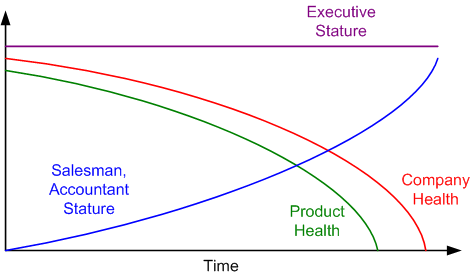
Quoting Steve Jobs on where salesmen come into play, and adding his own two cents on where accountants come into play, “rad” Steve describes an oft repeated pattern of corpo demise:
“The company does a great job, innovates and becomes a monopoly or close to it in some field, and then the quality of the product becomes less important. The company starts valuing the great salesman, because they’re the ones who can move the needle on revenues. So salesmen are put in charge, and product engineers and designers feel demoted: Their efforts are no longer at the white-hot center of the company’s daily life. They “turn off.”” – Steve Jobs
“The activities of these people (the accountants) further dispirit the creators, the product engineers and designers, and also crimp the firm’s ability to add value to its customers. But because the accountants appear to be adding to the firm’s short-term profitability, as a class they are also celebrated and well-rewarded, even as their activities systematically kill the firm’s future.” – Steve Denning
The dorky BD00 graph below attempts to map the above words onto an unscaled timeline.
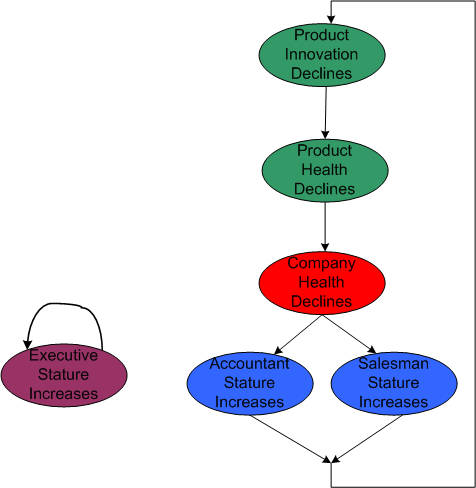
Or, if you prefer, here’s an alternative view of this unconscious pattern of demise:
Ambivalence
Prominent and presidentially decorated software process guru Watts Humphrey passed away last year. Over the years, I’ve read a lot of his work and I’ve always been ambivalent towards his ideas and methods. On the one hand, I think he’s got it right when he says Peter-Drucker-derived things like:
Since managers don’t and can’t know what knowledge workers do, they can’t manage knowledge workers. Thus, knowledge workers must manage themselves.
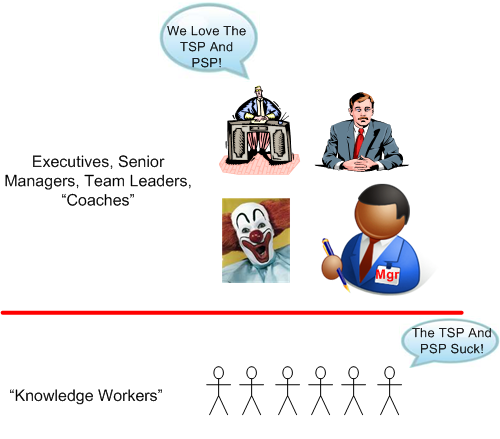
On the other hand, I’m turned off when he starts promoting his arcane and overly-pedantic TSP–PSP methodology. To me, his heavy, right wing measurement and prescriptive planning methods are an accountant’s dream and an undue burden on left leaning software development teams. Also, in at least his final two books, he targets his expert TSP-PSP way at “executives, senior managers, coaches and team leaders” while implying that knowledge workers are “them” in the familiar, dysfunctional “us vs. them” binary mindset (that I suffer from too).
 I really want to like Watts and his CMMI, TSP-PSP babies, but I just can’t – at least at the moment. How about you? It would be kool if I received a bunch of answers from a mixture of managers and “knowledge workers“. However, since this blog is read by about 10 people and I have no idea whether they’re knowledge workers or managers or if they even heard of TSP-PSP or Watts Humphrey, I most likely won’t get any. 🙂
Ineffective Immediately
“Ninety percent of what we call ‘management’ consists of making it difficult for people to get get things done” – Peter Drucker
If you believe this classic Drucker quote to be true, then whenever you receive an executive e-mail that contains the standard MBA textbook words “effective immediately”, mentally replace them with “ineffective immediately”. That way, you won’t be disappointed or surprised when your local work environment doesn’t change at all, or it changes for the worse.
To be fair, managers, like you and me, are just trying their best to make things better for all stakeholders. It’s just that they, for the most part (90% to be exact) have no clue on how to go about doing that.

Why am I here?
WTF?
Meh!
D'oh!

My BTC Address



 Bulldozer00's Blog