Archive
Ambivalence
Prominent and presidentially decorated software process guru Watts Humphrey passed away last year. Over the years, I’ve read a lot of his work and I’ve always been ambivalent towards his ideas and methods. On the one hand, I think he’s got it right when he says Peter-Drucker-derived things like:
Since managers don’t and can’t know what knowledge workers do, they can’t manage knowledge workers. Thus, knowledge workers must manage themselves.
On the other hand, I’m turned off when he starts promoting his arcane and overly-pedantic TSP–PSP methodology. To me, his heavy, right wing measurement and prescriptive planning methods are an accountant’s dream and an undue burden on left leaning software development teams. Also, in at least his final two books, he targets his expert TSP-PSP way at “executives, senior managers, coaches and team leaders” while implying that knowledge workers are “them” in the familiar, dysfunctional “us vs. them” binary mindset (that I suffer from too).
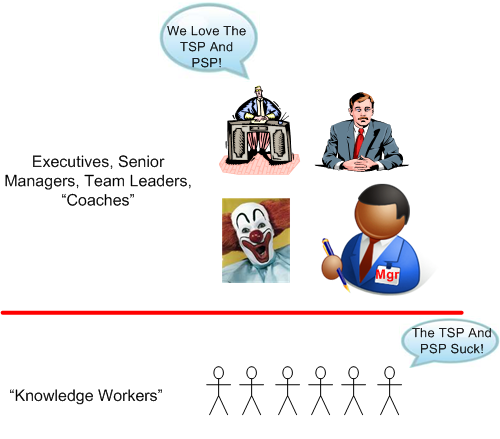 I really want to like Watts and his CMMI, TSP-PSP babies, but I just can’t – at least at the moment. How about you? It would be kool if I received a bunch of answers from a mixture of managers and “knowledge workers“. However, since this blog is read by about 10 people and I have no idea whether they’re knowledge workers or managers or if they even heard of TSP-PSP or Watts Humphrey, I most likely won’t get any. 🙂
Apples And Oranges
In “Leadership, Teamwork, and Trust“, Watts Humphrey and James Over build a case against the classic “Test To Remove Defects” mindset (see the left portion of the figure below). They assert that testing alone is not enough to ensure quality – especially as software systems grow larger and commensurately more complex. Their solution to the problem (shown on the right of the figure below) calls for more reviews and inspections, but I’m confused as to when they’re supposed to occur: before, after, or interwoven with design/coding?
If you compare the left and right hand sides of the figure, you may have come to the same conclusion as I have: it seems like an apples to oranges comparison? The left portion seems more “concrete” than the right portion, no? Since they’re not enumerated on the right, are the “concrete” design and code/build tasks shown on the left subsumed within the more generic “Product Development” box on the right?
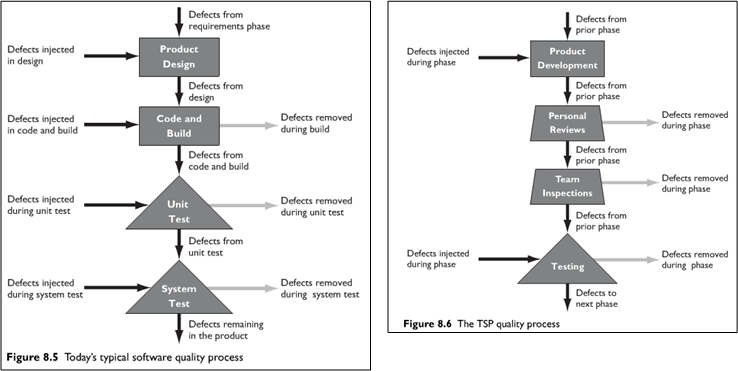
In order to un-confuse myself, I generated the equivalent of the Humphrey/Over TSP (Team Software Process) quality process diagram on the right using the diagram on the left as the starting reference point. Here’s the resulting apples-to-apples comparison:
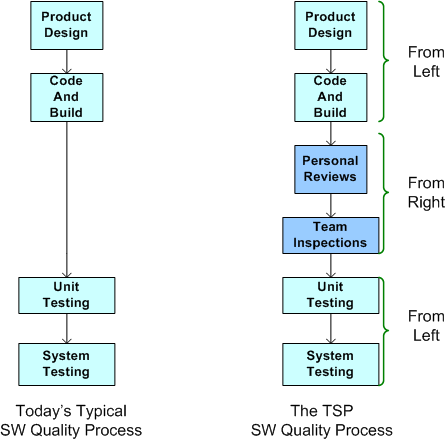 If this is what Humphrey and Over meant, then I’m no longer confused. Their TSP approach to software quality is to supplement unit and system testing with reviews and inspections before testing occurs. I wish they said that in the first place. Maybe they did, but I missed it.

Why am I here?
WTF?
Meh!
D'oh!

My BTC Address



 Bulldozer00's Blog