Archive
Three Types
One simple (simplistic?) way of looking at how orgs of people operate is by classifying them into three abstract types:
- The Malevolent Patriarchy
- The Benevolent Patriarchy
- The Meritocracy
Since it’s so uncommon and rare to find a non-patriarchically run org (which is so pervasive that the genre includes small, husband-wife-children, families like yours and mine), I struggled with concocting the name of the third type. Got a better name?
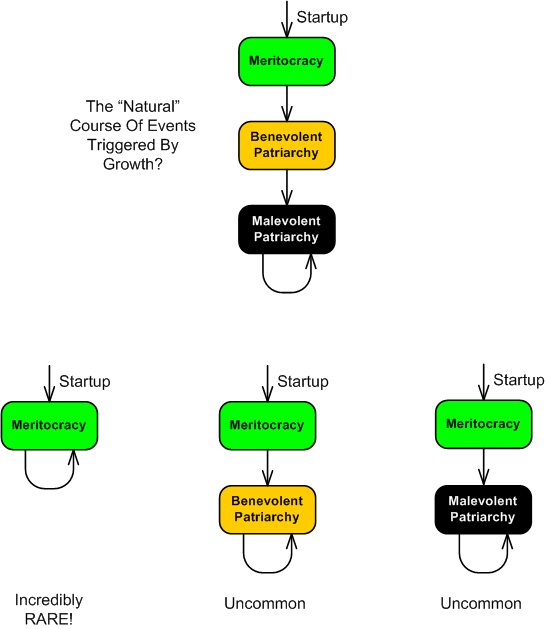
The figure below shows a highly unscientific family of maturation trajectories that an org can take after “startup”. The ubiquitous, well worn path that is tread as an org grows in size is the Meritocracy->Benevolent Patriarchy->Malevolent Patriarchy sojourn. Note that there are no reverse transitions in any of the trajectories. That’s because reverse state changes, like a Benevolent Patriarchy-to-Meritocracy transformation, are as rare as a company remaining in the Meritocracy state throughout its lifetime.
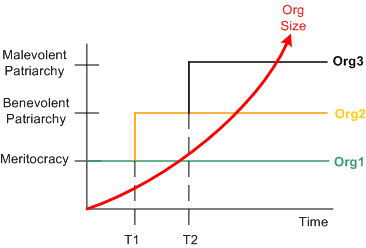
The state versus time graph below communicates the same information as the state machine family above, but from a time-centric viewpoint. Since “all models are wrong, but some are useful” (George Box), the instantaneous transition points, T1 and T2, are wrong. These insidious transitions occur so gradually and so slooowly that no one, not even the So-Called Org Leadership (SCOL), notices a state change. Bummer, no?
Stewardship
In “Stewardship: Choosing Service Over Self-Interest“, Peter Block logically and unemotionally exposes the warts of patriarchical management and promotes the concept of stewardship as a much needed replacement for it. Check out these gems:
The antidote to self-interest is to commit and to find cause. To commit to something outside of ourselves. To be part of creating something we care about so we can endure the sacrifice, risk, and adventure that commitment entails. This is the deeper meaning of service.
When patriarchy asks its own organization to be more entrepreneurial and empowered, it is asking people to break the rules that patriarchy itself created and enforces.
Stewardship is the willingness to hold power, without using reward and punishment and directive authority, to get things done.
Many managers open the door to their employees, and no one walks through it. (BMs love when no one from below confronts them).
At the heart of entitlement is the belief that my needs are more important than the business and that the business exists for my own sake. (BMs always think this way).
At some point each of us has to discover that our self-interest is better served by doing good work than getting good things.
“Are you here to build a career or to build an organization?” has to be clear and without hesitation…we are here first to build the organization.
“You are teaching revolution to the ruling class.” The phrase stayed with me. There is something both unsettling and very true about it. The truth is that we are, in fact, talking about a revolution. Revolution means a turning. Changing direction. The act of revolving. It means the change required is significant, obvious even to the casual observer. Obvious, for example, even to customers. It is more comforting to talk about evolutionary change. Evolutionary change means that everything is planned, under control, and reasonably predictable.
Getting better at patriarchy is self-defeating. Having one group manage and one group execute is the death knell of the entrepreneurial spirit. (BMs ignore this).
The notion of management prerogatives disappears. There is no privileged class of people. Everyone does work that brings value to the marketplace. And everyone should do some of the core work of the organization part of the time. (BMs have no idea how to perform core work).
Measure business results and real outcomes, stop measuring people’s behavior and style in getting there.
The trick here is to be accountable without being controlling. Patriarchy has always justified control on the basis of accountability.
Overhead costs are an interesting one. We are very verbal about the costs of direct labor. There is much less information on the cost of field overhead or, especially, home office overhead charges and what they consist of. (BMs think they are worth every overhead penny that they consume).
We have been swinging between centralization and decentralization for decades, with our patriarchal method of governance remaining unscathed.
Systems are usually designed to control people, not to give those close to the customer information to make good decisions for the business.
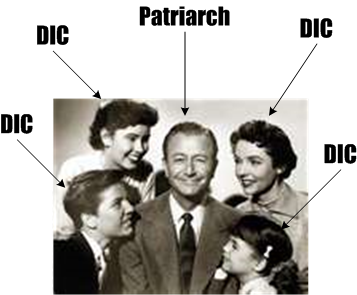
Groups that invent, design, produce, market, sell, and deliver the product or service are the line functions. The line functions are what are referred to in this book as the core work teams or core workers. (These are the DICs).
The main limitation of a functional structure is that it does not react well to the customer’s need for quick and whole-system oriented solutions.
If you insist on having an appraisal process, let people be appraised by their customers. This means bosses will be appraised by their subordinates. (BMs think subordinates have no right to appraise them).
Everyone likes the idea of pay for performance, but most of us have rarely experienced it. We most often get paid on the basis of how our boss evaluates us. This is more accurately called “pay for compliance.”
A demand for measurement is an expression of doubt and lack of faith.
Middle managers who made a living planning, organizing, and controlling are no longer needed and, in fact, get in the way. If they cannot now answer the question of what real value they add to their unit, then perhaps they are no longer needed. (LOL!)
Victims are strong believers in patriarchy, they are just angry that they are not the patriarchs. (Victims = DICs like you and me).
We replace coercion and persuasion with invitation.
At nights and on weekends we cry out for human rights and freedom of speech, and then we go to work and become strategic and cautious about our every word for fear we will be seen as disloyal or uncommitted.
Of course, since Block’s views align closely with my own, reading the book got me all juiced up. I found myself rooting for him and constantly saying to myself: “Wow, I wish I’d thought of that!”.

All My Children
When rearranging the chairs within their stratified and siloed command and control hierarchies fails (and it almost always fails) to improve performance, mechanistically thinking patriarchs often resort to the ubiquitous centralize/decentralize cycle. However, the c/d cycle is also a stone cold loser for improving performance because all it does is spawn mini command and control patriarchies – just like daddy’s. The mindsets of daddy and his sons don’t change, so neither does performance – duh! But hey, at least there’s a lot of action taking place and it looks impressive to outsiders – til the duplication of work and resources is realized and the move back to centralization takes place.

Leverage Points
In Places to Intervene in a System, systems thinker Donella Meadows lists the following 9 leverage points for keeping a system “on the rails” and in continuous pursuit of its goals.
9. Numbers (subsidies, taxes, standards).
8. Material stocks and flows.
7. Regulating negative feedback loops.
6. Driving positive feedback loops.
5. Information flows.
4. The rules of the system (incentives, punishment, constraints).
3. The power of self-organization.
2. The goals of the system.
1. The mindset or paradigm out of which the goals, rules, feedback structure arise.
The items are listed in increasing order of difficulty. Of particular interest is number 1, the “mindset” of the system controller(s). In so-called “modern” corpricracies, the patriarchical mindset of “we’re in charge and we know what’s best, so STFU and do what you’re told“, has ruled the day since the Henry Ford era. In that day, since the typical workforce was under-educated and managers actually knew how to perform and teach the work that kept a company viable, patriarchy worked well. These days, since the situation has changed (and continues to change) immensely, patriarchy can drive a company into the ground.
When managers don’t have a clue how to do the work, they ignore problems, issues, and ideas floated up from the bottom by the DICforce. This crucial feedback loop for sustained viability gets severed and the org suffers greatly for it. BMs collectively, and often unconsciously, behave this way in order not to look stupid and preserve their aura of infallible superiority. Ideas that can save six or seven figures in costs and product enhancements that may increase competitiveness go un-investigated or are killed via “it’s not in the budget”.
Maybe surprisingly to some, the vast majority of the DICforce actually buys into the patriarchical mindset because that’s the way it’s been for eons. DICs that initially don’t buy into patriarchy fall in line as soon as they are ignored or are slapped down a couple of times. Those that continue to buck the patriarchy after being “warned” are shackled or expelled for “insubordination” – another great term that reinforces the patriarchical mindset.

Why am I here?
WTF?
Meh!
D'oh!

My BTC Address



 Bulldozer00's Blog