Archive
My OSEE Experience
Intro
A colleague at work recently pointed out the existence of the Eclipse org’s Open System Engineering Environment (OSEE) project to me. Since I love and use the Eclipse IDE regularly for C++ software development, I decided to explore what the project has to offer and what state it is in.
The OSEE is in the “incubation” stage of development, which means that it is not very mature and it may require a lot more work before it has a chance of being accepted by a critical mass of users. On the project’s main page, the following sentences briefly describe what the OSEE is:
The Open System Engineering Environment (OSEE) project provides a tightly integrated environment supporting lean principles across a product’s full life-cycle in the context of an overall systems engineering approach. The system captures project data into a common user-defined data model providing bidirectional traceability, project health reporting, status, and metrics which seamlessly combine to form a coherent, accurate view of a project in real-time.
The feature list is as follows:
- End-to-end traceability
- Variant configuration management
- Integrated workflows and processes
- A Comprehensive issue tracking system
- Deliverable document generation
- Real-time project tracking and reporting
- Validation and verification of mission software
I don’t know about you, but the OSEE sounds more like an integrated project management tool than a system engineering toolset that facilitates requirements development and system design. Promoting the product ambiguously may be intended to draw in both system engineers and program managers?
The OSEE is not a design-by-committee, fragmented quagmire, it’s a derivation of a real system engineering environment employed for many years by Boeing during the development of a military helicopter for the US government. Like IBM was to the Eclipse framework, Boeing is to the OSEE.
“Standardization without experience is abhorrent.” – Bjarne Stroustrup
Download, Install, Use
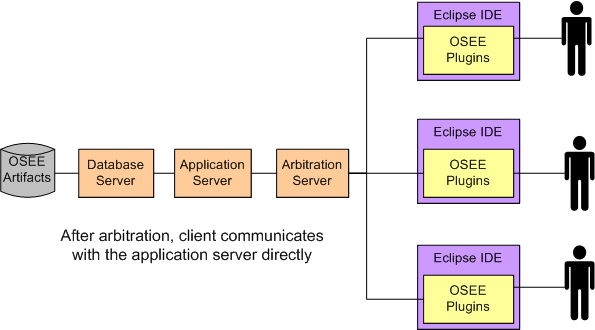
The figure below shows a simple model of the OSEE architecture. The first thing I did was download and install the (19) Eclipse OSEE plugins and I had no problem with that. Next, I tried to install and configure the required PostgresQL database and OSEE application and OSEE arbitration servers. After multiple frustrating tries, and several re-reads of the crappy install documentation, I said WTF! and gave up. I did however, open and explore various OSEE related Eclipse perspectives and views to try and get a better feel for what the product can do.
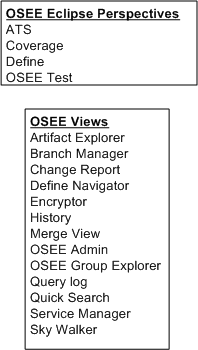
As shown in the figure below, the OSEE currently renders four user-selectable Eclipse perspectives and thirteen views. Of course, whenever I opened a perspective (or a view within a perspective) I was greeted with all kinds of errors because the OSEE back end kludge was not installed correctly. Thus, I couldn’t create or manipulate any hypothetical “system engineering” artifacts to store in the project database.
Conclusion
As you’ve probably deduced, I didn’t get much out of my experience of trying to play around with the OSEE. Since it’s still in the “incubation” stage of development and it’s free, I shouldn’t be too harsh on it. I may revisit it in the future, but after looking at the OSEE perspective/view names above and speculating about their purposes, I’ve pre-judged the OSEE to be a heavyweight bureaucrat’s dream and not really useful to a team of engineers. Bummer.

Why am I here?
WTF?
Meh!
D'oh!

My BTC Address



 Bulldozer00's Blog