Archive
Idealized Design
Russell Ackoff describes the process of “Idealized Design” as follows:
In this process those who formulate the vision begin by assuming that the system being redesigned was completely destroyed last night, but its environment remains exactly as it was. Then they try to design that system with which they would replace the existing system right now if they were free to replace it with any system they wanted.
The basis for this process lies in the answer to two questions. First, if one does not know what one would do if one could do whatever one wanted without constraint, how can one possibly know what to do when there are constraints? Second, if one does not know what one wants right now how can one possibly know what they will want in the future?
An idealized redesign is subject to two constraints and one design principle: technological feasibility and operational viability, and it is required to be able to learn and adapt rapidly and effectively.
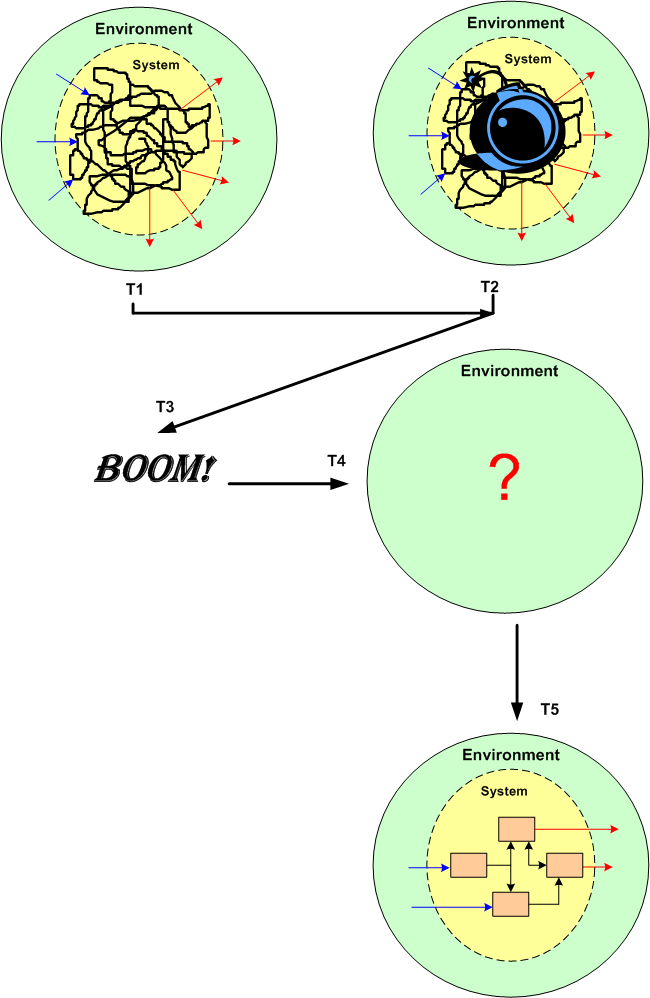
So, are you ready to blow up your system? Nah, tis better to keep the unfathomable, inefficient, ineffective beast (under continuous assault from the second law of thermo) alive and unwell. It’s easier and less risky and requires no work. And hey, we can still have fun complaining about it.
Pragmatic?
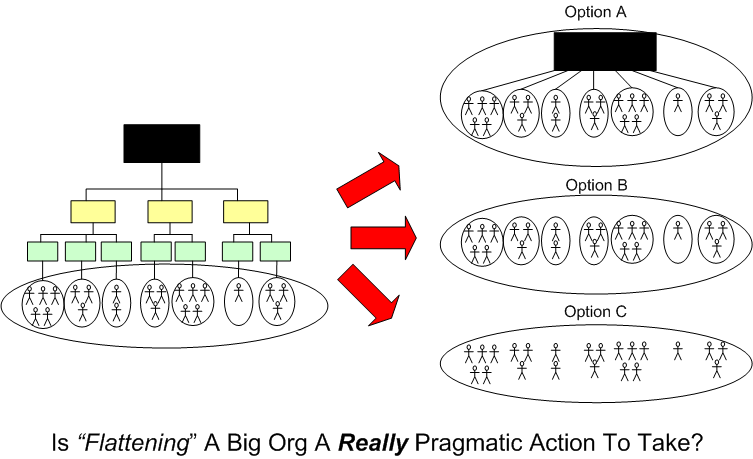
Still Applicable Today

Note: This graphic was clipped out of Bill Livingston’s D4P4D.
No Lessons Learned
Because I’m fascinated by the causes and ubiquity of socio-technical project explosions, I try to follow technical press reports on the status of big government contracts. Here’s a recent article detailing the demise of the DoD’s Joint Tactical Radio System (JTRS): “How to blow $6 billion on a tech project“.
Even though the reasons for big, software-intensive, multi-technology project failures have been well known for decades, disasters continue to be hatched and cancelled daily around the world by both public and private institutions everywhere – except yours, of course.
What follows are some snippets from the Ars Technica article and the JTRS wikipedia entry. The well-known, well-documented, contributory causes to the JTRS project’s demise are highlighted in bold type.
When JTRS and GMR launched, the services broke out huge wish lists when they drafted their initial requests for proposals on individual JTRS programs. While they narrowed some of these requirements as the programs were consolidated, requirements were constantly revised before, during, and after the design process.
In hindsight, the military badly underestimated the challenges before it.
First and foremost was the software development problem. When JTRS started, software-defined radio (SDR) was still in its infancy. The project’s SCA architecture allowed software to manipulate field-programmable gate arrays (FPGAs) in the radio hardware to reconfigure how its electronics functioned, exposing those FPGAs as CORBA objects. But when development began, hardware implementations of CORBA for FPGAs didn’t really exist in any standard form.
Moving code for a waveform from one set of radio hardware to another didn’t just mean a recompile—it often meant significant rewrites to make it compatible with whatever FGPAs were used in the target radio, then further tweaking to produce an acceptable level of performance. The result: the challenge of core development tasks for each of the initial designs was often grossly underestimated. Some of those issues have been addressed by specialized CORBA middleware, such as PrismTech’s OpenFusion, but the software tools have been long in coming.
When JTRS began, there was no WiFi, no 3G or no 4G wireless, and commercial radio communications was relatively expensive. But the consumer industry didn’t even look at SDR as a way to keep its products relevant in the future. Now, ASIC-based digital signal processors are cheap, and new products also tend to include faster chips and new hardware features; people prefer buying a new $100 WiFi router when some future 802.11z protocol appears instead of buying a $3,000 wireless router today that is “future proofed” (and you can’t really call anything based on CORBA “future proofed”).
“If JTRS had focused on rapid releases and taken a more modular approach, and tested and deployed early, the Army could have had at least 80 percent of what it wanted out of GMR today, instead of what it has now—a certified radio that it will never deploy.”
Having an undefined technical problem is bad enough, but it gets even worse when serious “scope creep” sets in during a 15-year project.
Each of the five sub-programs within JTRS aimed not at an incremental goal, but at delivering everything at once. That was a recipe for disaster.
By 2007 (10 years after start) the JTRS program as a whole had spent billions and billions—without any radios fielded.

In the fall of 2011, after 13 years of toil and $6B of our money wasted, the monster was put out of its misery. It was cancelled on October 2011 by the United States Undersecretary of Defense:
Our assessment is that it is unlikely that products resulting from the JTRS GMR development program will affordably meet Service requirements, and may not meet some requirements at all. Therefore termination is necessary.
And here’s what we, the taxpayers, have to show for the massive investment:
After 13 years in the pipeline, what those users saw was a radio that weighed as much as a drill sergeant, took too long to set up, failed frequently, and didn’t have enough range. (D’oh! and WTF!)
Scripted Behavior
Since I’m on a mini-roll hoisting excerpts from W. L. Livingston’s D4P book, here’s yet another one (I had to type the example in by hand because it only appears in the print version and not in the pdf. D’oh!):
In project review meetings, the whimsical plan, riddled with entropy and misinformation, is used as gospel to measure “actual” progress. Since everyone at the meeting knows the measurement is useless as a control, it becomes an instrument of management to manage the project. Invariably, management directs a get-well plan be devised to get back on the horribly-flawed milestone plan. Of course, the get-well plan is composed in the same toxic way.
The attending executive proclaims “If you don’t get this mess back on schedule by tomorrow, I’ll get somebody who can.” Everyone has heard this proclamation of executive out-of-control. The impact of this act of desperation on the project is wholesale CYA (Cover Your Ass) and subreption. Information available for forecasting progress becomes nothing but calculated lies. That’s where attempts to defy natural law land you.

Matched Vs. Mismatched
If for some strange reason you wasted some precious time and read yesterday’s post, you might have wondered what this “mismatch” thing is all about. Hopefully, this excerpt from the forthcoming 2012 edition of Bill Livingston’s D4P book (not the layman’s D4P4D) should shed some light on the mystery:
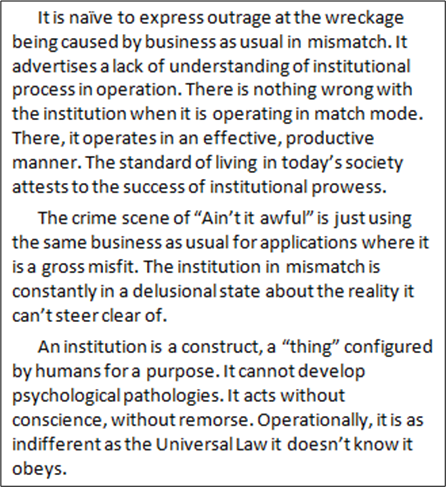
Naive outrage? Lack of understanding? Hmm. Not BD00. He knows everything.
Keystone Koppers
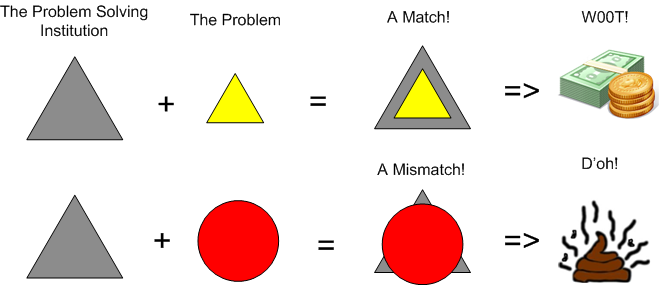
Here’s just one entertaining excerpt from Bill Livingston’s darkly insightful and mind-bending book, “D4P4D“:
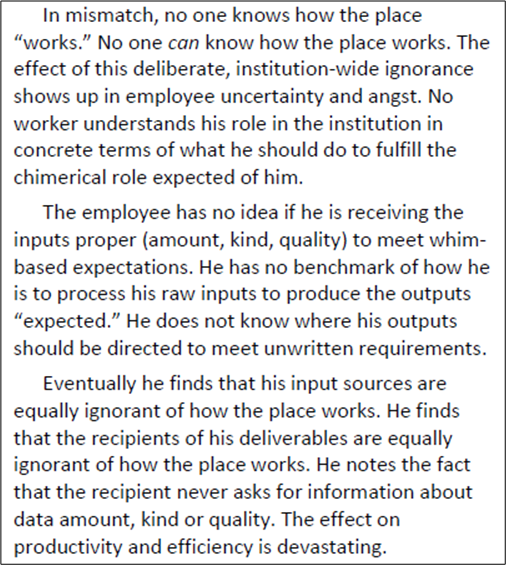
The key word in the whole excerpt is “mismatch“. When there is a “match“, all is well, and “business as usual” gets the job done effectively and efficiently.
So, whadya think? Fearful fact? Funny fiction? A touch of both?

A Blank Stare In Return
In a previous life, I once was commiserating with a manager about how difficult and time consuming it was to keep up with technological change in the software development industry. She said “That’s why I went into management“. After sharing a chuckle, I asked her if there were any other reasons for movin’ on up. I received a blank stare in return.
In a previous life, I once was talking to a software lead and hinted that maybe he should do more than watching schedules and doling out tasks (like cutting some code from time to time or keeping the technical documentation in synch with the code or doing some exploratory testing on the code base or taking on the role of buildmaster). I received a blank stare in return.
In a previous life, I once asked a software lead why he moved out of “coding” and into the periphery of management. He said: “For more money“. When I asked him if there were any other reasons, I received a blank stare in return.
At least they were honest. They could’ve offered up the classic management textbook response: “to take on more responsibility“. Better yet, they could’ve said “to help people do their jobs better” or “to help improve the quality of our processes by reducing red tape and eliminating low value steps“.
So, are they “selfish” people? Nah. This ubiquitous behavior is simply a side effect of how the vast majority of reward and power distribution systems are structured in hierarchical orgs. It’s been that way for 100 years and it looks like it will stay that way for the next 100 years. But then again, maybe not.

Aligned On A Misalignment
After recently tweeting this:

Chris Chapman tweeted this link to me: “Understanding Misalignments in SoftwareDevelopment Projects“. Lo and behold, the third “misalignment” on the page reads:
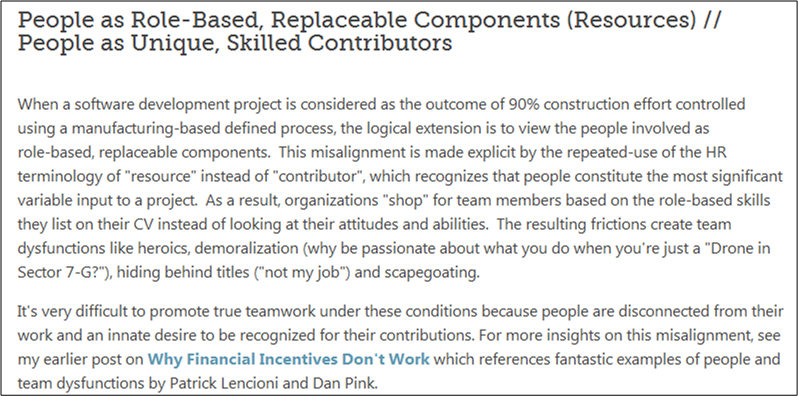
Chris and I seem to be aligned on this misalignment.
Your Fork, Sir
To that dumbass BD00 simpleton, it’s simple and clear cut. People don’t like to be told how to do their work by people who’ve never done the work themselves and, thus, don’t understand what it takes. Orgs that insist on maintaining groups whose sole purpose is to insert extra tasks/processes/meetings/forms/checklists of dubious “added-value” into the workpath foster mistrust, grudging compliance, blown schedules, and unnecessary cost incursion. It certainly doesn’t bring out the best in their people, dontcha think?

You would think that presenting “certified” obstacle-inserters with real industry-based data implicating the cost-inefficiency of their imposed requirements on value-creation teams might cause them to pause and rethink their position, right? Fuggedaboud it. All it does, no matter how gently you break the news, is cause them to dig in their heels; because it threatens the perceived importance of their livelihood.
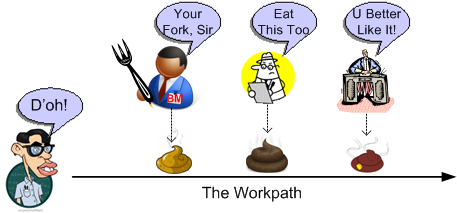
Of course, this post, like all others on this bogus blawg, is a delusional distortion of so-called reality. No?

Why am I here?
WTF?
Meh!
D'oh!

My BTC Address



 Bulldozer00's Blog