Archive
The Org Is The Product
Someone once said something like: “the products an organization produces mirror the type of organization that produces them“. Thus, a highly formal, heavyweight, bureaucratic, title-obsessed, siloed, and rigid org will most likely produce products of the same ilk.
With this in mind, let’s look at the US DoD funded Software Engineering Institute (SEI) and one of its flagship products: the “CMMI® for Development, Version 1.3“. The snippet below was plucked right out of the 482 page technical report that defines the CMMI-DEV:
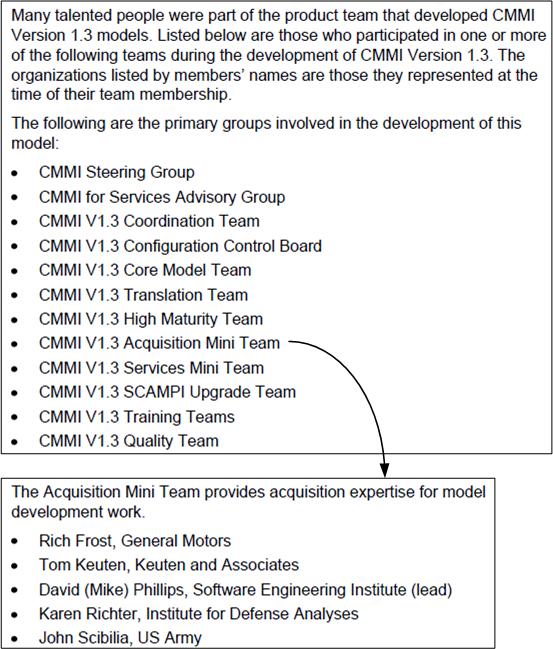
So, given no other organizational information other than that provided above, what kind of product would you speculate the CMMI-DEV is? Of course, like BD00 always is, you’d be dead wrong if you concluded that the CMMI-DEV is a highly formal, heavyweight, bureaucratic, title-obsessed, siloed, and rigid model for product development.
Preposterously Unacceptable
Unless they’re cosmetic tweaks, all proposed alternatives to the unassailable and revered Annual Performance Review (APR) will always be auto-stamped as preposterously unacceptable by the powers that be. It has to be that way, cuz expecting the wolf who’s guarding the hen house to voluntarily give up his post is a slam dunk losing proposition. Nevertheless, let’s look at one of these preposterously unacceptable alternatives just for fun.
Sam Culbert, in “Get Rid Of The Performance Review“, proposes deep-sixing the laughable APR ritual and replacing the stinker with the (crappily named) “performance preview” (PP). The first major feature of the PP is that salary actions are severed from the process. They’re independently determined according to a more objective set of criteria (perhaps like how Joel Spolsky does it at Fog Creek Software). Removing the salary sledgehammer from the hand of the formerly omnipotent manager increases the chance that a straight-talking, two-way conversation regarding individual and organizational improvement will occur.
Mr. Culbert’s face-to-face PP, which can be called into being whenever either side “feels” it should happen, is predicated on both sides answering simple questions like these:
- What have I been doing recently that helps you and the organization perform better?
- What have I been doing recently that isn’t working for you and the organization?
- What can I do in the near future to help you and the organization improve?
Notice that thesw are questions to be answered by both sides – as opposed to one way, judgmental assertions made by the boss “on behalf of the borg” to the subordinate. There are also no formal forms or checklists to be signed and squirreled away in Hoover files to be brandished later for compliance coercion.
This blog post barely scratches the surface of Mr. Culbert’s PP process, but hopefully it’ll spur you to buy his book and learn more about this HR anti-christ. On second thought, don’t do it. If you’re a DICkster, it might bum you out since you’ll vividly realize that you’re helpless and you can’t “fight city hall“. If you’re in the hallowed guild of management (especially the unconsciously evil HR echelon), because of its preposterous unacceptability, it might send shivers up your spine and/or piss you off.
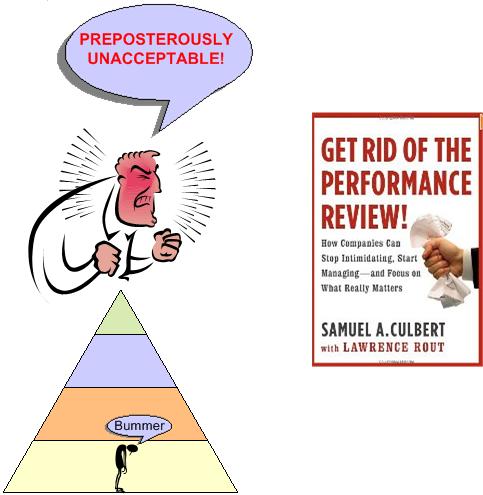
Note: Instead of “Performance Preview” (PP), BD00 would’ve called it something like “I Help, You Help” (IHYH).
Be Thankful
In “Abolishing Performance Appraisals“, Coens and Jenkins state:
One study found that 98% of people saw themselves in the top half of all performers. Another study showed that 80% of people saw themselves in the top quarter of all performers. Other research indicates that 59% of workers across a variety of jobs disagreed or strongly disagreed with any rating that was not the highest on the scale.
Now, assume that your in-Human Resources (iHR) department, under the condoning eyes of the C-suite, enforces the standard bell curve rating system on the DICforce to keep operating costs in check and to implement the industry’s most sacred “best practice“. Of course, the ratings are doled out at the beloved Annual Performance Review (APR) ritual along with subjective lists of personal faults that need “improvement” and 2% raises – a brilliant triple punch combo to the psyche. To make things more interesting, assume that all the reviews are given at the same time each year.
Given the information above, the cyclical morale curve below was scientifically developed by BD00 using one of his patented social system algorithms.
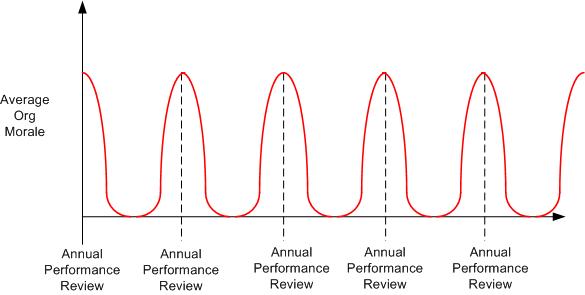
The curve shows that the average “system-wide” morale peaks just prior to the APR; and then it takes a nose dive after most of those optimistic DICs get a dose of reality from their supervisors (whose morale also takes a nose dive from being forced by iHR to administer the deflating news). Subsequent to the nadir, the system morale slowly recovers and rises back to its peak – until boom, the next iHR sponsored APR takes place. Whoo hoo! Dontcha just luv rollercoaster rides?
Just think of the lost productivity and sub-quality work performed during the annual dips. The next time you see an iHR group member, don’t fugget to thank him/her for the wonderful APR system his/her group presides over. Uh, on second thought, don’t do it. Nothing of substance is likely to change and you may be perceived as difficult, disrespectful, and disloyal – three more items to tack onto next year’s personal fault list. Plus, these types of things are undiscussable and they’re not within your tiny silo of expertise.
The Accumulation Of Rules
According to that dumbass BD00, in any given level in an institutional hierarsy, the number of internal org rules a member of that level is required to follow is a function of the number of levels above. Each level makes some rules for the levels below. Relatively speaking, the dudes in the head shed have to follow zero rules and they concoct the “high level” rules for the levels below them.
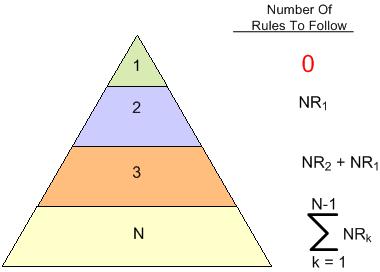
As one travels down a dysfunctional hierarsy, the number of rules to be obeyed is cumulative. By the time you’re down in the bilge room, the number of written and (especially) unwritten rules to follow is essentially infinite. The irony is that while the unfettered infallibles at the top keep piling on the handcuffs, they’re also simultaneously professing their love for empowerment, taking-initiative, dedication, trust, loyalty, yada-yada-yada.
T’is what it is, just another paycheck-for-repression tradeoff. You can’t have your cake and eat it too, so suck it up soldier!
Not Arbiters, Nor Catalysts
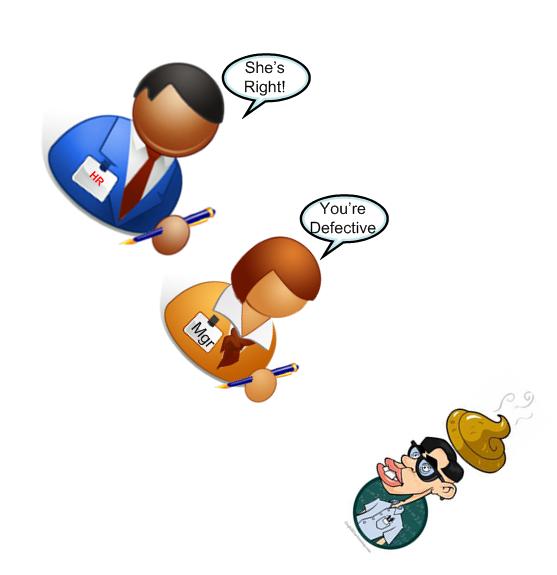
When I was young and naive (as opposed to my current state: old and misinformed), I entered the werkfarce thinking that HR departments were supposed to be compassionate arbiters of disputes and employee development catalysts – until I discovered what they actually did:
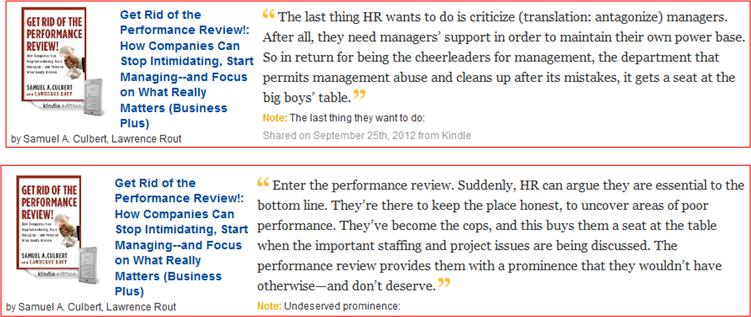
HR groups are bright shining examples of POSIWID. “The Purpose Of a System Is What It Does” – not what it says it does. Alas, BD00 doesn’t think that most HR departments are maliciously evil, they’re just so indoctrinated and immersed in Tayloresque, Theory-X thinking that “they know not what they do“. How about you? Besides thinking that BD00 knows not what he does, what do you think?
Industry Best Practice
When we got the idea for this book, we expected to surely find dozens of other books with the same theme… To our surprise, however, we found no other books devoted to abolishing (the annual performance) appraisal and exploring fresh approaches to the functions of appraisal. – Coens/Jenkins (Abolishing Performance Appraisals)
Since the thought of replacing the sacred “annual performance review” is so shockingly unthinkable, any proposed alternative doesn’t have a snowball’s chance in hell of being embraced. The undiscussability of this “industry best practice” is so palpable, that not many souls even make an attempt to concoct any alternatives, let alone expose them for scrutiny. Alas, such is the power of entrenched 20th century management thinking to keep the status quo on corpo-social issues that really matter, in-situ.
 Related articles
- Behind One’s Back (bulldozer00.com)
- He Said, He Thought, He Said, He Thought (bulldozer00.com)
The Real Customer
In “12 ‘best practices’ IT should avoid at all costs”, InfoWorld‘s Bob Lewis asserts:

I enjoy Bob’s books and columns, but I have to side with the likes of Russell Ackoff and Vineet Nayar on this one. All of an org’s “enabling” functions: HR, QA, Finance, Purchasing, IT, etc; should indeed serve the direct revenue-generating business functions and treat them as paying customers. Otherwise, the natural tendency of these groups in hierarchical orgs is to turn into obstacle-inserting, unresponsive, monopolistic dictatorships. Of course, in the “real world” this rarely happens because rational adults are in charge – and Bob is right. What is your opinion?
Scrum And Non-Scrum Interfaces
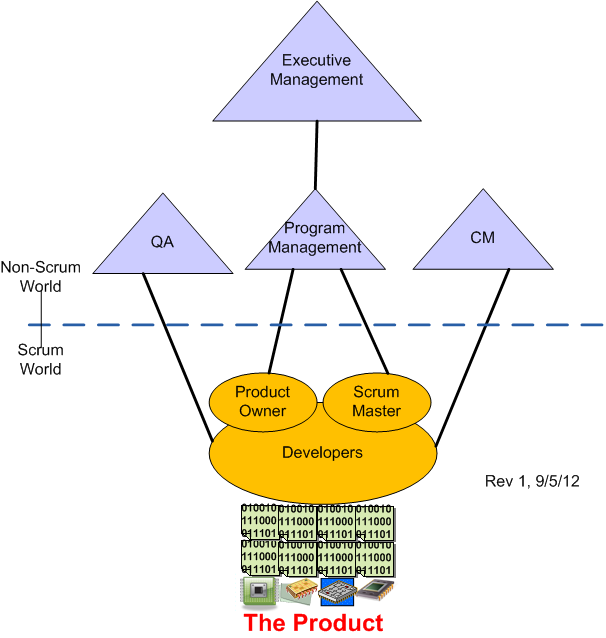
According to the short and sweet Schwaber/Sutherland Scrum Guide, a Scrum team is comprised of three, and only three, simple roles: the Product Owner, the Scrum Master, and the Developers. One way of “interfacing” a flat and collaborative Scrum team to the rest of a traditional hierarchical organization is shown below. The fewer and thinner the connections, the less impedance mismatch and the greater the chances of efficient success.
Regarding an ensemble of Scrum Developers, the guide states:
Scrum recognizes no titles for Development Team members other than Developer, regardless of the work being performed by the person; there are no exceptions to this rule.
I think (but am not sure) that the unambiguous “no exceptions” clause is intended to facilitate consensus-based decision-making and preclude traditional “titled” roles from making all of the important decisions.
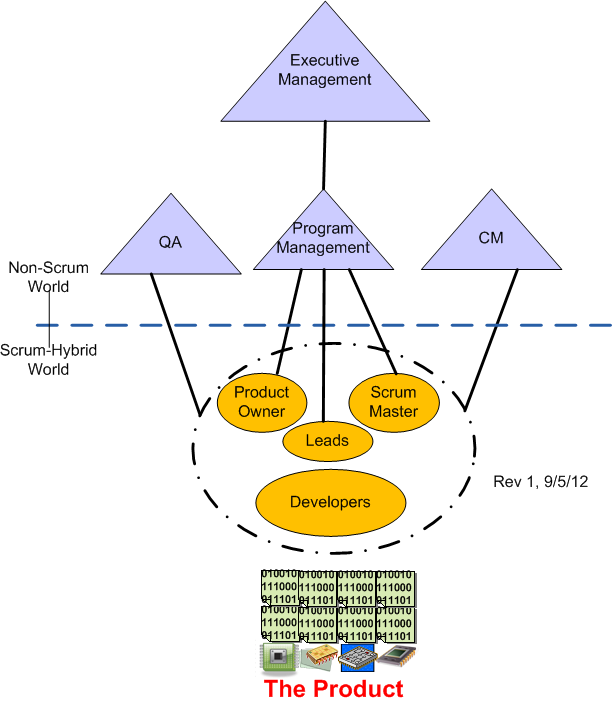
So, what if your conservative org is willing to give Scrum an honest, spirited, try but it requires the traditional role of “lead(s)” on teams? If so, then from a pedantic point of view, the model below violates the “no exceptions” rule, no? But does it really matter? Should Scrum be rigidly followed to the letter of the law? If so, doesn”t that demand go against the grain of the agile philosophy? When does Scrum become “Scrum-but“, and who decides?
Related articles
- The Scrum Sprint Planning Meeting (bulldozer00.com)
- Bring Back The Old (bulldozer00.com)
- Ultimately And Unsurprisingly (bulldozer00.com)
- From Complexity To Simplicity (bulldozer00.com)
- Why I’m done with Scrum (lostechies.com)
He Said, He Thought, He Said, He Thought
In “Get Rid of the Performance Review!: How Companies Can Stop Intimidating, Start Managing–and Focus on What Really Matters“, Sam Culbert provides several, made-up, boss-subordinate exchanges to make his case for jettisoning the archaic, 1900’s “annual performance review“. For your reading pleasure, I lifted one of these depressingly funny exchanges out of the book and transformed it into a derivation of Chris Argyris’s terrific LHS-RHS format. It’s long, and it took me a bazillion years to recreate it on this stupid-arse blawg; so please read the freakin’ thing.
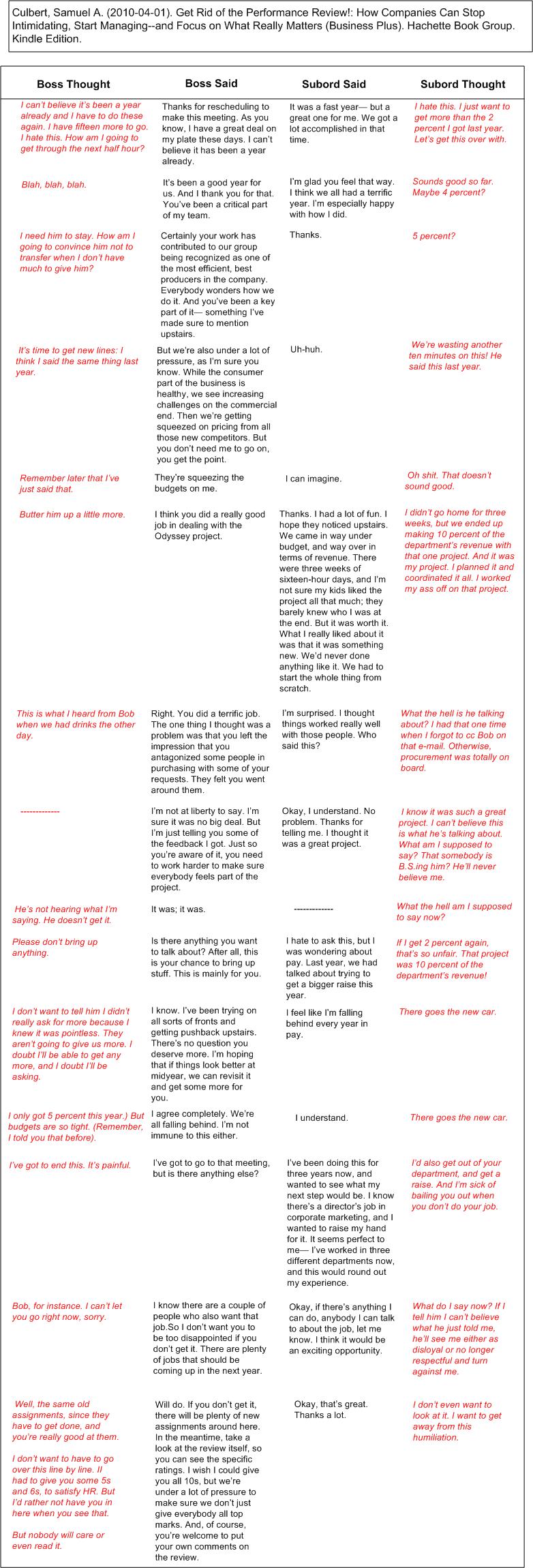
Did you notice how both the boss and the subordinate suffered from the ordeal? But of course, you don’t have to worry about experiencing similar torture because the “annual performance review” at your institution is different. Even better, your org has moved into the 21st century by implementing an alternative, more equitable and civilized way of gauging performance and giving raises.
In his hard-hitting and straight-talking book, Mr. Culbert, a UCLA management school professor and industry consultant firebrand (he’s got street cred!), really skewers C-level management. He fires his most devastating salvos at evil HR departments for sustaining the “annual performance review” disaster that sucks the motivation out of everybody within reach. And yes, he does provide viable alternatives (that won’t ever be implemented in established, status-quo-loving borgs) to HR’s beloved “annual performance review“. Buy and read the book to find out what they are.
Note: Thanks Elisabeth, for steering me toward Mr. Culbert’s blasphemous work. It has helped to reinforce my entrenched UCB and the self-righteous illusion that “I’m 100% right“. But wait! I’m not allowed to be right.
Temporary Enlightenment
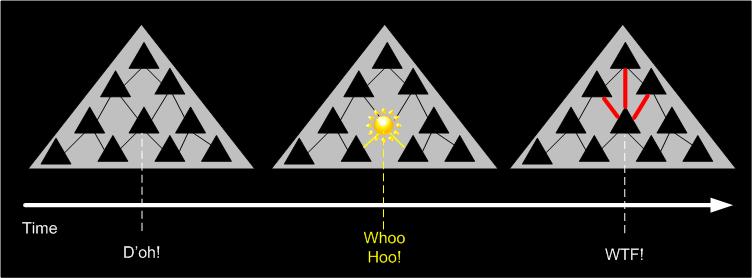

Why am I here?
WTF?
Meh!
D'oh!

My BTC Address



 Bulldozer00's Blog