Archive
Analysis Paralysis Vs. 59 Minutes
“If I had an hour to save the world, I would spend 59 minutes defining the problem and one minute finding solutions” – Albert Einstein
If they didn’t know that Einstein said the quote above, MBA taught and metrics-obsessed “go-go-go” textbook managers would propose that the person who did say it was a slacker who suffered from “analysis paralysis”. In the Nike age of “just do it” and a culture of “act first and think later” (in order to show immediate progress regardless of downstream consequences), not following Einstein’s sage advice often leads to massive financial or human damage when applied to big, multi-variable hairball problems.
The choice between “act first, think later” (AFTL) and “think first, act later” (TFAL) is not so simple. For small, one dimensional problems where after-the-fact mistakes can be detected quickly and readjustments can be made equally as quickly, AFTL is the best way to go. However, most managers, because they are measured on schedule and cost performance and not on quality (which is notoriously difficult to articulate and quantify), apply the AFTL approach exclusively. They behave this way regardless if the situation cries out for TFAL because that’s the way that hierarchical structured corpo orgs work. Since the long term downstream effects of crappy decisions may not be traceable back to the manager who made them, and he/she will likely be gone when the damage is discovered, everybody else loses – except the manager, of course. Leaders TFAL and managers AFTL.
The FAE
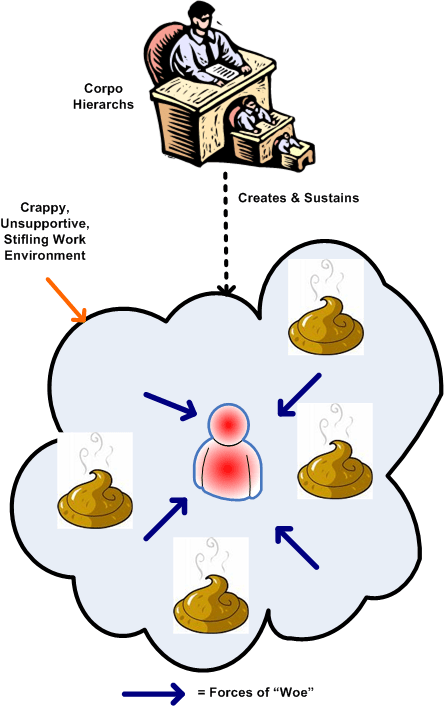
Over the years, I’ve read quite a few books and articles on managing the soft side of an organization. In many of these info sources, I’ve seen the term FAE = Fundamental Attribution Error mentioned. The FAE represents the tendency of a manager to instinctively and unthinkingly blame a person’s character and/or work ethic for under-performance. The real cause, which cannot possibly be true in a corpo manager’s conditioned mind, is likely that his/her inability to create, nurture, and continuously sustain a helpful, supportive, learning work environment is killing productivity and creating under-performers.
Of course, the FAE cannot account for all under-performance in an absolute sense. There are self-made underperformers (like BD00) in every org, regardless of the quality of the surrounding work environment.
Two Playbooks
When revenues and/or profits go flat or they start eroding, one of the 3 textbook moves that a mediocre company usually make is to reorganize (yet again). The other two moves in the utterly uncreative and standard MBA playbook are: 2) fire people; 3) instill fear via coercion and adding more rigid/constraining processes to extract more productivity from the value creation team at the bottom of the corpo hierarchy. Sometimes, especially in a time of crisis, all three actions are executed. Notice that all 3 moves are attempts to cut costs and not to raise revenues. Raising revenues requires exploring, discovering, and finding new customers along with developing successful new products that open up new markets. These actions require creativity, innovation, new ways of thinking, leadership, and courage. Sadly, these attributes are not the forte of mechanistic and Newtonian MBAs who are trained to solely look at data and compute fancy state-of-the art derivative business metrics.
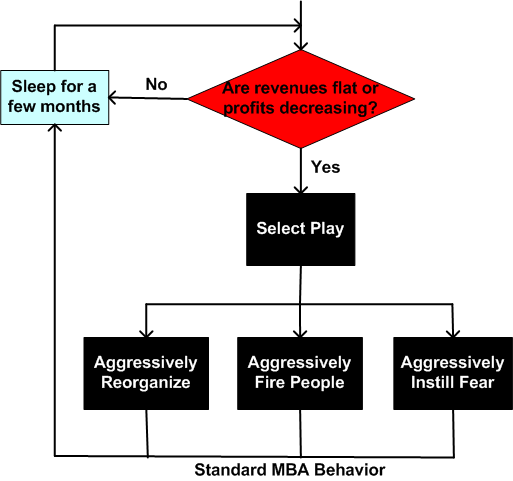
When a company reorganizes, which is the least painful action that can be applied to the productive members at the bottom of the org, grand new titles are created, groups are renamed, and new layers are added/subtracted. Management temporarily feels better and optimism permeates the top of the stratified pyramid. The people down in the dirty boiler room know better. Since the reorg usually consists of shuffling the same people with the same old crusted mindsets into new positions, no deep and lasting change happens. If, during the reorg, people with new ideas are promoted from the bottom or brought in from the outside, they are quickly “set in their place” by the old guard that remains. They get absorbed by the borg. Blech.

Imposers And Imposees
“Never tell people how to do things. Tell them what to do and they will surprise you with their ingenuity.” – George S. Patton
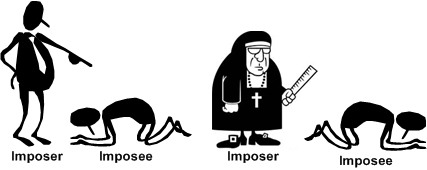
Isn’t it amazing at how people and groups, especially those in positions of authority, are always exhorting others to perform work exactly the way that they want the work to be done? Instead of carefully clarifying “what” needs to be done, which is much more difficult and requires leadership over management, the “imposers” obsess over every little detail of the “how” – which is management over leadership. Leaders focus on the “what”, but managers obsess over the “how”. What’s really mind-boggling, is that if you ask an imposer for helpful examples of excellence that they’ve personally created before they were promoted from an imposee to an imposer, you get some kind of evasive smokescreen answer, or some combo of body and facial movement that conveys this message: “it’s taboo for you to ask that question”. When that happens, credibility and professional respect, extremely tough to earn but easily lost, go right down the crapper. Is asking for leadership-by-example a disrespectful thing to do? In dysfunctional orgs where there are few, if any leadership-by-examples of excellence, asking probing questions is considered an act of subordination that is not easily forgiven or forgotten.
Under the veil of “industry best practices”, and the unspoken but clearly understood directive that imposees are required to learn the details of the “how” fully and instantaneously on their own time, the pounding into submission by imposers continues. The pounding only stops when enough camouflage has been generated by the imposee(s) to anesthesize the imposers into thinking that they’ve prevailed. It’s only a temporary high. Sooner or later, everyone finds out, sometimes spectacularly, that the neglected “what” is FUBAR. In dysfunctional organizations that behave in accordance with these “industry worst practices”, it’s no wonder that the majority of employees become cynical, apathetic, disengaged, and disgruntled camouflage creators.
“You do not lead by hitting people over the head – that’s assault, not leadership” – Dwight D. Eisenhower
So, am I a “do as I say not as I do” imposer and hippocrate? Well, I try not to be one, but I might be failing miserably at it. Judge for yourself by reading one or more of the rants on this blog. Do I overdo it sometimes or, uhhh, always? Decide for yourself.
Round And Round We Go
Engineering Councils, Master Engineering Groups, Centers of Excellence, yada-yada-yada. Has your company repeatedly formed and dissolved elite groups like these over the years? The purpose of sanctioning these groups is always well-intentioned, but always doomed. Why are they doomed? Because:
- they are always underfunded and, at the first hint of corpo financial stress, they are abandoned because they are an overhead expense group that doesn’t create or add value.
- all of the sitting members have real day jobs that need to get done in order to put money in the corpo coffers and food on the table.
- they don’t actively solicit input from the people who have to operate by their decisions – if they ever make any decisions and produce non-verbal output at all.
- they ignore input from non-members when they do get it – losing credibility and respect in the process.
- they never agree to a systematic method of making decisions when they are formed.
- they spend all their time in philosophical debates, with each elite member trying show how smart he/she is.
I could probably make up some more excuses for the repeated cyclical failure of elite councils, but I’ll leave it as an exercise for you, dear reader, to add your own reasons to the list. Feel free to add your own thoughts on this via the comments section.
Each time the elite council idea is recycled, nobody seems to remember the failures of the past and the same unproductive group behavior emerges. Everybody but the BOTG (Boots On The Ground) innocently thinks that this time it will be “different”. I’ve participated in these elite groups in the past, but from now on, I’ll always respectfully decline membership when asked. The last time I was asked, I declined to sit on one of these boards (that’s exactly what they do – just sit) . However, I offered up my services to work on any specific and funded task that the group deemed important. Unsurprisingly, nobody has taken me up on my offer. Bummer :^)
So how can the elite council idea be successful and add value to an org? Just invert the reasons-for-failure list above. Even if you do manage to change the context from disabling to enabling, it still might not work but, at least it will have a chance.

Why am I here?
WTF?
Meh!
D'oh!

My BTC Address



 Bulldozer00's Blog