Archive
Underbid And Overpromise
As usual, I don’t get it. I don’t get the underbid-overpromise epidemic that’s been left untreated for ages. Proposal teams, under persistent pressure from executives to win contracts from customers, and isolated from hearing negative feedback by unintegrated program execution and product development teams, perpetually underbid on price/delivery and over-promise on product features and performance. This unquestioned underbid-overpromise industry worst practice has been entrenched in mediocracies since the dawn of the cover-your-ass, ironclad contract. The undiscussable but real tendency to, uh, “exaggerate” an org’s potential to deliver is baked into the system. That’s because competitors and customers are willing co-conspirators in this cycle of woe. The stalemate ensures that there’s no incentive for changing the busted system. As the saying goes; “if we can’t fix it, it ain’t broke!“. D’oh!

If a company actually could take the high road and submit more realistic proposals to customers, they’d go out of business because non-individual customers (i.e. dysfunctional org bureaucracies where no one takes responsibility for outcomes) choose the lowest bidder 99.99999% of the time. I said “actually could” in the previous sentence because most companies “can’t“. That’s because most are so poorly managed that they don’t know what or where their real costs are. Unrecorded overtime, vague and generic work breakdown structures, inscrutable processes, and wrongly charged time all guarantee that the corpo head sheds don’t have a clue where their major cost sinks are. Bummer.
Perverted Inversion
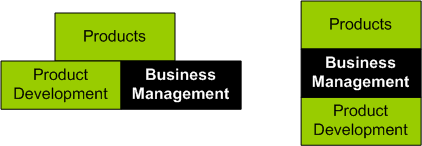
In simplistic terms, material wealth in the form of profits is created through the delivery of products and/or services that provide some sort of perceived value to a set of customers. The figure below illustrates the priorities, from highest on the top to lowest on the bottom, of all successful product-oriented startup businesses.

Since products create the wealth that sustains a business, they receive top billing. The care and feeding of the golden geese via a supportive product development group is next in importance. At the bottom, and deservedly so, is the management of the business. Nevertheless, the fact that it’s on the priority list at all means that managing the business is important – but not as important as the product-centric activities.
Without any facts or any background research to back it up (cuz I like to make stuff up), I assert that most entrepreneurs hate doing the business management “stuff”. Some despise the mundane activities of running a business so much that their negligence can cause the fledgling enterprise to fail just as quick as launching the business without any product or service to sell. Having said that, hopefully you’ll agree that any business priority list without the product portfolio perched at the top is a sure path to annihilation. The other two arrangements of the lower priority activities (shown below) can also work, but maybe not as effectively as the initial proposed stack.
As a business thrives and grows larger, a strange perverted inversion occurs to those who lose their way (but thankfully, not all do). The business management function bubbles to the surface of the priority stack (WTF?). This happens ubiquitously across the land because hot shot, fat headed, generic managers who don’t know squat about the org’s specific product portfolio are chaufeurred in to grow the business. These immodest dudes, thinking of themselves as Godsends from MBA city, put themselves and what they do at the top of the priority stack to…… enrich themselves no matter what. Of course, these wall street stooges perform this magic act while espousing that the product set and those that create it are forever the org’s “most valuable asset“.
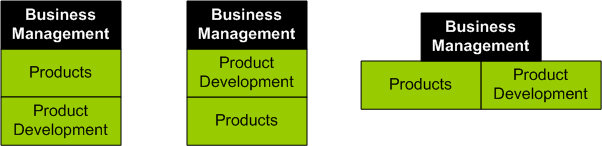
Post-startup businesses can survive with the perverted priority stack in place, but they usually muddle along with the rest of the herd and they aren’t exhilarating or engaging places to work. Do you work for one?
At a certain age institutional minds close up; they live on their intellectual fat. – William Lyon Phelps
A New Title Should Do It
“To solve our decreasing revenue and rising cost problems, we’ll just create a new title and insert the position into the org (thereby adding another layer to the stratified corpo cake). Voila! The problem will be solved (so let’s give ourselves a special bonus for being so smart).”
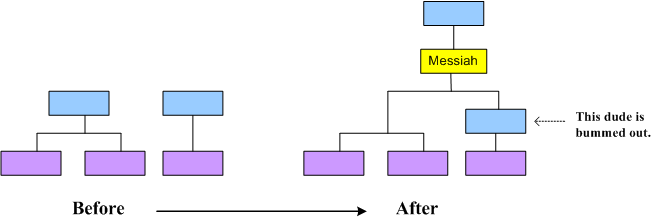
“But wait. What should the title be? Supervisor, Manager, Deputy Manager, Director, Deputy Director, General Manager? Should we bump it up by attaching a “Chief” and/or VP to the label? “We must be careful because the loftier the title, the more we’ll have to pay our new colleague (who will no doubt accomplish what we have failed to do).”

Such is the mindset of MBA trained corpo elites and their stooge press magazines like Business Week, Forbes, Fortune, et al. Do ya really think parachuting a messiah in to jumpstart an org with:
- an apathetic DICforce that is not as stupid as the head shed assumes and doesn’t appreciate management’s patronizing attitude
- an aging product development and manufacturing infrastructure (e.g. tools, processes, know how)
- an old and tired product portfolio that’s continually being usurped by competitor offerings
- a culture of undiscussable but obvious inter-group rivalry and disrespect
is realistic? Fragmented, hero-worshipping mindsets don’t clean up what Russell Ackoff calls, for lack of a better word, “messes”. Systemic thinking, along with the willingness to skinny dip, fully exposed, into the stinky mess is the only way to understand and clean up messes. Sadly, even if one or two dudes in the head shed junta are closet system thinkers and they try to speak out or take action, they’re promptly put back into their assigned slot….. and business resumes as usual…. while the mess grows ominously larger.
And now, for the bad news….. 🙂
Docu-centric, Model-centric
Let’s say that your org has been developing products using a Docu-Centric (DC) approach for many years. Let’s also say that the passage of time and the experience of industry peers have proven that a Model-Centric (MC) mode of development is superior. By superior, I mean that MC developed products are created more quickly and with higher quality than DC developed products.
Now, assume that your org is heavily invested in the old DC way – the DC mindset is woven into the fabric of the org. Of course, your bazillions of (probably ineffective) corpo processes are all written and continuously being “improved” to require boatloads of manually generated, heavyweight documents that clearly and unassailably prove that you know what you’re doing (lol!) to internal and external auditors.
How would you move your org from a DC mindset to an MC mindset? Would you even risk trying to do it?

Competitive Edge
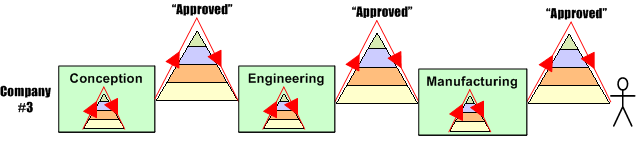
Check out the figure below. Which model more closely maps to your company’s way of operating?
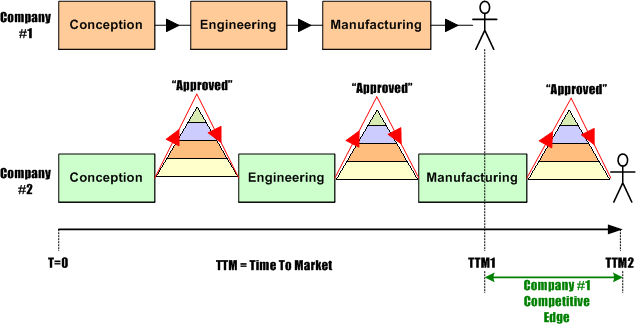
If you picked company #2, does the nested approval model below represent your company even more closely? Does every swingin’ dick (not DIC) in the house with one or more titles feel the need to be informed and bestow his/her approval before anything of substance can get done within the corpo citadel?
Don’t Say It!
One of Paul Graham’s brilliant essays in “Hackers and Painters” is titled “What You Can’t Say“. In it, he analyzes the question: “How do people in power determine what you can’t say in a given historical time period?” He goes back to the Galileo era and cites the fact that what was taboo to say in one generation became trivially “OK” to say in subsequent generations. It’s sad because over the ages many people were persecuted, tortured, and killed because of what they said in one generation, only to have their deaths become senseless in the subsequent generation(s).
I think Paul’s answer to the “what you can’t say” question is pretty much right on:
“The statements that make people mad are the ones they worry might be believed. I suspect the statements that make people maddest are those they worry might be true.” – Paul Graham
How do I know that Paul is close to ground zero? Because when I get mad those are the reasons that trigger the madness. Mr. Graham’s conclusion aligns closely with the following GBS assessment.
“All great truths begin as blasphemies.” – George Bernard Shaw
If I was GBS, I would have stated it as: “All great truths begin as blasphemies that, when stated before it’s appropriate to do so, will get you censured, fired, tortured, killed, or all of the above.”

The Bad Person
At my company, unlike the legions of others who are afraid of what they might discover, we have a web-based portal that enables anyone to post questions to management. Fittingly, the answers to most of the questions get publicly posted along with the questions themselves from someone in the management group. Again, unlike the legions of companies littering the landscape who’s upper management layers don’t “get involved” with such trivia from the DICforce, my company’s questions are often answered by our CEO.
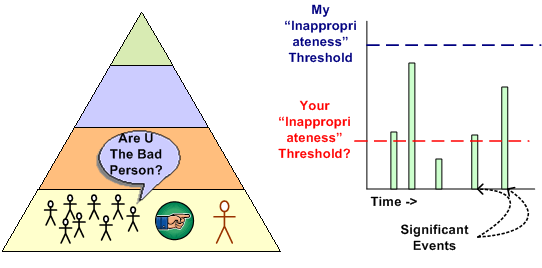
As you might surmise, some of the submitted questions could be judged as hurtful and hostile by many, if not the majority, of people in the organization. Nevertheless, everyone has a different threshold of “inappropriateness“, and as you might guess, mine is pretty high.
Because:
- of my high personal inappropriateness threshold,
- I like to continuously skirt the edge of inappropriateness to feel alive and perhaps influence other people’s thinking,
- I think (but am not sure) that quite a few people have at least judged me to be perpetually disrespectful,
I often get asked “Did you submit this question?” regarding some potentially controversial submittals. The interesting thing is, I’ve only been asked that by fellow DICs, and never by anyone in the management group. Is that both cool and weird, or what?
Every time I get asked the “Did you submit this question?” question by a fellow DICster, a slight twinge of guilt courses through my being even though I didn’t ask the question and even though I have judged it “appropriate” according to my subjective inappropriateness threshold setting. I suspect that I experience the discomfort because I feel like the asker is searching for “the bad person” who would ask such a thing. When that happens, the following quotes pop into my head to help me move past the icky and uncomfortable feeling associated with dancing on the edge of the abyss:
“It is only by risking our persons from one hour to another that we live at all.” – William James
“Do one thing everyday that scares you.” – Baz Luhrmann
How about you? Are you always on the hunt for “bad people“? Do you like to skirt the edge of inappropriateness? Do you like to sit in the lazy boy, munch on popcorn, watch the show, and remain on the sideline?
Thinking Is Not Allowed
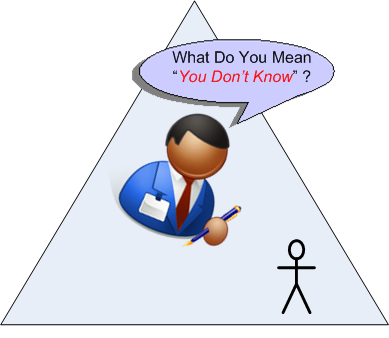
I’m not very good at flying by the seat of my pants during encounters with bozeltine managers who demand answers to complex questions on-the-spot, in real-time. When I spontaneously find myself in those situations, I tend to get flustered and make stuff up (more than I normally do (which is a lot)) to appease those in authority.
Rather than calmly saying “(please) let me think about it and get back to you“, I tend to cave and pull some stanky chit out of my arse. Maybe it’s because of the perception that “thinking” isn’t allowed? Maybe it’s because of the expectation that everyone should be perfectly all-knowing? If BMs were conscious of their irrational behavior when they ask for information, then they’d say “please think about it and get back to me“. But then, they wouldn’t be BMs. They’d be, heaven forbid, empathetic leaders.
Inappropriate
It seems that the word “inappropriate” is in fashion these days. It’s the modern and eloquent replacement for old and tired words like “disrespectful”, “disloyal”, “blasphemy”, “heresy”, and “sacrilege”. Infallible judgers are always on the lookout for impactful, fear-inducing words like these to silence conscientious objectors and concerned citizens. As you might surmise, the word “inappropriate” is directed at me quit frequently :).
Based on my personal experience, I can tell you that the fear effect works, but it’s success is person-specific. In my case, the fear effect usually wears off quickly and I’m back at being “inappropriate” yet again.
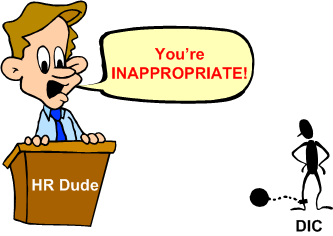
In dysfunctional CCHs, one of the primary functions of HR departments is to police the behavior of the DICforce. Thus, since they’ve been “approved” by the corpocracy to inject fear into non-conformers and rabble rousers, they’re the final arbiter of what’s deemed “inappropriate”. When someone “reports” (a.k.a rats out) someone to HR, the group happily kicks into action to assess the allegation. Unlike the drawn out investigation that occurs when a DIC rats out another DIC, the verdict of “inappropriate” is always certain when a manager rats on a DIC. You see, since HR is an integral member of the management guild and it gets paid by its brethren, it does whatever is best for management – which may not be best for the company as a whole.
Since (as I’ve said several times before) I like to make things up, don’t believe a word I say. If I could, I’d change the name of this blog to “Don’t Read This Blog Because I Like To Make Things Up“.
Hey Nicky, Please Pass The Culture Sauce
This Inc. Magazine piece, Lessons From a Blue-Collar Millionaire, tells the story of CEO Nick Sarillo and Nick’s Pizza & Pub. Like Tony Hsieh of Zappos.com , Jim Goodnight of the SAS Institute, and Ricardo Semler of Semco, Nick knows that the real key to business success is building a people-centric culture and relentlessly husbanding it so that the second law of thermodynamics doesn’t slowly but surely destroy it.
Here are some snippets from the article followed by comments from the peanut gallery.
In an industry in which annual employee turnover of 200 percent is considered normal, Sarillo’s restaurants lose and replace just 20 percent of their staff members every year. Net operating profit in the industry averages 6.6 percent; Sarillo’s runs about 14 percent and has gone as high as 18 percent. Meanwhile, the 14-year-old company does more volume on a per-unit basis (an average of $3.5 million over the past three years) than nearly all independent pizza restaurants. And customers, it seems, adore the service: On three occasions, waitresses have received tips of $1,000.
The above results clearly show that what Nick’s doing works, no?
Sarillo has built his company’s culture by using a form of management best characterized as “trust and track.” It involves educating employees about what it takes for the company to be successful, then trusting them to act accordingly. The company’s training program is elaborate, rigorous, and ongoing. The alternative is command and control, wherein success is the boss’s responsibility and employees do what the boss says.”Managers trained in command and control think it’s their responsibility to tell people what to do,” Sarillo says. “They like having that power. It gives them their sense of self-worth. But when you manage that way, people see it, and they start waiting for you to tell them what to do. You wind up with too much on your plate, and things fall through the cracks. It’s not efficient or effective. We want all the team members to feel responsible for the company’s success.”
There’s not much to add to the above snippet. I, and countless others much smarter and more eloquent than me, have ranted about the toxicity of dysfunctional CCH corpocracies to no avail. CCHs litter the landscape anf they will continue to do so because of Nick’s quote: “They like having that power. It gives them their sense of self-worth.”
They had someone else put in the numbers, and when the numbers came out wrong, they didn’t dig deeper to discover why. Because they didn’t know the ‘why,’ they couldn’t share it with the team members. When you know the ‘why,’ it’s really easy to figure out what to do, but sharing that kind of information wasn’t how they’d been trained to manage.”
In the above snippet, Nick relates his experience when he mistakenly hired managers with the old “I’m the boss and I don’t do details – I’m better than that” 1920’s mindset.
People who inquire about a job receive a handout detailing the company’s purpose and values. Candidates need four yes votes from three managers to receive an offer. Just one of every 12 applicants to Nick’s gets hired. “I was really surprised by the process,” she says. “You get interviewed twice, and you take a personality test.”
Like other culture-obsessed companies, the interviewing process is key to separating the wheat from the chaff.
- 1 Feel your community’s pain; share its joy
- 2 Hire only A+ players
- 3 Learn, grow, compensate
- 4 Systems are for building trust
- 5 Coach in the moment, not after the fact
- 6 A consultant can be more helpful than you think
- 7 Turn negatives into positives by making talk safe
- 8 “Why” is more important than “what” or “how”
- 9 “Trust” without “track” is an invitation to trouble
- 10 Beware of growing before you — and the company — are ready
The above list represents the 10 key ingredients that Nick uses to drive his business. My faves are numbers 4, 7, 8, and 9. What are yours?


Why am I here?
WTF?
Meh!
D'oh!

My BTC Address



 Bulldozer00's Blog