Archive
Cows And Babies
From The End of Management – WSJ.com:
“Corporations, whose leaders portray themselves as champions of the free market, were in fact created to circumvent that market.”
“In the relatively simple world of 1776, when Adam Smith wrote his classic “Wealth of Nations,” the enlightened self-interest of individuals contracting separately with each other was sufficient to ensure economic progress. But 100 years later, the industrial revolution made Mr. Smith’s vision seem quaint.”
“In recent years, however, most of the greatest management stories have been not triumphs of the corporation, but triumphs over the corporation.”
“The best corporate managers have become, in a sense, enemies of the corporation.”
“Corporations are bureaucracies and managers are bureaucrats. Their fundamental tendency is toward self-perpetuation. They were designed and tasked, not with reinforcing market forces, but with supplanting and even resisting the market.”
“The thing that limits us,” he (Gary Hamel) admits, “is that we are extraordinarily familiar with the old model, but the new model, we haven’t even seen yet.”
Alas, many smart people have been predicting the demise of mechanistic, coercive, command and control hierarchies for decades. But like Tom Peters said in a semi-recent tweet:

Looking on the bright side, since the herd will be practicing self-serving hierarchy till kingdom come, if you split with the cows and truly install a decentralized participative meritocracy that leverages all of the creative brains in your org instead of treating them like children, then you’ll kick ass. But, uh, how do you do that? Hah, the devil’s in the delicious details. I certainly don’t know how – I’m just a standard, run ‘o the mill RUU DIC.

Directors Of Disasters Wanted
As the title of the following “Directors Are in Demand, Even if Companies Fail” NY Times article states, high paid, do nothing directors who snoozed while the companies they “directed” went right down the tubular chute are still being sought out to “help” corpo survivors prosper.
While in some cases investors are suing members of the boards of the failed companies, shareholder advocates have for the most part focused their energies on other issues. And public outrage over the financial crisis has been mainly focused on the executives in charge of firms like Bear and Lehman.
In many cases during the real estate bubble, directors approved the strategy that paved the way for executives to make risky investments on borrowed money.
In our corporate system the directors are supposed to be in charge, not the C.E.O., yet they rarely get any of the blame because they’re typically dominated by the C.E.O.
The incestuous inbreeding that goes on in the CEO and board of directors stratosphere is so powerful that not even an A-bomb can break the lovefest. Of course, the classic response of board members from failed CCFs (which does have a grain of truth in the unlikely case where they’ve learned something from the failure) is that their hands-on experience will save their new CCFs from suffering the same fate. Uh, OK.

Get Your Beer Here!
The table below shows a mapping of 10 systems thinking approaches into 4 types based on primary “purpose“. I extracted this table from Michael C. Jackson‘s terrific “Systems Thinking: Creative Holism For Managers“.
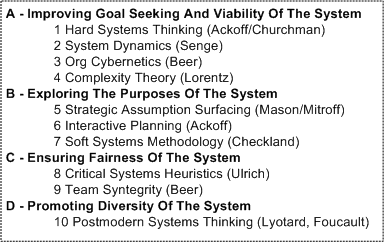
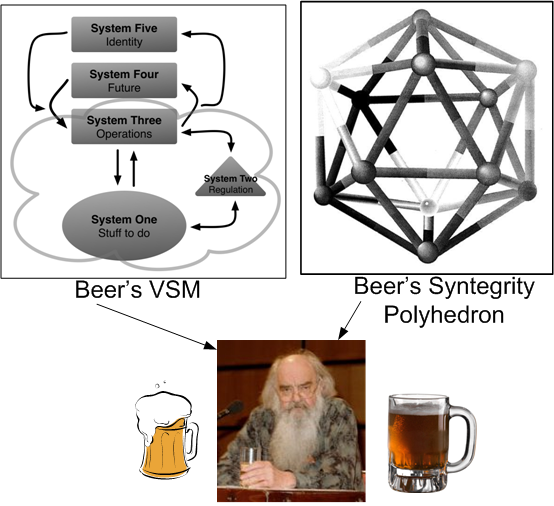
Did you notice that the brilliant Stafford, awesome-last-name, Beer is listed twice and his “Team Syntegrity” approach falls under the “ensuring fairness of the system category“? In Jackson’s opinion, Beer created his cybernetics-based, recursive 5 subsystem, Viable System Model (VSM) for the purpose of improving the goal seeking performance of complex social systems. Beer, both a tasty drink and a staunch anti-hierarchy champion, got so pissed when BMs, BOOGLs, BUTTs, SCOLs and dudes with BFTs interpreted his VSM as just another way of implementing a CCH with omnipotent and omniscient bosses at levels 2-5, that he developed his wildly innovative, polyhedron-based, “Team Syntegrity” approach to ensure fairness in org governance. In his design of the VSM, even though Beer articulated that the sole purpose of subsystems 2-5 is to support the operations of system 1 at the bottom (you know, the DICforce where you and I dwell), people of importance still kept their self-serving UCB blinders on and interpreted his system of management to be hierarchical.
As the figure below shows, the VSM appears to be hierarchical on the surface and, since most (not all) managers operate on the “surface” because they no longer roll up their sleeves to dive into anything difficult to understand, they internalize it as a better way to run their CCH psychic prisons as instruments of domination. However, when one studies Beer’s VSM approach to org management, it’s a self sufficient system of collaboration and intergroup support with each subsystem playing a key role in the holarchy.
Science, Philosophy, Systems Thinking
In Michael C. Jackson‘s rich and engrossing “Systems Thinking: Creative Holism For Managers“, Mr. Jackson describes 10 holistic systems thinking approaches designed to solve complex social managerial problems. As he progressed from the earlier, purely science based, hard-systems thinking approaches to the modern, soft-systems approaches that attempt to fuse science with philosophy, I composed the two pictures below to help clarify my understanding. As usual, I felt an internal urge to externally express my discombobulated thoughts on the topic; so here are the pics.
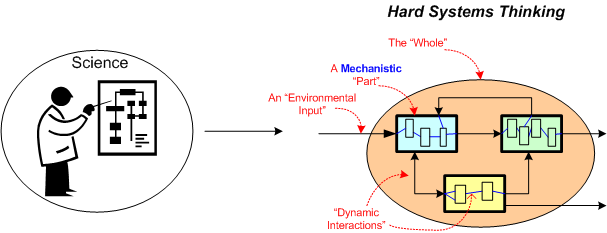
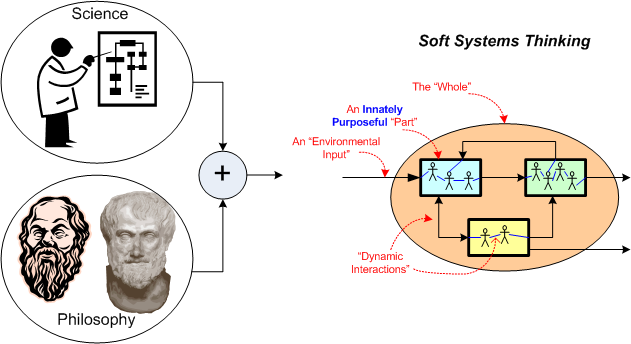 The main distinguishing difference that I see between the hard/soft models is the way that internal system “parts” are characterized. In the hard systems approaches, the system parts are conveniently assumed to have no self-purposes. This, as some people know from experience, is a horribly wrong assumption for systems composed of individual persons – social organizations.
Social org BOOGLs, SCOLs, and BUTTs are forever mired in the hard systems thinking mindset of yesteryear. Their simplistic solution for suppressing any externalization of self-purpose that is at odds with their own is to either consciously or unconsciously apply force to extinguish it. History has shown that this ubiquitously applied technique works – temporarily.
In The “Old Days”
In the “old days”, when companies fell upon hard times and had to let some DICs go, or when the DICforce went on strike, jobs were mechanized enough so that managers could fill the holes and keep the joint running until the situation improved. Of course, in most orgs, that is no longer true today since most managers, certainly those that are BMs, shed and conveniently forget their lowly “worker’s skills” as soon as they are promoted out of the cellar into the clique of elites. Thus, a company that cuts front line DICs without cutting some managers puts itself into a deeper grave. Not only does productivity go down because the holes of work expertise go unfilled, but the overhead cost rises because the same number of managers are left to “supervise” fewer DICs. On the other hand, if all or most of the jettisoned DICs were dead weight, the previous sentence may not be true – unless dead weight BMs were retained. But hey, in the minds of most managers (and all of those who fall into the BM category), fellow comrade managers are not dead weight.
 Update: Shortly after I queued this post up for publication, a friend(?) serendipitously sent me this link: Lockheed Martin press release. Notice the “delay” that took place from the time they shed 10000 DICs to the time they offered some 600 BOOGLs, CGHs, and SCOLs their (no doubt generous) “Voluntary Executive Separation Program“. Better late than never, right?
The executive reductions will help align the number of senior leaders with the overall decline of about 10,000 in the employee population since the beginning of last year, cut overhead costs and management layers, and increase the Corporation’s speed and agility in meeting commitments.
Nice corpo jargon, no?
Two Paths
As a small group of people assembled for a purpose greater than each individual grows, some form of structure is required to prevent chaos from reigning. The top path shows the emergence of a group of integral coordinators while the bottom path shows a traditional, stratified CCH being born.
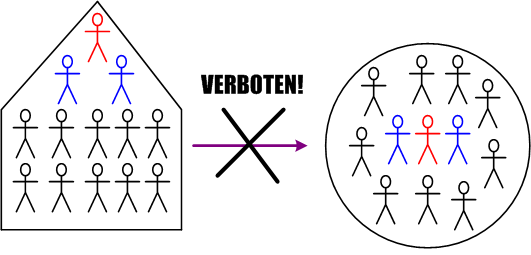
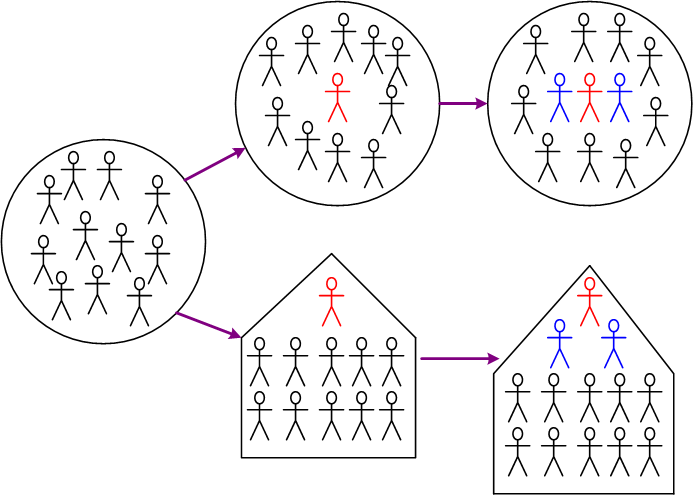 Which group would you rather be a part of? If you say you’d rather be a part of the “circular” group and you’re lucky enough to be a part of one, you’re still likely to get hosed down the road. You see, if your group continues to grow, it will naturally gravitate toward the pyramidal CCH caste system. That is, unless your natural or democratically chosen group leaders don’t morph into CGHs or BOOGLs and they actively prevent the subtle transformation from taking place.
 If you’re currently embedded in a CCH and one of its leaders bravely attempts to change the structure to a circular, participative meritocracy, fugg-ed-aboud-it. The change agent will get crushed by his/her clanthinking BOOGL and SCOL peers, who ironically espouse that they want circular behavior while still preserving the stratified CCH.
Alignment
You can supply your own words for this post…..

Deterministic, Animated, Social
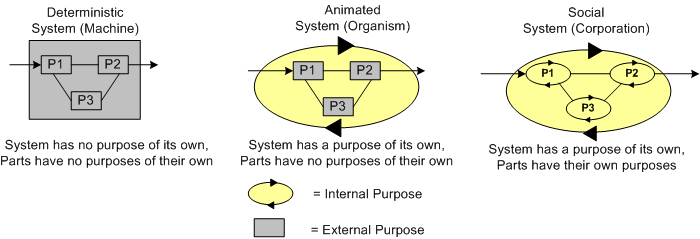
Unless you object, of course, a system can be defined as an aggregation of interacting parts built by a designer for a purpose. Uber systems thinker Russell Ackoff classified systems into three archetypes: deterministic, animated, and social. The main criterion Ackoff uses for mapping a system into its type is purpose; the purpose of the containing whole and the purpose(s) of the whole’s parts.
The figure below attempts to put the Ackoff “system of system types” 🙂 into graphic form.
Deterministic Systems
In a deterministic system like an automobile, neither the whole nor its parts have self-purposes because there is no “self”. Both the whole and its parts are inanimate objects with fixed machine behavior designed and assembled by a purposeful external entity, like an engineering team. Deterministic systems are designed by men to serve specific, targeted purposes of men. The variety of behavior exhibited by deterministic systems, while possibly being complex in an absolute sense, is dwarfed by the variety of behaviors capable of being manifest by animated or social systems.
Animated Systems
In an animated system, the individual parts don’t have isolated purposes of their own, but the containing whole does. The parts and the whole are inseparably entangled in that the parts require services from the whole and the whole requires services from the parts in order to survive. The non-linear product (not sum) of the interactions of the parts manifest as the external observable behavior of the whole. Any specific behavior of the whole cannot be traced to the behavior of a single specific part. The human being is the ultimate example of an animated system. The heart, lungs, liver, an arm, or a leg have no purposes of their own outside of the human body. The whole body, with the aid of the product of the interactions of its parts produces a virtually infinite range of behaviors. Without some parts, the whole cannot survive (loss of a functioning heart). Without other parts, the behavior of the whole becomes constrained (loss of a functioning leg).
Social Systems
In a social system, the whole and each part has a purpose. The larger the system, the greater the number and variety of the purposes. If they aren’t aligned to some degree, the product of the purposes can cause a huge range of externally observed behaviors to be manifest. When the self-purposes of the parts are in total alignment with whole, the system’s behavior exhibits less variety and greater efficiency at trying to fulfill the whole’s purpose(s). Both internal and external forces continually impose pressure upon the whole and its parts to misalign. Only those designers who can keep the parts’ purpose aligned with the whole’s purpose have any chance of getting the whole to fulfill its purpose.
System And Model Mismatch
Ackoff states that modeling a system of one type with the wrong type for the purpose of improving or replacing it is the cause of epic failures. For example, attempting to model a social system as a deterministic system with an underlying mathematical model causes erroneous actions and decisions to be made by ignoring the purposes of the parts. Human purposes cannot be modeled with equations. Likewise, modeling a social system as an animated system also ignores the purposes of the many parts. These mismatches assume the purposes of the parts align with each other and the purpose of the whole. Bad assumption, no?
What’s Your ITAR?
A recent personal discovery that revealed itself to me is that “inquiring more and asserting less” is more effective than vice versa. Nonetheless, even after discovering this insight, I’m having a hard time increasing my Inquiry To Assertion Ratio (ITAR).
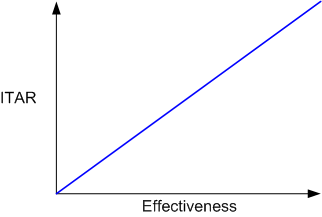
As you probably know, it’s difficult to change ingrained, long term behavior. When a social situation pops up in which the choice to inquire or assert appears, there often is no choice for me. In order to appear “in the know“, I automatically pull the trigger and make an assertion without asking any questions beforehand. However, I think I’ve made some progress. I can now often detect what I did after the fact. To improve even further, I’m hoping to reach the point where I can detect my transgression instantaneously, in the moment, so that I actually can choose to inquire or assert before I act. Ahhh, that would be nirvana, no?
In patriarchical CCH orgs, the ingrained mindset is such that the higher one moves up in the hierarchy, the lower the ITAR. That’s because BOOGLs and SCOLs unconsciously feel the need to appear infallible in front of the DICforce. Adding fuel to the fire, the DICsters fuel this behavior by expecting patriarchs to be infallible and have all the answers. It’s a self-reinforcing loop of ineffective behavior.
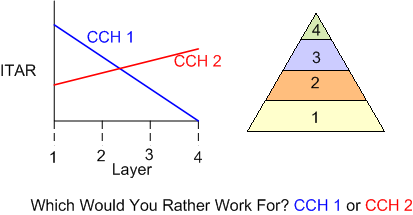 What’s your ITAR? As you age, do you find it rising – or sinking?
Zappos Rocks Again
As a huge, huge, huge, (did I say youuuuuuuge-uh?), fan of Tony Hsieh and Zappos.com, I blabber about them often. Zappos latest action to make the whole world, yes, the whole world, a better place is to offer up a free, yes free, download of the audio version of the best seller, yes best seller, book “Tribal Leadership“. The link is here, yes here.

Even though I’ve stalked Zappos.com for years, until recently I’ve never bought anything from them because I’m not a shoe or clothes dude. Hell, I’m an old and unredeemable person of questionable integrity and questionable character and questionable morality and questionable <<add your own trait here if you know me>>, so I renew these things about every 10 years or when they fall apart; whichever comes first. However, even with zero revenue from me, they upgraded me to VIP status. This means that with every order I place, they’ll guarantee free overnight shipping. WTF, you say? Uh, the only answer that I can give to you is: They’re fuckin’ Zappos.com dude, that”s why! Oops, I hope the F-bomb didn’t make you mad and send you to the altar to pray for me. If it did, then maybe you shouldn’t be wasting your time reading this blasphemous blog 🙂

Why am I here?
WTF?
Meh!
D'oh!

My BTC Address



 Bulldozer00's Blog