Archive
Executive Proposal
The lowly esteemed and dishonorable BD00 proposes to executives everywhere:
Whenever you change your org, supply the minions with TWO complementary org charts: the usual (yawn) who-reports-to-whom chart and a system operational structure chart.

Creating the first one is an easy task; the second one, not-so. That’s why you’ve never seen one.
The funny thing is, every borg has a “System Operational Structure” chart regardless of whether it’s known or (most likely) not. Reshuffling the “Who-Reports-To-Whom” chart without knowing and consulting with the “Systems Operational Structure” chart doesn’t improve operations (unless the reshuffler gets lucky), it justs changes who to blame when sub par performance persists after the latest and greatest reshuffle.
Bastions Of Objectivity
Experts don’t think, they know. (just like Bulldozer00)
In theory, high brow academic disciplines are supposed to be bastions of dispassionate objectivity. However, in the Oscar-winning documentary “Inside Job“, several of the most highly esteemed professors of economics are laughingly called out onto the mat by Charles Ferguson (ala Mike Wallace style) for taking payments from the financial institutions that triggered the 2008 meltdown. These dudes wrote papers and gave speeches praising the virtues of “no regulation” on junk bundles of sub-prime loans, credit default swaps and all other kinds of financial “innovations“. That in itself wouldn’t be so bad, but when these bozos shoveled their BS “expertise” onto laymen like you and me, they didn’t even disclose that they were being paid by the big bad dudes who figuratively deflated your pension and 401-K account.
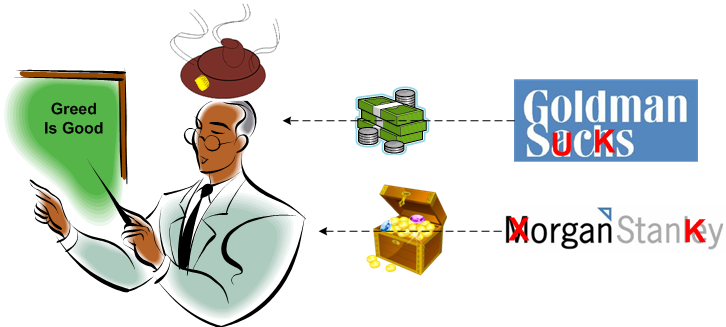
Along with Kevin Smith’s “Red State“, former software-weenie Charles Ferguson’s “Inside Job” are the best two movies I’ve seen this year. If you’ve still retained your Netflix subscription after their recent price change fiasco, put these movies at the top of your queue.
Bucket Brigade
If you are indispensable, you’re unpromotable. – Unknown
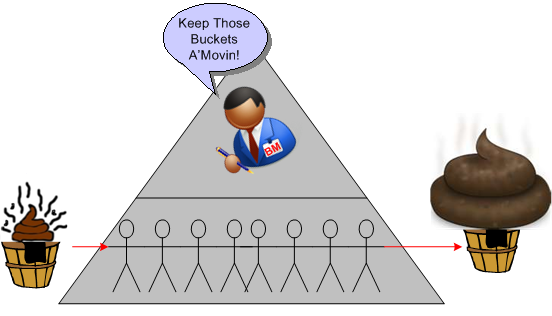
I don’t know who said that quote, but it’s pretty true, no? Some people and groups, especially bureaucrats and those in overhead middle management and staff roles, either wittingly or unwittingly do everything they can to make their jobs so complicated and unfathomable that no one else can do them and the org that employs them would be temporarily hosed if they left. It’s the familiar “truck number of 1” syndrome.
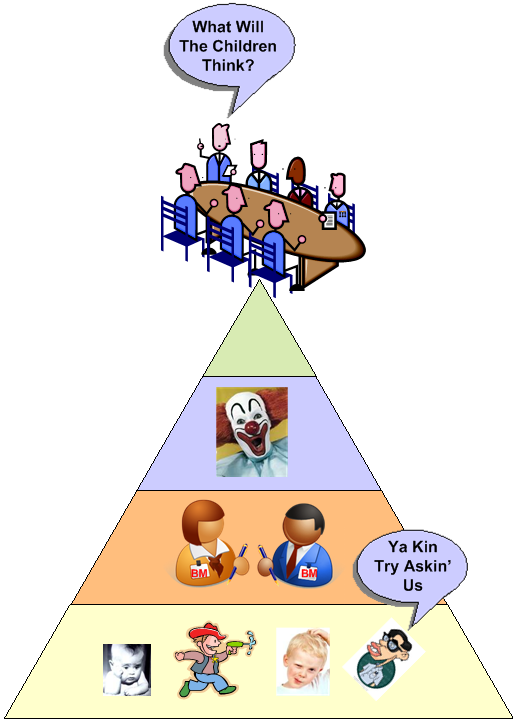
The problem is that both managers and “regular” employees in unenlightened borgs collude to make it so. Managers want efficiency to keep operating costs low and employees want a comfort zone that minimizes the chance of them making visible mistakes. Specialization breeds specialization over time until a brittle bucket brigade of one-dimensional, highly interdependent, change-averse “parts” is set in stone.
What Will The Children Think?
Confined Safety
In ho-hum, yawner borgs, a meticulously followed but mysteriously unwritten rule is that Domain Analysts (DA) and Software Developers (SD) remain safely within the confines of their area of expertise:

The borg’s job classification, compensation, and status-award sub-systems ensure that this “confined safety” rule is firmly in place; and silently enforced. No encroachment is allowed, lest social punishment be inflicted to “right the wrong“.
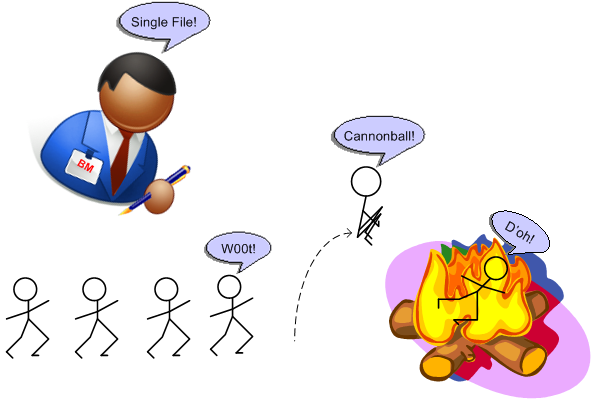
When turf transgressions in the form of hard-to-answer questions and “suggested” alternatives from an encroacher occur:

a rebuke from the (Jim) encroachee is sure to follow. If that tactic doesn’t flatten and widen the boundary curve back into place, then the big gun is rolled out: management. D’oh! Watchout!
In effective, world class orgs, there is no “confined safety” rule:

This non-horizontal, continuous, and smooth interface boundary between disciplines is not only an anomaly, but when it does miraculously manifest, it’s only temporary and local, no?
Hell, there are no rules here. We’re trying to accomplish something. – Thomas Alva Edison
Ubiquitous Dishonorability
While reading the delightful “Object-Oriented Analysis and Design with Applications“, Grady Booch et al extol the virtues of object-oriented analysis over the venerable, but passe, structured analysis approach to front end system composition. As they assert below, one of the benefits of OOA is that it’s easier and more natural to avoid mixing concrete design details with abstract analysis results.

Out of curiosity (which killed the cat), I scrolled down to see what note [4] meant:

WTF? Do they mean “because that’s the way the boss sez it must be done!” and “because that’s the way we’ve always done it!” aren’t honorable reasons for maintaining the status quo? If so, then dishonorable behavior runs rampant within the halls of most software shops the world over. But you already knew that, no?

Mostly True
“Adding people to a late project makes it later” – Frederick Brooks
If an underway project is perceived as a schedule buster (and it usually is if managers are thinking of hurling more bodies into the inferno) then this famous Brooksian quote is true. However, if the project’s tasks are reasonably well defined, loosely coupled, and parallelized to the extent they can be, then adding people to a late project may actually help it finish earlier – without severely degrading quality.
Alas, the bigger the project, the less likely it is to be structured well enough so that adding people to it will speed up its completion. Not only is it harder to plan and structure larger projects, the people who get anointed to run bigger projects are more likely to be non-technical managers who only know how to plan and execute in terms of the generic, cookie-cutter, earned-value sequence of: requirements->design->code->test->deliver (yawn). Knowledge and understanding of any aspect of the project at the lower, more concrete, project-specific, level of detail that’s crucial for success is most likely to be absent. Bummer.
Silo City
The title of this strategy+business article, “One Way to Lose Employees: Train Them”, is not shocking, no? If you believe it, then you’ll most likely believe a fictional, complementary article titled “One Way To Retain Employees: Don’t Train Them“.
Regarding the first, real article, the authors assert that mechanistic training is not enough to retain employees. It just makes them more marketable to competitors. If they’re not treated well and not allowed to grow, they’ll simply leave.
Regarding the second, reinforcing ghost article, the author summarizes his/her message as:
The researchers found that the deliberate withholding of funding and the lack of active encouragement to participate regularly in seminars, training sessions, and workshops kept workers from leaving because it left them thinking that their skills were becoming obsolete and feeling that they were unmarketable and “stuck” inside the borg. Additionally, the dearth of career mentoring and unhealthy boss–subordinate relationships instilled a culture of fear and an unsettling feeling of quiet desperation among employees. The lack of job rotations also decreased employees’ hopes of a bright future, the researchers found. A policy of no rotating assignments prevented employees from learning about different aspects of the company and from forming new social contacts across the organization.
Between the research findings summarized in the two articles, it’s a slam dunk. To keep employees from leaving, simply don’t train them and keep them sequestered within their one dimensional silos.
 But wait! All is not lost. To retain employees while simultaneously training them to be more productive to the org, the authors of the real article recommend this multi-faceted approach:
The researchers found that regular participation in seminars, training sessions, and workshops sent an important signal to workers that the organization was investing in and valuing them. Additionally, career mentoring and healthy boss–subordinate relationships built loyalty among employees. Job rotations also increased employees’ hopes of a bright future, the researchers found. Rotations allowed employees to learn about different aspects of the company and form new social contacts across the organization.
90 Degree Rotation
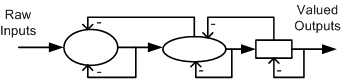
The figure below shows a 3 group system that efficiently transforms a stream of raw inputs into a stream of valued outputs (they’re valued because customers want to pay for them) via the application of talent, knowledge, and skill. In this system, since all groups are on the same horizontal plane of importance, negative feedback channels are embraced, and hence, the information that flows within them blunts the rate of increase in entropy while providing a source of reflective learning.
Now, let’s introduce vertical levels of “perceived importance” by rotating the system in the clockwise direction by 90 degrees:

So, you ask “why were those red verboten x’s introduced during the rotation? “. I put them there because once people start perceiving that the levels above are more important than them, they stop giving negative feedback – even when the inputs they’re given to work with turn into POPs over time. After all, if someone/group is perceived as more important than someone else, the “someone else” is likely to think that whatever they’re given as an input to work with must be good – regardless of its real quality.
Now, let’s introduce a culture of fear (which usually goes hand-in-hand with hierarchical levels of importance) into the system:

So, you ask “why were those feedback loops to “self” crossed out? “. You see, when a sub-group is an integral part in a fearful hierarchy of importance, it doesn’t critically evaluate its own work and it covers up mistakes – lest it be perceived as unworthy for promotion to the next higher level of importance by those in said level.
As startups grow, unless their founders exert Herculean force to prevent it, they start rotating to the right. The rate of rotation is often so sloooow that no one notices it until it’s too late . The feedback loops are broken, product/service quality erodes, and the fit hits the shan. D’oh! I hate when that happens. Don’t you?
Personal And Social

Why am I here?
WTF?
Meh!
D'oh!

My BTC Address



 Bulldozer00's Blog