Archive
The Principle Objective
The principle objective of a system is what it does, not what its designers, controllers, and/or maintainers say it does. Thus, the principle objective of most corpocratic systems is not to maximize shareholder value, but to maximize the standard of living and quality of work life of those who manage the corpocracy…
The principal objective of corporate executives is to provide themselves with the standard of living and quality of work life to which they aspire. – Addison, Herbert; Ackoff, Russell (2011-11-30). Ackoff’s F/Laws: The Cake (Kindle Locations 1003-1004). Triarchy Press. Kindle Edition.
It seems amazing that the non-executive stakeholders of these institutions don’t point out this discrepancy when the wheels start falling off – or even earlier, when the wheels are still firmly attached. Err, on second thought, it’s not amazing. The 100 year old “system” demands that silence is expected on the matter, no?

Reeking Of Rank
In the 20th century (remember what it was like way back when?), “neutron” Jack Welch unabashedly, successfully, and transparently used a ranking system to catapult GE to the top of the financial world by ex-communicating the bottom 10% on a yearly(?) schedule.
When leadership teams make a corpo-wide policy change, they do so in a sincere attempt to improve some performance metric in the org without inflicting too much collateral damage. For example, take the above policy of “ranking” employees. Orgs that rank their employees may “assert” that rankings will increase engagement, morale, and let people “know where they stand” in relation to their peers.

That’s all fine and dandy as long as the ranking system applies equally to each and every level in the org – especially if it’s asserted to be a guaranteed slam dunk for increasing employee engagement . Hell, if it’s a no-brainer, then why exclude the supervisor, manager, director, and C-level layers? After all they’re “employees” too, no?
I wonder if #1 Jack Welch ranked his direct reports and gracefully escorted his bottom 10% out the door every year?

ReOrg City
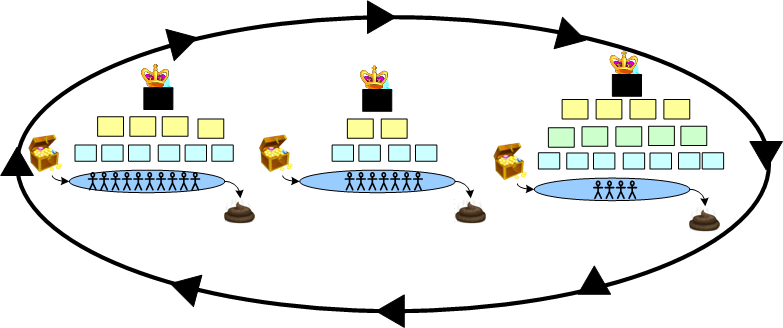
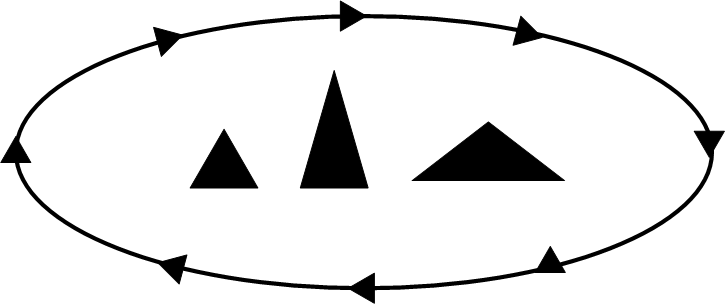
The structure of the “whole” and the behaviors at both the top and bottom remain the same. Only the width and/or height of the pyramid changes with each reorg. But alas, that’s just “the way it has to be“, no?
He’s In The MIX
Ricardo Semler, one of my innovation heroes, is now a MIXer: Ricardo Semler | Management Innovation eXchange. Until reading his first contribution to the MIX, I hadn’t seen hair nor hide of him for a couple of years. I had thought he’d retired or something like that.
As usual, in his “Retire-a-Little: Enabling More Fulfilled Working Lives“ management hack, Mr. Semler tells the story of yet another heretical and “outrageous” practice that he implemented at Semco Inc. Even if you don’t “buy into” his “retire a little” program, ya gotta love his 3 hour “Are You Nuts?” meetings, no? Try to picture the reception someone would get in your org for suggesting something like an “Are You Nuts?” initiative. Would anyone even attempt to suggest it?

Filtered And Delayed
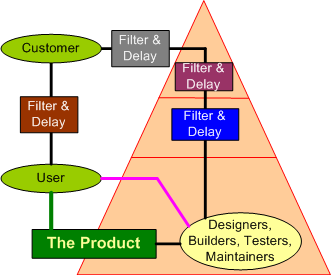
In the consumer products business, the customer and the user are one and the same – a “customoozer“. The figure below shows two system “designs” for a consumer products company. All other things equal, which one has the competitive advantage?

In industries like B2B and government contracting, where the customer and end user are separate entities with differing wants/needs/agendas, the typical institutional design structure is shown below:

It’s no wonder that most innovation occurs in the consumer products industry.
If it could be pulled off, do you think that the subversive system enhancement below could provide a competitive advantage?
Transparency, Meritocracy, and Collaboration
When Red Hat Inc. went public with much fanfare 12 years ago, I thought there was no way the company would make money on the Linux open source operating system. As usual, BD00 was outright wrong. This MIX article by Red Hat VP Jackie Yeaney, “Democratizing the Corporate Strategy Process at Red Hat”, may explain one reason why.
In her article, Ms. Yeaney shares all the details of the company’s strategic development process along with some performance metrics that demonstrate its effectiveness. Here are some snippets that I found refreshingly interesting.
“When I first started working with Red Hat at the beginning of 2008, it was readily apparent that the traditional corporate strategy development process would simply not work in an open source company where transparency, meritocracy, and collaboration were prized elements of the culture.”
“While many might view it is as a disadvantage or a time sink to systematically gather feedback from across the company, at Red Hat it’s a core part of our competitive advantage.”
“We built an internal wiki that leaders of each exploration team used to organize their thoughts and ideas out in the open where any employee could make comments or suggestions. Anyone who was particularly interested could read about the progress, and add their ideas or volunteer to help (and many did).”
“This information-gathering dialog lasted about 5 months. We communicated our progress along the way through regular updates at company meetings, through email, and on the Intranet. The strategy team leaders posted status updates to the wiki and replied to comments on their team’s internal blog. Jim hosted a company-wide online chat session where associates could ask him any question they wanted to about the strategy process (or anything else that was on their minds), and team leads communicated key updates through company-wide announcements and discussions.”
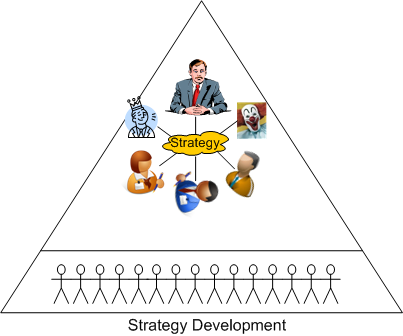
The likelihood that you have any clue of how business strategy is created in your org is low. The likelihood that you’re given the chance to actively participate in the process is even lower, dontcha think? Instead of being “engaged with” you’re simply “communicated to“, no?
The Mythical Dual Ladder
The figure below shows a typical skill development timeline. At “t=0” ignorance reigns and learning begins. After a period of learning/applying/practicing, which varies widely from person to person, the status of “Novice” is achieved. After yet another period of learning/applying/practicing, the transition from novice to amateur occurs – and so on up to the level of master and beyond.

The key attribute to focus on in the timeline is the change in length of time required to transition from one level of competence to the next. It doesn’t stay the same or get smaller, it gets longer. Thus, with exceptions of course, the time required to transition from expert to master is greater than the time to transition from amateur to expert.
To remain viable, every product development company requires a critical mass of expertise in the core technologies that comprise the soul of its product portfolio. World class companies actively “nourish and catalyze” the novice-to-expert pipeline via continuous investments in targeted training and conference attendance. Average companies neither nourish or catalyze the pipeline, they “hope for the best” in that their employees will keep up with technology advancements on their own time. In the extreme, CLORGS and DYSCOs unconsciously “toxify and inhibit” the pipeline – if one is even recognized at all. They do this by implicitly encouraging experts to move out of technology and into management via higher compensation and stature for those experts/masters who jump from the mythical technical ladder to the coveted management ladder.

Well Known And Well Practiced
It’s always instructive to reflect on project failures so that the same costly mistakes don’t get repeated in the future. But because of ego-defense, it’s difficult to step back and semi-objectively analyze one’s own mistakes. Hell, it’s hard to even acknowledge them, let alone to reflect on, and to learn from them. Learning from one’s own mistake’s is effortful, and it often hurts. It’s much easier to glean knowledge and learning from the faux pas of others.
With that in mind, let’s look at one of the “others“: Hewlitt Packard. HP’s 2010 $1.2B purchase of Palm Inc. to seize control of its crown jewel WebOS mobile operating system turned out to be a huge technical and financial and social debacle. As chronicled in this New York Times article, “H.P.’s TouchPad, Some Say, Was Built on Flawed Software“, here are some of the reasons given (by a sampling of inside sources) for the biggest technology flop of 2011:
- The attempted productization of cutting edge, but immature (freeze ups, random reboots) and slooow technology (WebKit).
- Underestimation of the effort to fix the known technical problems with the OS.
- The failure to get 3rd party application developers (surrogate customers) excited about the OS.
- The failure to build a holistic platform infused with conceptual integrity (lack of a benevolent dictator or unapologetic aristocrat).
- The loss of talent in the acquisition and the imposition of the wrong people in the wrong positions.
Hmm, on second thought, maybe there is nothing much to learn here. These failure factors have been known and publicized for decades, yet they continue to be well practiced across the software-intensive systems industry.
Obviously, people don’t embark on ambitious software development projects in order to fail downstream. It’s just that even while performing continuous due diligence during the effort, it’s still extremely hard to detect these interdependent project killers until it’s too late to nip them in the bud. Adding salt to the wound, history has inarguably and repeatedly shown that in most orgs, those who actually do detect and report these types of problematiques are either ignored (the boy who cried wolf syndrome) or ostracized into submission (the threat of excommunication syndrome). Note that several sources in the HP article wanted to “remain anonymous“.

Related articles
- Sluggish code and HP power plays blamed for webOS’ failure (slashgear.com)
- Leaks: webOS struggled with poor staff, fundamental design (electronista.com)
- Why WebOS Failed (technologizer.com)
Fish On Fridays
Note: Today, on 12/23/11, I’m delighted to present to you the first guest blog entry ever posted on bulldozer00.com. Woot! The following delicious blarticle comes to you from a frequent BD00 blog commenter who logs on using a myriad of creative names with the word “fish” in them. Could it be Abe Vigoda in disguise?
————————————————————————————————————–
Seasons Greetings to the followers of BD00’s blog—Welcome to a not-so-periodic, occasional feature we’re going to call “Fish on Fridays“.
Everyone knows the Bulldozer here puts in a great deal of effort spinning his wheels and blogging about the world as he sees it. And like everyone, he deserves a break–a vacation if you will. So here I am pinch-hitting every once in a while so BD00 can enjoy that extra dirty martini over the holidays.
Yesterday’s blog about glorifying the Salesmen and the Accountants spelling the demise of a company got me thinking about the perceptions of the people that “Do” versus the people that “Don’t“.
I’m a creative–not a code jockey like the ‘dozer. I take blank sheets of paper (white-screen on a monitor these days) and I draw up conceptual design solutions to merchandise consumer products in appealing ways and dress up retail environments that will convince consumers to part with their hard-earned cash for that next great thing in the store.
This time of year, there’s always a huge battle that goes on at just about every company, where the people that “Do” decide to take time off from their work and take a well-deserved vacation; a break from the daily grind. This leaves the people who “Don’t” holding the reigns while those that “Do” are away. In my company, two things happen. The people that “Do” (salesmen) all rush in with a whole list of new projects that require the people that “Don’t” to generate a great deal of output while those that “Do” are away. Generally, this output has a well-defined deadline–the “First of the Year” or “Right after the Holiday“, or “As soon as we get back“. This allows them to set up a huge flurry of new customer visits and get a ‘fresh start‘ on the year, while they take their break and kick up their feet in the sand with a cooler of Corona’s beside them.
As a result, the people that “Do” go away for a week or two, and the people that “Don’t” have a mad rush of activity that must all be completed right at the time when EVERYONE wants to take a break and enjoy the season. Usually, this also means short-time frames as there are at least 2 and sometimes 3 or 4 workdays that have been turned into corporate days off, so the actual work-week is truncated and those that “Don’t” actually have much less time to complete their tasks than they normally would. This is compounded by the fact that at least a portion of the people that “Don’t” are also taking time off, leaving a skeleton crew around to cover and handle the work that comes in.
Quite often, particularly when your business activities rely on the support of other businesses (suppliers, contractors, agencies, etc), everything at this time of year slows down or becomes impossible because everyone is short-handed. You can’t get answers from your customer, the salesperson is unavailable to help, you can’t find stuff, and the outside groups you depend on are unable to respond in the same timely manner as you are used to. As a result, the things you need to do can’t get finished until everyone else gets back and you get to start the year with a whole bunch of extra time in the office, sweating out the details while those who “Do” are off relaxing.
The perception is that there is this great holiday season and everyone should enjoy it, but in the great corporate world of BOZOs the reality is that there is usually one class of workers where the holiday time is one of the busiest and most stressful times of the year. I found this quote from an Apple employee that just about sums it all up…
You can expect that your needs will always come second to “the needs of the business”. In fact, anytime you hear that phrase, be prepared for the next sentence to describe how you’re going to be screwed. For example, “I’m sorry, Joe, but the needs of the business dictate that you can’t take a vacation between October and February, or June through September”.
I am reminded of the movie Ants, where the worker Ants–those that ‘Don’t‘ bust their little exoskeletons to feed the Grasshoppers who ‘Do‘. There is a quote in this blog attributed to Tom Sutcliffe where he is looking at the recent uprisings in Egypt and comparing them to business. Sutcliffe mentions that:
It seems odd that people will endure, within the framework of a firm or an institution, a degree of subjection and speechlessness that would strike them as insufferable at the level of citizenship and that “office tyrannies” might end up becoming the target of mass uprisings not unlike those that we have been witnessing in the Middle East.
At a forward thinking company, the entire place shuts down for the holidays–no one is left holding the bag. But with the glorification of those that ‘Do‘ as BD00 discussed, we are creating an internal separation between groups, which is part of the process of demise. Look at your company and the people around you. Are you someone that “does” or someone that “doesn’t“? What are you doing for the people on the other side of that equation?
Happy Holidays?

Salesmen And Accountants
No one has ever failed to find the facts they are looking for. – Peter Drucker
Mr. Drucker may have gotten it wrong, at least in BD00’s case. It seems like the “facts” that I desperately need to continuously confirm my distorted world view come right up to me out of hiding and bite me in the bumpkiss. (If they don’t, I simply make some pseudo-facts up to feed the need).
Here’s one of the latest confirmations, and it’s in the form of another quote:
“It is difficult to get a man to understand something, when his salary depends upon his not understanding it.” – Upton Sinclair
Say what, you ask? That quote deftly closes this Forbes article written by “radical” Steve Denning: “Why Big Companies Die”.
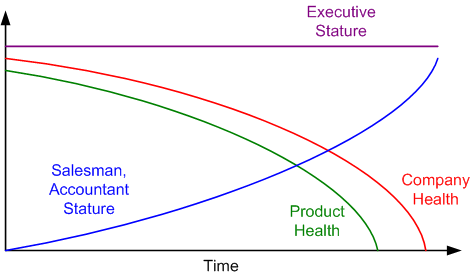
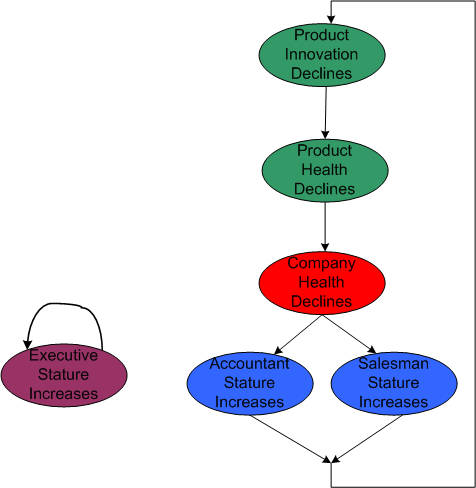
Quoting Steve Jobs on where salesmen come into play, and adding his own two cents on where accountants come into play, “rad” Steve describes an oft repeated pattern of corpo demise:
“The company does a great job, innovates and becomes a monopoly or close to it in some field, and then the quality of the product becomes less important. The company starts valuing the great salesman, because they’re the ones who can move the needle on revenues. So salesmen are put in charge, and product engineers and designers feel demoted: Their efforts are no longer at the white-hot center of the company’s daily life. They “turn off.”” – Steve Jobs
“The activities of these people (the accountants) further dispirit the creators, the product engineers and designers, and also crimp the firm’s ability to add value to its customers. But because the accountants appear to be adding to the firm’s short-term profitability, as a class they are also celebrated and well-rewarded, even as their activities systematically kill the firm’s future.” – Steve Denning
The dorky BD00 graph below attempts to map the above words onto an unscaled timeline.
Or, if you prefer, here’s an alternative view of this unconscious pattern of demise:

Why am I here?
WTF?
Meh!
D'oh!

My BTC Address



 Bulldozer00's Blog