Archive
Improving, Exploring, Ensuring, Promoting
In Michael C. Jackson‘s rich and engrossing “Systems Thinking: Creative Holism For Managers“, Mr. Jackson describes 10 holistic systems thinking approaches designed to solve complex social managerial problems. As the tables below illustrate, Mr. Jackson allocates the approaches to four classes depending on the main purpose of the approach. For example, he asserts that Stafford Beer‘s “Team Syntegrity” approach is employed primarily to ensure fairness during the process of solving a complex social systems problem.
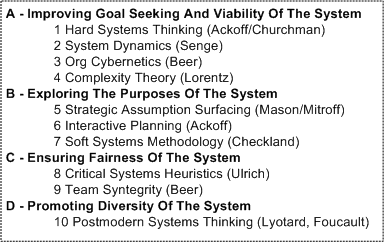
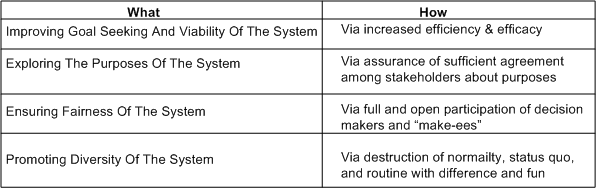
I really like Jackson’s book because of its breadth, vocabulary, and the way he covers each of the 10 systems approaches from its philosophical roots, to theory, to methods. He also supplies a real application example for each approach. In the final part of the book, Jackson integrates all of the approaches into a supra-holistic (?) approach that advocates mixing and matching elements of each approach and tailoring the “Creative Holism” meta-methodology to the specific “mess” at hand.
The last book that I read twice in a row was the brilliant Quantum Enigma by Fred Kuttner and Bruce Rosenblum. I’m gonna do the same with this masterpiece.
Positive Or Negative, Meaning Or No Meaning?
In Claude Shannon‘s book, “The Mathematical Theory Of Communication“, Mr. Shannon positively correlates information with entropy:
Information = f(Entropy)
When I read that several years ago, it was unsettling. Even though I’m a layman, it didn’t make sense. After all, doesn’t information represent order and entropy represent its opposite, chaos? Shouldn’t a minus sign connect the two? Norbert Wiener, whom Claude bounced ideas off of (and vice-versa) thought it did. His entropy-information connection included the minus sign.
In addition, Shannon’s theory stripped “meaning”, which is person-specific and unmodel-able in scrutable equations, from information. He treats information as a string of bland ‘0’ and ‘1’ bits that get transported from one location to another via a matched, but insentient, transmitter-receiver pair. Wiener kept the “meaning” in information and he kept his feedback loop-centric equations analog. This enabled his cybernetic theory to remain applicable to both man and the machine and make assertions like: “those who can control the means of communication in a system will rule the roost“.

Like most of my posts, this one points nowhere. I just thought I’d share it because I think others might find the Shannon-Wiener differences/likenesses as interesting and mysterious as I do.
Morally Irresponsible Stooges
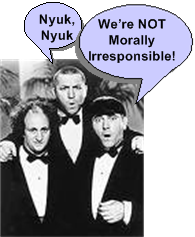
In the first place, it is clear that the degradation of the position of the scientist as an independent worker and thinker to that of a morally irresponsible stooge in a science factory has proceeded even more rapidly and devastatingly than I had expected. The subordination of those who ought to think to those who have the administrative power is ruinous to the morale of the scientist, and quite to the same extent, the objective scientific output of the nation. – Norbert Wiener.
By stealing Norby’s quote and replacing a few words, we can make up this nasty, vitriolic, equivalent passage (cuz I like to make stuff up):
In the first place, it is clear that the degradation of the position of the product creator/developer as an independent worker and thinker to that of a morally irresponsible stooge in a corpocracy has proceeded even more rapidly and devastatingly than I had expected. The subordination of those who ought to think to those who have the bureaucratic power is ruinous to the morale of the wealth creator, and quite to the same extent, the productive output of the CCF. – Bulldozer00.
These days, exploiters are more valued than explorers and makers. In the good ole days (boo hoo!) and in most present day startup companies, the exploiters were/are also the explorers and makers, but because of a lack of respect and support for the species, the multi-disciplined systems thinker and doer has gone the way of the dinosaur. It’s only getting worse because as complexity grows, the need for renaissance men and women to harness the increase in complexity’s dark twin, entropy, is accelerating.
Dark Hero
In Dark Hero of the Information Age: In Search of Norbert Wiener The Father of Cybernetics, authors Flo Conway and Jim Siegelman trace the life of Mr. Wiener from child prodigy to his creation of the interdisciplinary science of cybernetics. As a student of the weak (very weak) connection between academic and spiritual intelligence, I found the following book excerpt fascinating:
Since his youth, Wiener was mindful that his best ideas originated in a place beneath his awareness, “at a level of consciousness so low that much of it happens in my sleep.” He described the process by which ideas would come to him in sudden flashes of insight and dreamlike, hypnoid states:
Very often these moments seem to arise on waking up; but probably this really means that sometime during the night I have undergone the process of deconfusion which is necessary to establish my ideas…. It is probably more usual for it to take place in the so-called hypnoidal state in which one is awaiting sleep, and it is closely associated with those hypnagogic images which have some of the sensory solidity of hallucinations. The subterranean process convinced him that “when I think, my ideas are my masters rather than my servants.”
Barbara corroborated her father’s observation. “He frequently did not know how he came by his answers. They would sneak up on him in the middle of the night or descend out of a cloud,” she said. Yet, because Wiener’s mental processes were elusive even to him, “he lived in fear that ideas would lose interest in him and wander off to present themselves to somebody else.”
This description of how and when ideas instantaneously appear out of the void of nothingness aligns closely with those people who say their best ideas strike them: in the shower, on vacation, out in nature, during meditation, while driving to work, exercising, or doing something they love. In situations like these, the mind is relaxed, humming along at a low rpm rate, and naturally prepared for fresh ideas. Every person is capable of receiving great ideas because it’s an innate ability – a gift from god, so to speak. Most people just don’t realize it.
I haven’t heard many stories of a great idea being birthed in a drab, corpo-supplied, cubicular environment under the watchful eyes of a manager. Have you?
 Note: The picture above is wrong. Exept for “what’s your status?“, BMs don’t ask DICs for anything. Since they know everything, they just tell DICs what to do.

Why am I here?
WTF?
Meh!
D'oh!

My BTC Address



 Bulldozer00's Blog