Archive
Dependable Mission Critical Software
In this post, Embedded.com – Software for dependable systems, Jack Gannsle introduced me to the book: Software for Dependable Systems–Sufficient Evidence?. It was written by the “Committee on Certifiably Dependable Software Systems” and it’s available for free pdf download.
Despite being written by a committee (blech!), and despite the bland title (yawn), I agree with Jack in that it’s a riveting geek read. It’s understandable to field-hardened practitioners and it’s filled with streetwise wisdom about building dependability into large, mission critical software systems that can kill people or cause massive financial loss if they collapse under stress. Essentially, it says that all the bloated, costly, high-falutin safety and security and certification processes in existence today don’t guarantee squat – except jobs for self-important bureaucrats and wanna-be-engineers. They don’t say it THAT way of course, but that’s my warped and unprofessional interpretation of their message.
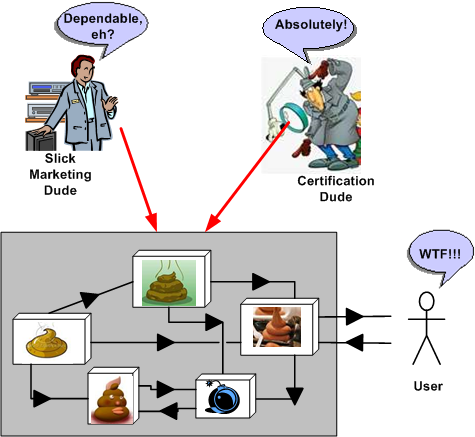
Here are a few gems from the 149 page pdf:
As is well known to software engineers, by far the largest class of problems arises from errors made in eliciting, recording, and analysis of requirements.
Undependable software suffers from an absence of a coherent and well articulated conceptual model.
Today’s certification regimes and consensus standards have a mixed record. Some are largely ineffective, and some are counterproductive. (<- This one is mind blowing to me)
The goal of certifiably dependable software cannot be achieved by mandating particular processes and approaches regardless of their effectiveness in certain situations.
In addition to lampooning the “way things are currently done” for certifying software-centric dependability, the committee dudes actually make some recommendations for improving the so-called state of art. Stunningly, they don’t prescribe yet another costly, heavyweight process of dubious effectiveness. They recommend any process comprised of best practices; as long as there is scrutable connectivity from phase to phase and from start to end to “preserve the chain of evidence” for a claim of dependability that vendors of such software should be required to make. Where there is a gap between links in the chain of scrutability, they recommend rigorous analysis to fill it.
To make the transition to the new mindset of scrutable connectivity, they say that these skills, which are rare today and difficult to acquire, will be required in the future:
- True systems thinking (not just specialized, localized, algorithmic thinking that’s erroneously praised as systems thinking by corpocracies) of the properties of the system as a whole and the interactions among its components.
- The art of simplifying complex concepts, which is difficult to appreciate since the awareness of the need for simplification usually only comes (if it DOES come at all) with bitter experience and the humility gained from years of practice.
Drum roll please, because my absolute favorite entry in the book, which tugs at my heart, is as follows:
To achieve high levels of dependability in the foreseeable future, striving for simplicity is likely to be by far the most cost-effective of all interventions. Simplicity is not easy or cheap but its rewards far outweigh its costs.
That passage resonates deeply with me because, even though I’m not good at it, that’s what my primary professional goal has been for 20+ years. Clueless companies that put complexifying and obfuscating experts that nobody can understand up on a pedestal, deserve what they get:
- incomprehensible, unmaintainable, and undependable products
- a disconnected and apathetic workforce
- low (if any) profit margins.
As my Irish friend would say, they are all fecked up. They’re innocent and ignorant, but still fecked up.

Why am I here?
WTF?
Meh!
D'oh!

My BTC Address



 Bulldozer00's Blog