Archive
Get Your Beer Here!
The table below shows a mapping of 10 systems thinking approaches into 4 types based on primary “purpose“. I extracted this table from Michael C. Jackson‘s terrific “Systems Thinking: Creative Holism For Managers“.
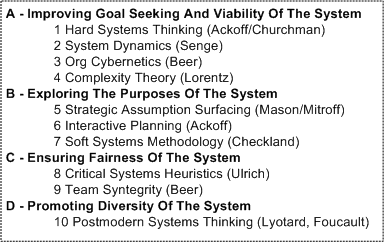
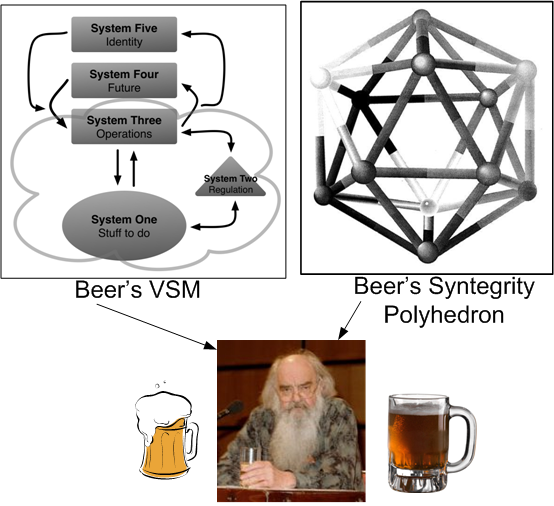
Did you notice that the brilliant Stafford, awesome-last-name, Beer is listed twice and his “Team Syntegrity” approach falls under the “ensuring fairness of the system category“? In Jackson’s opinion, Beer created his cybernetics-based, recursive 5 subsystem, Viable System Model (VSM) for the purpose of improving the goal seeking performance of complex social systems. Beer, both a tasty drink and a staunch anti-hierarchy champion, got so pissed when BMs, BOOGLs, BUTTs, SCOLs and dudes with BFTs interpreted his VSM as just another way of implementing a CCH with omnipotent and omniscient bosses at levels 2-5, that he developed his wildly innovative, polyhedron-based, “Team Syntegrity” approach to ensure fairness in org governance. In his design of the VSM, even though Beer articulated that the sole purpose of subsystems 2-5 is to support the operations of system 1 at the bottom (you know, the DICforce where you and I dwell), people of importance still kept their self-serving UCB blinders on and interpreted his system of management to be hierarchical.
As the figure below shows, the VSM appears to be hierarchical on the surface and, since most (not all) managers operate on the “surface” because they no longer roll up their sleeves to dive into anything difficult to understand, they internalize it as a better way to run their CCH psychic prisons as instruments of domination. However, when one studies Beer’s VSM approach to org management, it’s a self sufficient system of collaboration and intergroup support with each subsystem playing a key role in the holarchy.
Improving, Exploring, Ensuring, Promoting
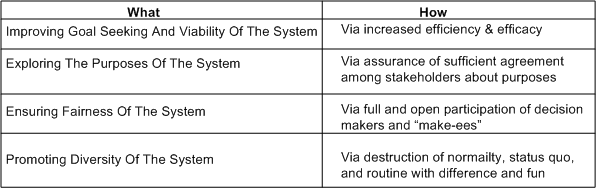
In Michael C. Jackson‘s rich and engrossing “Systems Thinking: Creative Holism For Managers“, Mr. Jackson describes 10 holistic systems thinking approaches designed to solve complex social managerial problems. As the tables below illustrate, Mr. Jackson allocates the approaches to four classes depending on the main purpose of the approach. For example, he asserts that Stafford Beer‘s “Team Syntegrity” approach is employed primarily to ensure fairness during the process of solving a complex social systems problem.
I really like Jackson’s book because of its breadth, vocabulary, and the way he covers each of the 10 systems approaches from its philosophical roots, to theory, to methods. He also supplies a real application example for each approach. In the final part of the book, Jackson integrates all of the approaches into a supra-holistic (?) approach that advocates mixing and matching elements of each approach and tailoring the “Creative Holism” meta-methodology to the specific “mess” at hand.
The last book that I read twice in a row was the brilliant Quantum Enigma by Fred Kuttner and Bruce Rosenblum. I’m gonna do the same with this masterpiece.
Science, Philosophy, Systems Thinking
In Michael C. Jackson‘s rich and engrossing “Systems Thinking: Creative Holism For Managers“, Mr. Jackson describes 10 holistic systems thinking approaches designed to solve complex social managerial problems. As he progressed from the earlier, purely science based, hard-systems thinking approaches to the modern, soft-systems approaches that attempt to fuse science with philosophy, I composed the two pictures below to help clarify my understanding. As usual, I felt an internal urge to externally express my discombobulated thoughts on the topic; so here are the pics.
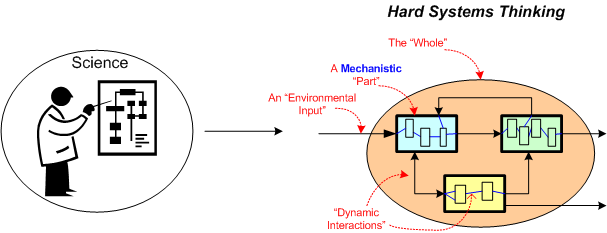
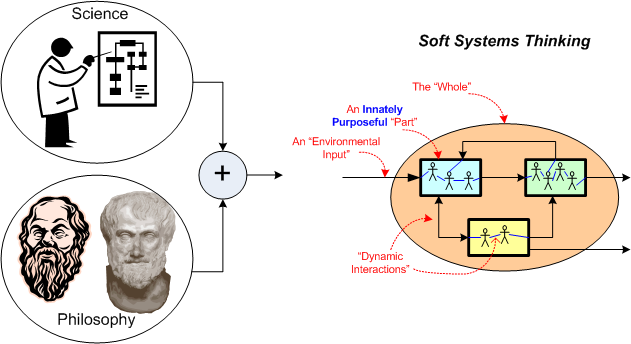 The main distinguishing difference that I see between the hard/soft models is the way that internal system “parts” are characterized. In the hard systems approaches, the system parts are conveniently assumed to have no self-purposes. This, as some people know from experience, is a horribly wrong assumption for systems composed of individual persons – social organizations.
Social org BOOGLs, SCOLs, and BUTTs are forever mired in the hard systems thinking mindset of yesteryear. Their simplistic solution for suppressing any externalization of self-purpose that is at odds with their own is to either consciously or unconsciously apply force to extinguish it. History has shown that this ubiquitously applied technique works – temporarily.

Why am I here?
WTF?
Meh!
D'oh!

My BTC Address



 Bulldozer00's Blog