Archive
Inter-Thread Message Communication
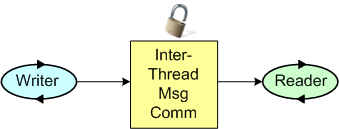
When the asynchronously executing threads in a multi-threaded application process need to communicate with each other using same-address-space messages, a thread-safe way of providing a message passing service is required. The figure below shows a black, um, yellow box model of the functionality that needs to be designed, coded, and tested for solving the problem. The little ovals with arrow thingies on them represent asynchronously executing threads of code either on the same cpu or on separate cpus. The little lock thingy represents a mutex that protects the mechanism internals from data corruption via simultaneous, uncontrolled access by more than one thread (I hate when that happens!).
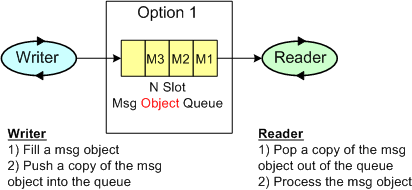
There are at least two ways to implement a thread-safe, inter-thread message passing service; by passing copies of the message objects themselves or by passing (smaller) pointers to message objects. As the figures in the models below illustrate, the design and user API for the pass-by-objects approach is simpler than the pass-by-pointers approach. The tradeoff is that the performance of the pass-by-objects approach degrades as the message size gets larger. In addition, passing by pointer allows dynamic polymorphism to be utilized.
Option 1: Pass-By-Objects
Option 2: Pass-By-Pointers (a.k.a references)
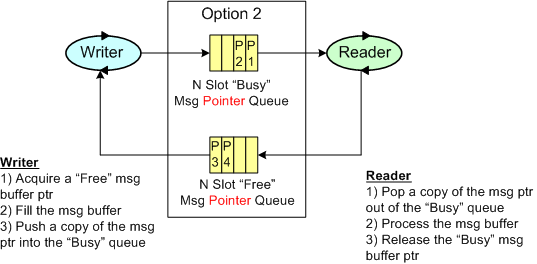 Since, in option 2, the memory that holds the message content is managed by the mutex-protected message passing mechanism and not shared by the clients themselves, the clients must acquire a pointer to a message memory buffer before either filling (writer) or processing (reader) the payload. Thus, the mutex must be locked/unlocked twice; once to “pop” the pointer and a second time to “push” the pointer.
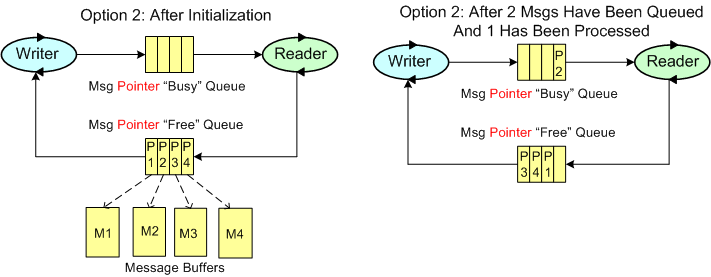 An alternative to the double queue design in option 2 is to require the clients to manage the message buffers themselves via the aid of a memory pool. The disadvantage of pushing the message memory management out of the queuing mechanism and up into the application layer is that it introduces a long distance coupling between the Writer and Reader – which may be written by different people. If the reader programmer forgets to release a pointer back to the pool after processing a message, a memory leak will occur (I hate when that happens!). By encapsulating the lock/unlock actions within the message passing mechanism written by one person, the chances of introducing a memory leak are reduced and the reader and writer threads remain decoupled.
A third inter-thread message passing design option is to employ a (much trickier to implement) lockless mechanism. Better yet, the use of a programming language that natively supports inter-thread message passing under the covers unburdens application programmers with the subtleties of inter-thread synchronization.
Rate this:

Why am I here?
WTF?
Meh!
D'oh!

My BTC Address

Top Clicks
Categories
- bitcoin (153)
- business (200)
- C++ (108)
- C++11 (49)
- C++14 (5)
- C++17 (3)
- Cancer (121)
- Cannabis (5)
- management (593)
- miscellaneous (307)
- Quantum Physics (11)
- spirituality (122)
- sysml (22)
- technical (520)
- uml (53)
Blog Stats
- 378,190 hits


 Bulldozer00's Blog