Archive
Reckless Meritocracies
Being a staunch advocate of democratic meritocracy, when I stumbled across the title of this potentially UCB-loosening op-ed by Ross Douthat; “Our Reckless Meritocracy“, I dove right in. I was intrigued by the use of the word “reckless” in the title.
Ross commences his opinion piece by telling the rags-to-riches-to-rags story of Jon Corzine:
- Boy grows up in rural Illinois
- Boy’s grandfather was a farmer who lost everything in the great depression
- Boy graduates from Illinois state university
- Boy goes into Marine Corps
- Boy gets MBA
- Boy works for regional bank
- Boy works for Goldman Sachs
- Boy becomes Goldman Sachs CEO
- Boy serves in US senate
- Boy serves as governer of NJ
- Boy returns to Wall St. as CEO of MF Global
- MF Global files for bankruptcy after “mislaying” $600M
- Boy resigns in disgrace (but with plenty of dough in the bank)
Ross uses this lead-in to postulate that the US has “created what seems like the most capable, hardworking, high-I.Q. elite in all of human history – and we’ve watched this same elite lead us off a cliff“.
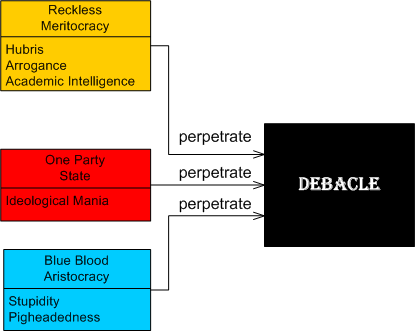
Ross then theorizes on how catastrophies are perpetrated by the rich and powerful in reckless meritocracies, hereditary aristocracies, and one-party states:
- Hereditary aristocracies: debacles caused by stupidity and pigheadedness
- One Party States: debacles caused by ideological mania
- Reckless Meritocracies: debacles caused by hubris
Relative to the other two forms of governance, at least scores of little people aren’t physically massacred in reckless meritocracies. They’re simply thrust into poverty. The real genius of reckless meritocracy is that when a meritocrat falls, he/she isn’t beheaded. At worst, he/she goes to jail. At best, he/she gets away with a huge bag of loot.
So, what’s a democratically run institution to do? Mr. Douthat rightly states that “it will do America no good to replace the arrogant with the ignorant, the overconfident with the incompetent“. (Didn’t you see the movie “Idiocracy“?)
We need intelligent leaders with a sense of their own limits, experienced people whose lives have taught them caution. We still need the best and brightest, but we need them to have somehow learned humility along the way. – Ross Douthat
If you made it thus far into this post, you may be wondering why BD00 is wasting your time by simply parroting Ross Douthat in yet another meta-blog post? It’s because BD00 wanted to display his fledgling UML skill again:
But wait! It may ironically be because of BD00’s own personal lack of humility and the fact that BD00 gets off on reading funny spammer comments like these:

Meritocracy Hippocracy
Thanks to software guru Ron Jeffries, I just discovered this article from “Sociation Today“: The Meritocracy Myth. In their piece, authors McNamee and Miller restate the oft espoused American dream as:
Getting ahead is ostensibly based on individual merit, which is generally viewed as a combination of factors including innate abilities, working hard, having the right attitude, and having high moral character and integrity.
They then attempt to prove that it’s a myth:
“..the really big money in America comes not from working at all but from owning, which requires no expenditure of effort, either physical or mental. In short, working hard is not in and of itself directly related to the amount of income and wealth that individuals have.”
Of course, being academics, McNamee and Miller are required to present income and wealth distribution statistics to bolster their case:

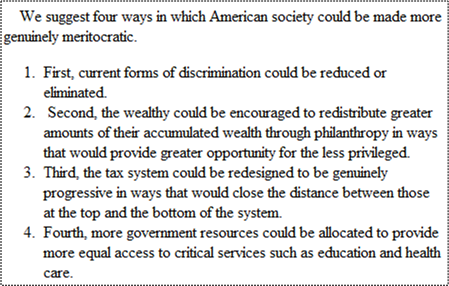
OK, so assume that they convinced “us” that the American dream has morphed into a ruse. What actions do McNamee and Miller propose to transform the myth into reality? They present these well-worn yawners:
But wait. Maybe we don’t want an ideally meritocratic society. As McNamee and Miller imply: Isn’t there a chance that the meritorious who’ve risen to the top of the income and wealth charts would develop a sense of righteous entitlement? Wouldn’t they “look down” upon those who haven’t advanced in life based on merit?
Well, yeah – ego dominated humans will be humans. But wouldn’t a system based on merit be fairer than one that keeps privileged and meritless aristocrats entrenched in power and “looking down“? Don’t you think meritorious leaders would have a greater sense of humility and compassion than aristocratic, silver-spoon-fed leaders? At least the American dream would be alive and kicking. The hope of personally creating a better life would become a reality, and not remain just a mythical pipe dream.
All ideologies end up killing people. – Jean Goss
Two Paths
As a small group of people assembled for a purpose greater than each individual grows, some form of structure is required to prevent chaos from reigning. The top path shows the emergence of a group of integral coordinators while the bottom path shows a traditional, stratified CCH being born.
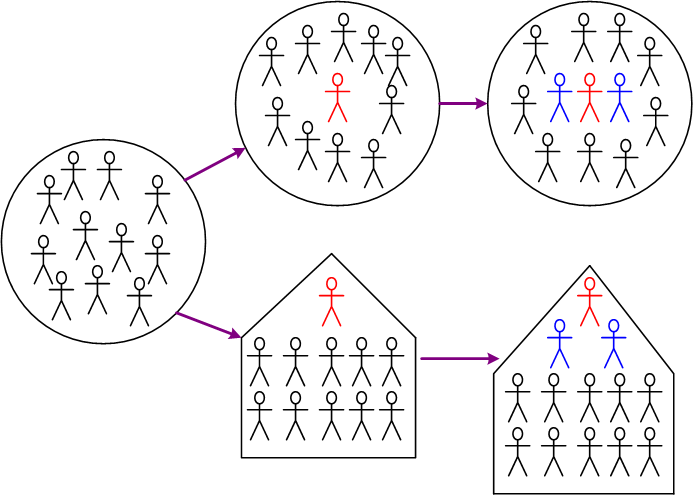 Which group would you rather be a part of? If you say you’d rather be a part of the “circular” group and you’re lucky enough to be a part of one, you’re still likely to get hosed down the road. You see, if your group continues to grow, it will naturally gravitate toward the pyramidal CCH caste system. That is, unless your natural or democratically chosen group leaders don’t morph into CGHs or BOOGLs and they actively prevent the subtle transformation from taking place.
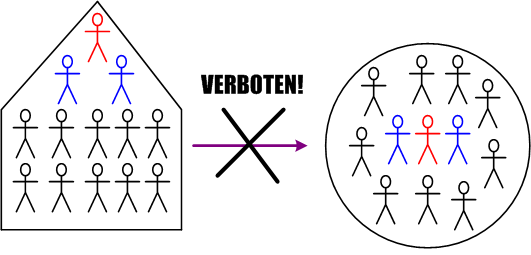
 If you’re currently embedded in a CCH and one of its leaders bravely attempts to change the structure to a circular, participative meritocracy, fugg-ed-aboud-it. The change agent will get crushed by his/her clanthinking BOOGL and SCOL peers, who ironically espouse that they want circular behavior while still preserving the stratified CCH.
Three Types
One simple (simplistic?) way of looking at how orgs of people operate is by classifying them into three abstract types:
- The Malevolent Patriarchy
- The Benevolent Patriarchy
- The Meritocracy
Since it’s so uncommon and rare to find a non-patriarchically run org (which is so pervasive that the genre includes small, husband-wife-children, families like yours and mine), I struggled with concocting the name of the third type. Got a better name?
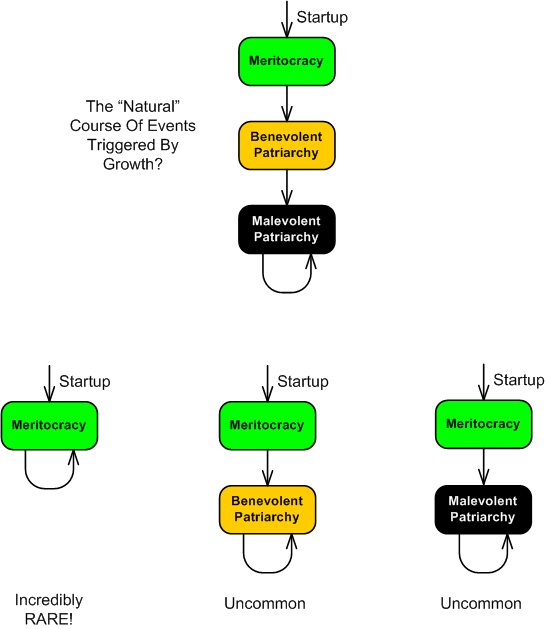
The figure below shows a highly unscientific family of maturation trajectories that an org can take after “startup”. The ubiquitous, well worn path that is tread as an org grows in size is the Meritocracy->Benevolent Patriarchy->Malevolent Patriarchy sojourn. Note that there are no reverse transitions in any of the trajectories. That’s because reverse state changes, like a Benevolent Patriarchy-to-Meritocracy transformation, are as rare as a company remaining in the Meritocracy state throughout its lifetime.
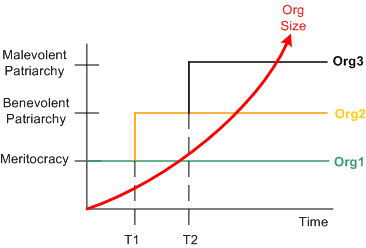
The state versus time graph below communicates the same information as the state machine family above, but from a time-centric viewpoint. Since “all models are wrong, but some are useful” (George Box), the instantaneous transition points, T1 and T2, are wrong. These insidious transitions occur so gradually and so slooowly that no one, not even the So-Called Org Leadership (SCOL), notices a state change. Bummer, no?

Why am I here?
WTF?
Meh!
D'oh!

My BTC Address



 Bulldozer00's Blog