Archive
King Of The Hill
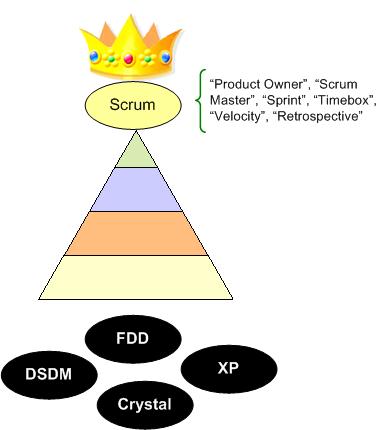
Scrum is an agile approach to software development, but it’s not the only agile approach. However, because of its runaway success of adoption compared to other agile approaches (e.g. XP, DSDM, Crystal, FDD), a lot of the pro and con material I read online seems to assume that Agile IS Scrum.
This nitpicking aside, until recently, I wondered why Scrum catapulted to the top of the agile heap over the other worthy agile candidates. Somewhere online, someone answered the question with something like:
“Scrum is king of the hill right now because it’s closer to being a management process than a geeky, code-centric set of practices. Thus, since enlightened executives can pseudo-understand it, they’re more likely to approve of its use over traditional prescriptive processes that only provide an illusion of control and a false sense of security.”
I think that whoever said that is correct. Why do you think Scrum is currently the king of the hill?
Related articles
- The Scrum Sprint Planning Meeting (bulldozer00.com)
- Scrum And Non-Scrum Interfaces (bulldozer00.com)
Quantum Chaotic Complexity
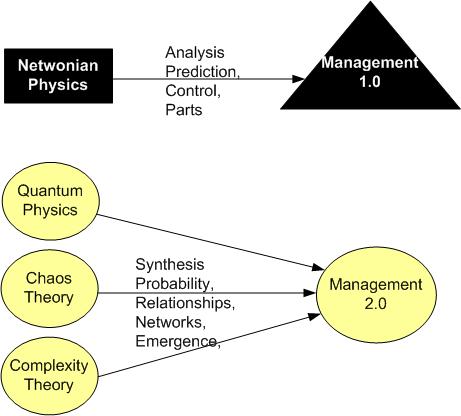
How many institutions are still being managed in accordance with the knowledge learned from 17th century physics? These days, its networks and relationships, not billiard balls and force.
Blown, Busted, And Riddled
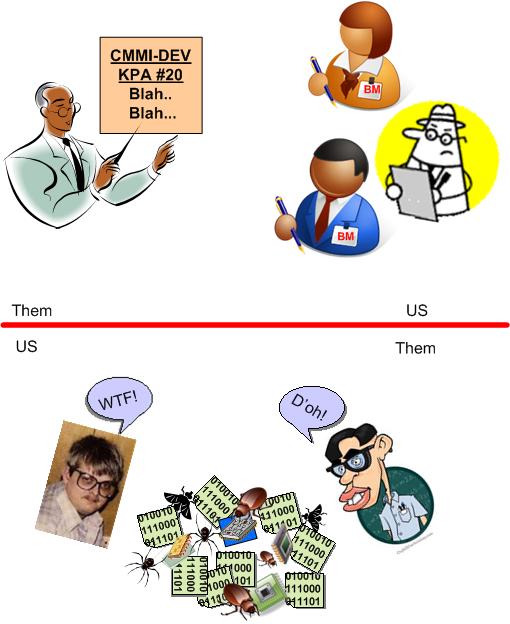
The CMMI-DEV model for software development contains 20+ Key Process Areas (KPA) that are required to be addressed by an org in order to achieve a respectable level of compliance. With such complexity, one could think that L3+ orgs would sponsor periodic process refresher courses for their DICforces in order to minimize social friction between process enforcers and enforcees and reduce time-sucking rework resulting from innocent process execution errors made by the enforcees.
BD00 postulates that many CMMI L3+ orgs don’t hold periodic, rolling process refreshers for their cellar dwellers. The worst of the herd periodically retrains its technical management and process groups (enforcers) , but not its product development teams (enforcees). These (either clueless or innocently ignorant) orgs deserve what they get. Not only do they get blown budgets, busted schedules, and bug-riddled products, but they ratchet up the “us vs. them” social friction between the uninformed hands-on product dweebs and the informed PWCE elites.
So Professional That It’s Unprofessional
Mike Williams is one of the big three Erlang creators (along with Joe Armstrong and Robert Virding) and the developer of the first Erlang Virtual Machine. Since then, he’s “moved up” and has been working as a software engineering manager for 20+ years. In his InfoQ talk titled “The Ideal Programmer – Why They Don’t Exist and How to Manage Without Them?“, Mike presents this hilarious slide:

It’s hilarious because, if you browse web sites like LinkedIn.com and Monster.com, you’ll find tons of similar, impossible-to-satisfy job descriptions. Everybody, especially the job description writer, knows that exhaustive “requirements” lists like these are a crock of BS. This practice is so professional that it’s unprofessional. So, why does it persist?

Leaders, Followers, Standers
Everybody knows what leaders and followers are, but what about “standers“? A stander is not a slacker. It’s a capable person who is content to stay within his/her comfort zone doing the same thing over and over again.

BD00 thinks that all people are capable and they innately want to “move” forward either as a leader or a follower. It’s a social system’s culture that molds “standers” out of capable people.
In cultures where mistakes of commission are penalized and mistakes of omission go undetected and unacknowledged, the optimum strategy, courtesy of Russell Ackoff, is simply to do as little as needed to elude ex-communication. It’s stagnation city with a burgeoning population of standers; sad for the people and sad for the org.
Preposterously Unacceptable
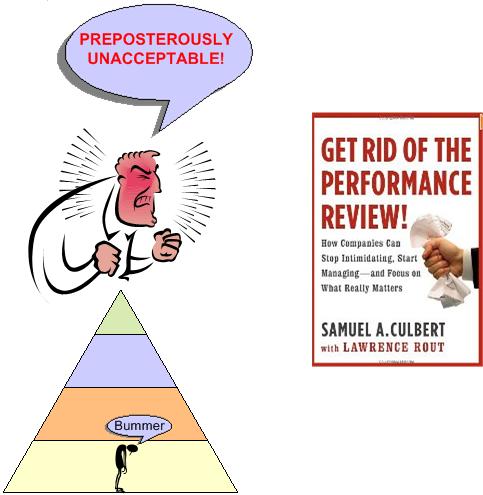
Unless they’re cosmetic tweaks, all proposed alternatives to the unassailable and revered Annual Performance Review (APR) will always be auto-stamped as preposterously unacceptable by the powers that be. It has to be that way, cuz expecting the wolf who’s guarding the hen house to voluntarily give up his post is a slam dunk losing proposition. Nevertheless, let’s look at one of these preposterously unacceptable alternatives just for fun.
Sam Culbert, in “Get Rid Of The Performance Review“, proposes deep-sixing the laughable APR ritual and replacing the stinker with the (crappily named) “performance preview” (PP). The first major feature of the PP is that salary actions are severed from the process. They’re independently determined according to a more objective set of criteria (perhaps like how Joel Spolsky does it at Fog Creek Software). Removing the salary sledgehammer from the hand of the formerly omnipotent manager increases the chance that a straight-talking, two-way conversation regarding individual and organizational improvement will occur.
Mr. Culbert’s face-to-face PP, which can be called into being whenever either side “feels” it should happen, is predicated on both sides answering simple questions like these:
- What have I been doing recently that helps you and the organization perform better?
- What have I been doing recently that isn’t working for you and the organization?
- What can I do in the near future to help you and the organization improve?
Notice that thesw are questions to be answered by both sides – as opposed to one way, judgmental assertions made by the boss “on behalf of the borg” to the subordinate. There are also no formal forms or checklists to be signed and squirreled away in Hoover files to be brandished later for compliance coercion.
This blog post barely scratches the surface of Mr. Culbert’s PP process, but hopefully it’ll spur you to buy his book and learn more about this HR anti-christ. On second thought, don’t do it. If you’re a DICkster, it might bum you out since you’ll vividly realize that you’re helpless and you can’t “fight city hall“. If you’re in the hallowed guild of management (especially the unconsciously evil HR echelon), because of its preposterous unacceptability, it might send shivers up your spine and/or piss you off.
Note: Instead of “Performance Preview” (PP), BD00 would’ve called it something like “I Help, You Help” (IHYH).
Be Thankful
In “Abolishing Performance Appraisals“, Coens and Jenkins state:
One study found that 98% of people saw themselves in the top half of all performers. Another study showed that 80% of people saw themselves in the top quarter of all performers. Other research indicates that 59% of workers across a variety of jobs disagreed or strongly disagreed with any rating that was not the highest on the scale.
Now, assume that your in-Human Resources (iHR) department, under the condoning eyes of the C-suite, enforces the standard bell curve rating system on the DICforce to keep operating costs in check and to implement the industry’s most sacred “best practice“. Of course, the ratings are doled out at the beloved Annual Performance Review (APR) ritual along with subjective lists of personal faults that need “improvement” and 2% raises – a brilliant triple punch combo to the psyche. To make things more interesting, assume that all the reviews are given at the same time each year.
Given the information above, the cyclical morale curve below was scientifically developed by BD00 using one of his patented social system algorithms.
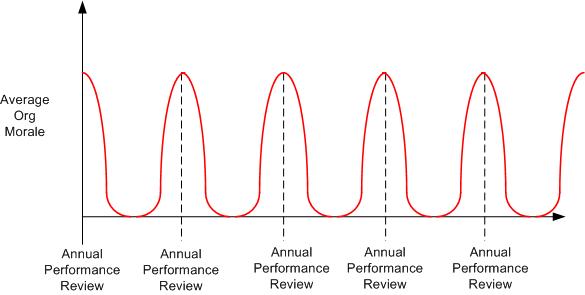
The curve shows that the average “system-wide” morale peaks just prior to the APR; and then it takes a nose dive after most of those optimistic DICs get a dose of reality from their supervisors (whose morale also takes a nose dive from being forced by iHR to administer the deflating news). Subsequent to the nadir, the system morale slowly recovers and rises back to its peak – until boom, the next iHR sponsored APR takes place. Whoo hoo! Dontcha just luv rollercoaster rides?
Just think of the lost productivity and sub-quality work performed during the annual dips. The next time you see an iHR group member, don’t fugget to thank him/her for the wonderful APR system his/her group presides over. Uh, on second thought, don’t do it. Nothing of substance is likely to change and you may be perceived as difficult, disrespectful, and disloyal – three more items to tack onto next year’s personal fault list. Plus, these types of things are undiscussable and they’re not within your tiny silo of expertise.
Not Arbiters, Nor Catalysts
When I was young and naive (as opposed to my current state: old and misinformed), I entered the werkfarce thinking that HR departments were supposed to be compassionate arbiters of disputes and employee development catalysts – until I discovered what they actually did:
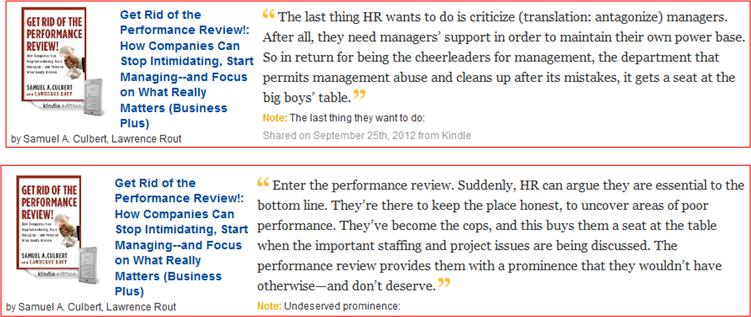
HR groups are bright shining examples of POSIWID. “The Purpose Of a System Is What It Does” – not what it says it does. Alas, BD00 doesn’t think that most HR departments are maliciously evil, they’re just so indoctrinated and immersed in Tayloresque, Theory-X thinking that “they know not what they do“. How about you? Besides thinking that BD00 knows not what he does, what do you think?
You May Be Wrong
With the frequency and ferocity of attacks BD00 foists upon the guild of institutional management in this highfalutin blog, you might think BD00 is a miserably unhappy and vengeful malcontent at work. If you do, then you’d be wrong. BD00 knows for a fact that his boss’s boss reads this blog “religiously“. BD00 also knows that his company’s CEO has stopped by to sample the waters at least once. The CEO even discretely and unjudgmentally referenced an idea from this caustic blog in a large gathering (for which he received a free BD00 T-shirt).
Do one thing every day that scares you. – Baz Luhrmann (Everybody’s Free To Wear Sunscreen)
In three-plus years of blogging, BD00 has never received a peek-a-boo visit or been directly rebuked or threatened by anyone in his company’s leadership chain for exposing his wacko, close-to-home thoughts in writing. If you wrote a similar, self-exposing blog, could you confidently say the same about your management ?

It’s The Relationships, Stupid
If you read Sam Culbert’s book rant against the taken-for-granted and unassailable “annual performance review” process, you’d think he is an anti-hierarchy revolutionary deserving to be crushed. But the dude is not:
Hierarchical structure, in the form of an organization chart, serves many constructive purposes. By showing the chain of command, it allows everyone to see who is responsible for what, how organization units are being deployed, and, most importantly, who should be accountable for bottom-line results. In contrast, I can’t think of a single constructive purpose served by hierarchical relationships— that is, those in which the boss gets to dominate all conversations.
Culbert, Samuel A. (2010-04-01). Get Rid of the Performance Review!: How Companies Can Stop Intimidating, Start Managing–and Focus on What Really Matters (Business Plus) (pp. 128-129). Hachette Book Group. Kindle Edition. – Sam Culbert
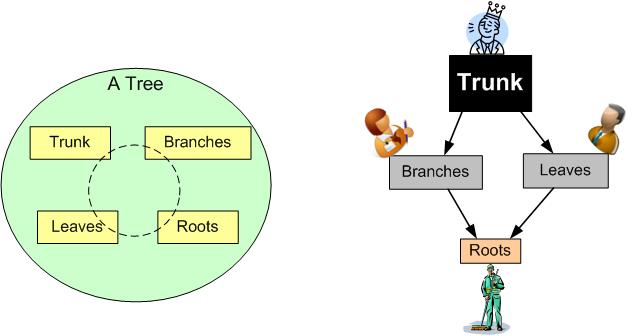
In a man-made conceptual hierarchical breakdown of a tree’s “parts“, the relationships between the parts have nothing to do whatsoever with their “position” in the hierarchy. A tree’s components miraculously work together in synchronous harmony to manifest and share its beauty as a whole with all of nature – including us (perhaps undeserving) humans. Leaves aren’t pitted against leaves for the purpose of gaining more hierarchical status in the “minds” of the other tree parts. The trunk doesn’t perceive itself as “more important and deserving” than the “lowly” branches. The roots don’t talk about the topmost branches in a derogatory manner, nor vice versa.
Related articles
- He Said, He Thought, He Said, He Thought (bulldozer00.com)

Why am I here?
WTF?
Meh!
D'oh!

My BTC Address



 Bulldozer00's Blog