Archive
Another One Bites The Dust
Another one bites the dust. Another one bites the dust. And another one gone, and another one gone… – Queen
Companies that have a superficial dual career ladder love to delude themselves into thinking they have a real one. The alternative, which is “unacceptable!” because it would trigger an unsettling feeling of cognitive dissonance and undermine a self-image of infallibility, is to simply own up to the inconsistency and stop lying to themselves and their constituents.

It’s always a sad affair to watch brilliant engineers jump from the dead-end technical ladder to the golden management ladder because it’s the only way they can do more for themselves and their families.
Sometimes the “promotion” works out fine for both the org and the newly minted manager. But sometimes it achieves a double loss. The engineer morphs into a crappy manager with poor people skills, a propensity to obsess over schedules, and a bent toward micro-managing technical details. Plus (or should I say minus?), the org’s product development group loses precious technical expertise. D’oh! I hate when that double whammy happens.

So Much More
If you haven’t seen the following hilarious and entertaining “I Quit” youtube video, then you’ve been living in a cave for too long. It’s gone viral with over 14 million hits as of this writing.
The fact that so many people tuned in says a lot about how organizations operate in the 21st century. Sure, there’s been some progress in injecting more humanity into the workplace since the dawn of the 2oth century, but there’s so much more that can be done.
Sadly, the dudes who have the power to get it done don’t want it to get done. It’s all about ego, loss of control, loss of stature, yada, yada, yada. Take your pick.
It is difficult to get a man to understand something, when his salary depends upon his not understanding it. – Upton Sinclair
They’ve Finally Done It, They Are In Control!
Oh ratz! BD00 wishes he concocted this brilliant “Planet Of The Apes” parody T-shirt:

But alas, BD00 didn’t create the masterpiece. The Random Manager team did. Damn it! Here’s the BD00 rip off version:
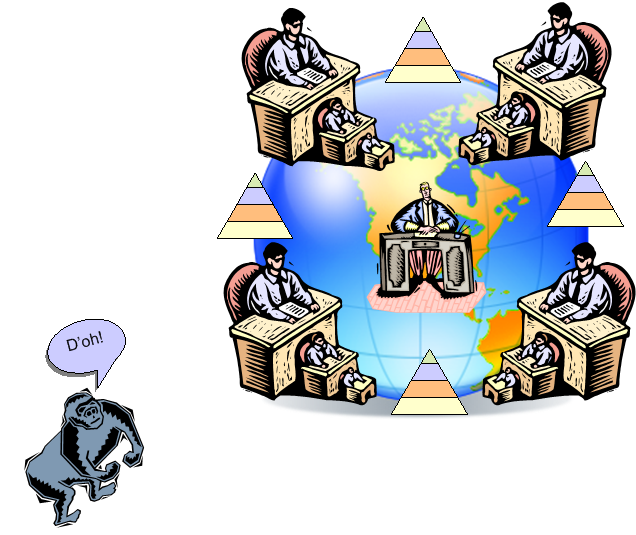
Size, Flexibility, Learning

So, do ya think that the losses in flexibility and capacity for learning are forgone conclusions as an org increases in size (i.e. adds more managers, directors, executives)? If not, got any examples that demolish the theory?
One of the great tragedies of life is the murder of a beautiful theory by a gang of brutal facts. – Benjamin Franklin
A Bureaucrat’s Dream
Thanks to powerful, vested interests and ignorant leadership, some stodgy dinosaur orgs still cling to a bevy of high-falutin’, delay-inducing, product conception/development/maintenance processes. Because of the strong nuclear forces in place, it’s virtually impossible to change these labyrinthian processes – despite those noble “continuous improvement” initiatives that are seemingly promoted 24X7.
The state transition diagram below models a hypothetical schedule and budget busting maintenance process. But beware! Since BD00 likes to make sh*t up, the 5 role, 12 step, bureaucrat’s dream is a totally contorted fabrication that has no semblance to the truth.

Of course, some classes of discovered product defects should indeed be run through the ringer so that they don’t happen again. But mindlessly requiring every single defect (e.g. a low risk, one-line code change?, formatting violation?, documentation typo?) to plod through the glorious process is akin to using brain surgery to cure a headache.
Many of these process worshipping orgs can save a ton of time, money, and frustration if they “allowed” a parallel JFTDT process for those simple, low risk, defects discovered during and after a product is developed.

But no! In zombie orgs that have these types of beloved processes in place, it can’t be done. Despite the unsubstantiated and outrageous BD00 claim that the vast majority of discovered defects in most projects can be safely run through the insanely simple JFTDT process, anyone who’s not the CEO that thinks of advocating for a parallel, streamlined process should think twice. No one wants to be the next dude who gets shoved through the hidden JSTFU process.
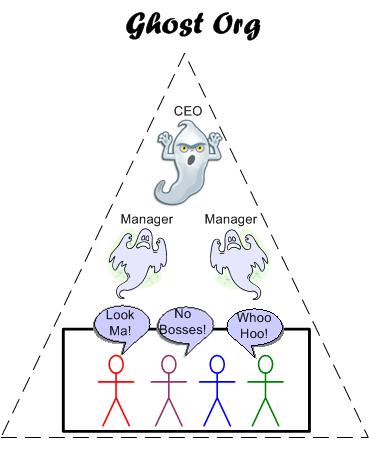
Ghost Org
After discovering Valve Inc. earlier this year, I wrote several posts (here and here and here) praising their flat organizational structure and unique management practices. Well, as the saying goes, “nothing ever is as it seems“.
In February, Valve laid off a group of hardware designers and one of them has spoken out against the company. Jeri Ellsworth, the former head of Valve’s hardware division, is that person:

In a podcast interview, Jeri said the following unflattering things about the company:
There is actually a hidden layer of powerful management structure in the company, and it felt a lot like High School. There are popular kids that have acquired power, then there’s the trouble makers, and then everyone in between. Everyone in between is ok, but the trouble makers are the ones trying to make a difference.
Now we’ve all seen the Valve handbook, which offers a very idealized view. A lot of that is true. It is a pseudo-flat structure, where in small groups at least in small groups you are all peers and make decisions together.
Their structure probably works really well with about 20 people, but breaks down terribly when you get to a company of 300 people. Communication was a problem. I don’t think it works.
They have a bonus structure in there where you can get bonuses – if you work on very prestigious projects – that are more than what you earn. So everyone is trying to work on projects that are really visible. And it’s impossible to pull those people away for something risky like augmented reality because they only want to work on the sure thing. So that was a frustration, we were starved for resources. And I probably was [abrasive] but I just couldn’t find a way to make a process to actually deliver any hardware inside that company.
If I sound bitter, it’s because I am. I am really, really bitter. They promised me the world and then stabbed me in the back.
Despite my naivete and gullibility, I originally thought that Valve was an exemplar case. With over 300 employees, they seemingly proved that flatness and egalitarianism can scale. It seemed magical. But sigh, according to Jeri, who admittedly is only one data point, it doesn’t.
In light of this sad, new information, I no longer think flatness scales. At a certain (but unknown) size, hierarchy is required for sustained economic viability in for-profit enterprises. When you arrive at the (unknown) size where you need a hierarchy, tis better to have a visible, transparent pyramid than a hidden, privileged one.
The trouble with unwritten rules is that you don’t know where to go to erase them. – Unknown
I’m glad to be part of an org with a visible hierarchy instead of an invisible one. At least I know who to suck up to (which I do well) and who not to piss off (which I don’t do well).
Hierarchy will never go away, never. – Tom Peters
Schmuckers?
Ooh, ooh. Look at the picture that I snapped whilst on vacation. Expectedly, the sign “protected” the first parking spot next to the restaurant entrance. I’d speculate that it’s a great place to work, wouldn’t you?

By Default
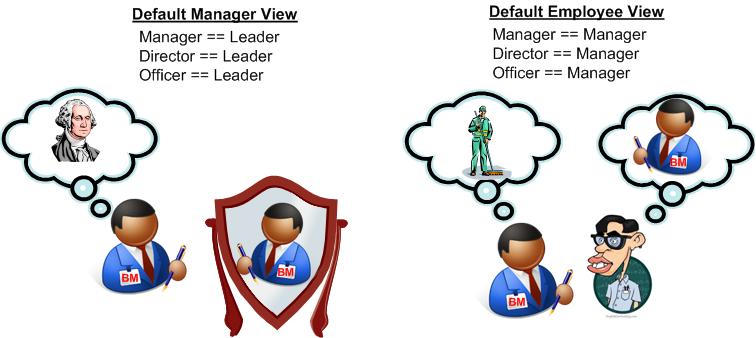
Much has been written about the differences between, and similarities across, management and leadership. But unsurprisingly, most managers equate the word “manager” with the word “leader” by default. After all, they’ve been appointed by other “leaders“. Thus, by (their) definition, managers are leaders.
On the other hand, most raw employees equate the word “manager” with “manager” by default. Err, on second thought, since (as usual) he has no supporting “data“, this BD00 post is prolly full of BS00:
Our old arrogant, egotistical nature (continuously) seeks out sustaining agreement with itself and its distorted opinions. – William Samuel
Sensors AND Actuators
Stacked Ranking
The title of this post sounds like the stodgy name of some inhumane, BS, corpo process under which “supervisors” evaluate their children, I mean, induhvidual contributors. But wait! It’s the Valve way.
You don’t know who Valve is? Valve is a company that creates massive, multi-player, online games. According to “economist-in-residence“, Yanis Varoufakis, Valve rakes in $1B in revenue even though they have a measly 300 employees. Also, according to Yanis (and their employee handbook), they are totally flat chested. There’s not a single boob, oops, I mean “boss“, in the entire community. D’oh!
The employee handbook spells out the details of the “Stacked Ranking” process, but in summary, peers rate each other once a year according to these four, equally-weighted metrics:
Skill Level/Technical Ability
Productivity/Output
Group Contribution
Product Contribution
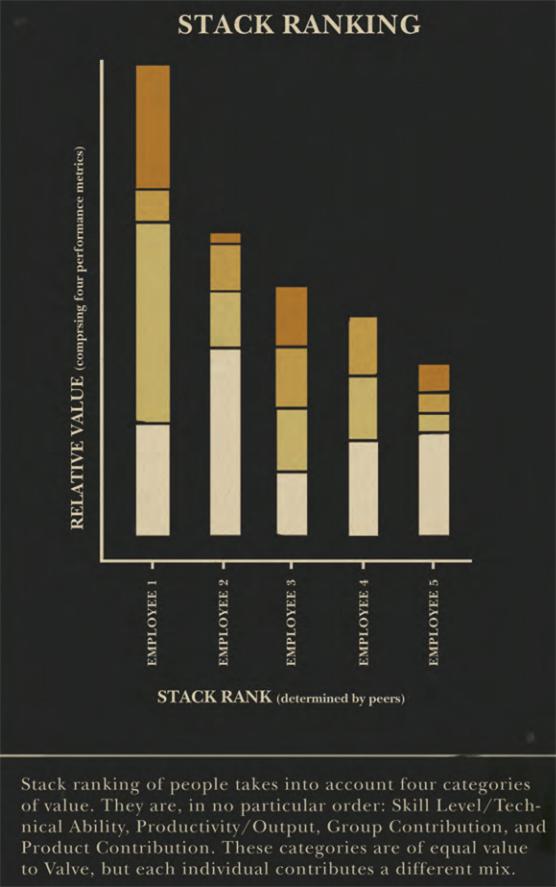
Notice that there’s no long list of patriarchical, corpo-BS ditties like these in the four simple Valve metrics:
- Takes initiative and is a self-starter
- Knows how to acquire resources when needed
- Manages time well
- Knows how to prioritize tasks
- Yada, yada, yada
As you might guess, the stack rankings are used for salary adjustment:
…stack ranking is done in order to gain insight into who’s providing the most value at the company and to thereby adjust each person’s compensation to be commensurate with his or her actual value. Valve pays people very well compared to industry norms. Our profitability per employee is higher than that of Google or Amazon or Microsoft, and we believe strongly that the right thing to do in that case is to put a maximum amount of money back into each employee’s pocket. Valve does not win if you’re paid less than the value you create. Over time, compensation gets adjusted to fit an employee’s internal peer-driven valuation. – The Valve Employee Handbook
Whenever I serendipitously discover jewels in the rough like Valve, SAS Institute, HCL Technologies, Semco, Zappos.com, etc, I always ask myself why they’re rare exceptions to the herd of standard, cookie-cutter corpricracies that dominate the business world. The best answer I can conjure up is this Ackoff-ism:
The only thing harder than starting something new is stopping something old. – Russ Ackoff
But it’s prolly something more pragmatic than that. Since corpo profits seem to keep rising, there is no burning need to change anything, let alone blow up the org and re-design it from scratch to be both socially and financially successful. That would be like asking the king to willingly give up the keys to his kingdom.

Why am I here?
WTF?
Meh!
D'oh!

My BTC Address



 Bulldozer00's Blog