Archive
Particular Individuals Don’t Matter
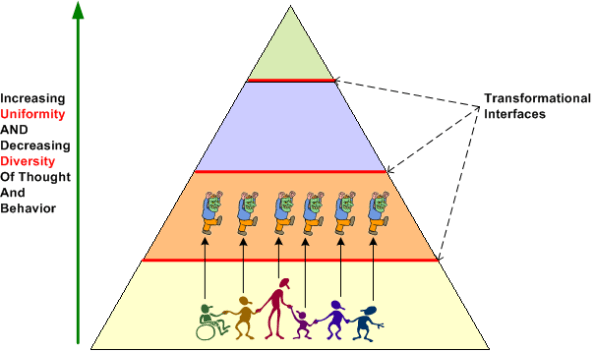
It doesn’t matter who the particular individuals in a corpocracy are. No matter how smart and well meaning they are, the awesome power of the pyramidal structure of woe to suppress their individuality and transform them into zombie clones tasked to guard the status-quo will prevail. How many of you have seen and experienced the ascension of smart, and formerly-effective, people into the ranks of the elite, only to be instantaneously transformed into ineffective druids?
Must Be An Outsider
One must be an outsider to escape being scalded for pointing out problems within a corpocracy. Unlike insiders (except for the obligatory, once a year, watered down employee survey), outsider opinions are actually solicited by the infallible hierarchs (who confidently and assuredly think they run the show). In addition, outsider pundits with “impeccable credentials” actually get paid for their analysis and recommendations! That’s why Weinberg’s “Secrets of Consulting” is in my reading queue.

Sadly, even if the situation on the left in the above diagram never happens in your org, DICs won’t stand up and expose turds that threaten the well being of the corpocracy because the image is dogmatically burned into their mind. There’s a reason why the story of the “emperor’s new clothes” is so funny and well known. The boy who pointed out his “highny”-ness’ s wardrobe malfunction was outside of the emperor’s kiss-ass court. Had he been an insider, it would have been “off with his head”.
Galileo And Kepler
To reinforce my anti-corpocracy UCB (Unshakeable Cognitive Burden), I just finished reading “The Age Of Heretics: A History Of The Radical Thinkers Who Reinvented Corporate Management“. It’s the second time in the last few months that I stumbled across the Galileo-Pope Urban story. The first time was in W. L. Livingston’s forthcoming “Design For Prevention”. Here’s a snippet from “Heretics”:
Why does Galileo Galilei have the reputation of a heretic, while his seventeenth-century fellow scientist Johannes Kepler does not? Because Kepler evaded the Church. Galileo sought to change it. The professor from Pisa spent the last third of his life arguing, with increasing fervor, that the Christian doctrines and even Bibles should be rewritten to conform to the realities he had seen through his telescope. Many of the cardinals and Church officials who censured and imprisoned him recognized the validity of the new cosmology and physics that Galileo championed, but they didn’t want to shake up their system too quickly. Too many monks and village priests clung to Ptolemy and Aristotle. The “people” would rebel at any sudden revision of the “truth.” Galileo didn’t care. Like many other heretics, past and present, he thought at first that the truth would set the institution free. He only had to show people what he had seen, and they would naturally adapt. When people doubted observations that to him were obvious, he lost his tact. He made enemies (some said needlessly) of the Jesuits, who fought bitterly to see him condemned, and he closed one of his notorious tracts, the Dialogue on the Great World Systems, with a snide lampoon of the views of Pope Urban VIII. Until then Urban had been his patron and champion. Ten months after publication in 1633, Galileo was on trial in Rome.

Here’s a snippet that is written further along in the book:
Even the Roman Catholic church eventually admitted that Galileo’s cosmology was correct—after 359 years.

Bummer. Behind the illusory cloak of modern civility, irrational and insane institutional behavior hasn’t changed much over the years. Heretics are still reviled by the bozos in power who will do whatever it takes to retain that power, and more importantly, the personal riches that automatically go along with it. Today’s well meaning but unconscious corpocrats are simply much more clever at veiling the methods that they use to annihilate heretics, even when individual heretics arise from their own ranks. Kepler rules!
Proprietary Sneeze
In stodgy, arrogant, and paranoid corpocracies, everything is marked as proprietary: the company letterhead, the standard powerpoint layout, all documented processes (that (shhhh!) nobody follows), every e-mail, every conversation, the company newsletter, the recipes in the cafeteria, etc. Hell, when someone sneezes it’s deemed proprietary. Geez, what up wit dat?
“Lighten up Francis” – Sergeant Hulka (from the movie “Stripes”)
Heaven forbid that a competitor gets its slimy hands on any of your proprietary “stuff”. OMG, they’ll put you out of business by using all of your world-changing intellectual property against you. Anyone caught disclosing anything about the corpo innards will swiftly receive a peek-a-boo visit from a high ranking corpocrat, right?
To be fair, there probably is some stuff that really is proprietary, like some domain-specific algorithms and/or some custom hardware modules. But gimme a break Einstein. Regardless of what you espouse, the ubiquitous Bell curve says that you’re most likely not all that (pause for a yawn) great. Although you, like the vast majority of corpo citadels on the landscape, think and espouse that you’re obviously a cut above the rest, you’re not. Deal with it. Remove the camouflage that everyone is aware of, but is forbidden to discuss.
When you explicitly “allow” your people to discuss the undiscussables in a truly open and receptive environment without publicly or privately tarring and feathering them, then you’ve taken the first courageous step toward differentiating yourself from the herd. Mooo!

Note: I’m just a Dilbertonian DIC (Dweeb In the Cellar) who makes things up, so don’t believe a word I say.
Six To Nine Months
As a rule of thumb, one can assume that a corpo reorg will take place every six to nine months. “Our new organization will (no doubt) increase efficiency, profitability, and align us more closely with our customers“. Yada, yada, yada. Yeah, right. Whatever you say dude.
The figure below shows sample before-and-after corpo reorg charts. After the re-org, more profit-sapping fat has been added in an ill fated attempt to increase corpo performance. In the shiny new org, less productive work gets performed because some lucky(?) or ass-kissin’ DICs (Dweebs In the Cellar) are “promoted” into the ranks of the elite. Of course, as a reward for their loyalty, and regardless of their performance (because behavior is always more important than performance), some MIMs (Managers In the Middle) are further promoted up into the rafters or reshuffled sideways. Narrow, specialized, confusing, undefined, and weird new corpo titles are conjured up like “manager of the company newsletter”, “deputy director of timecard compliance”, “director of trade show booth setup “, and “manager of coffee grounds disposal”.

After six to nine months of further deteriorating financial performance, the corpo hierarchs shrug, scratch their heads, and repeat the cycle to “(no doubt) increase efficiency, profitability, and align us more closely with our customers“. Wash, rinse, and repeat. Wash, rinse, and repeat………….
Evasion And Abdication
One way to evade or abdicate responsibility is to never write anything down. Writing something down is a form of commitment because other people can see what you wrote, and archive it, and use it to hold you accountable.
“The palest of ink is better than the best memory.” – Chinese proverb
As a rule, managers don’t write down what they’ve signed up to do because they don’t “do” anything of substance. Of course, everyone in a standard cookie-cutter corpo hierarchy unquestioningly accepts that it’s “not a manager’s job” to do or commit to anything. Managers do, however, insist that others write things down because without the written word a manager can’t periodically poll for status and hold others accountable when schedules are missed.
On the other hand, really bad managers love to conjure up and write down what work others are required to do and when that work is due (even when they don’t have a klue what the work is). It’s the best of both worlds because they can hold others accountable without having to be held accountable themselves (whoopee!).
Even if managers are held accountable for poor team performance by higher up meta-managers (who also don’t write down their non-existent commitments), they don’t experience a guilty conscience because they fall back on the “the team failed and not me because it’s not my job” mentality.
When was the last time your immediate manager asked you “what problems are you having and how can I help?” or told you “let me know when you run into a problem so that I can try my best to help you“?

Disclaimer: I don’t have any badges or credentials and I just make things up, so don’t believe a word I say.
90 Percent Done
In order for those in charge (and those who are in charge of those who are in charge ad infinitum) to track and control a project, someone has to estimate when the project will be 100% complete. For any software development project of non-trivial complexity, it doesn’t matter who conjures up the estimate, or what drugs they were on when they verbalized it, the odds are huge that the project will be underestimated. That’s because in most corpo command and control hierarchies, there is always implicit pressure to underestimate the effort needed to “get it done”. After all, time is money and everyone wants to minimize the cost to “get it done”. Even though everybody smells the silent-but-deadly stank in the air and knows that’s how the game is played, everybody pretends otherwise.
The graph below shows a made up example (like John Lovitt, I’m a patholgical liar who makes everything up, so don’t believe a word I say) of a project timeline. On day zero, the obviously infallible project manager (if you browse linkedin.com, no manager has ever missed a due date) plots a nice and tidy straight (blue) line to the 100% done date. During the course of executing the project, regular status is taken and plotted as the “actual” progress (red) line so that everybody who is important in the company can know what’s going on.

For the example project modeled by the graph, the actual progress starts deviating from the planned progress on day one. Of course, since the vast majority of project (and product and program) managers are klueless and don’t have the expertise to fix the deficit, the gap widens over time. On really dorked up projects, the red line starts above the blue line and the project is ahead of schedule – whoopee!
At around the 90-95% scheduled-to-be-done time, something strange (well, not really strange) happens. Each successive status report gets stuck at 90% done. Those in charge (and those who are in charge of those who are in charge ad infinitum) say “WTF?” and then some sort of idiotic and ineffective action, like applying more pressure or requiring daily status meetings or throwing more DICs (Dweebs In the Cellar) on the project, is taken. In rare cases, the project (or product or program) manager is replaced. It’s rare because project (and product and program) managers and those who appoint them are infallible, remember?
So, is “continuous replanning”, where new scheduled-to-be-done dates are estimated as the project progresses, the answer? It can certainly help by reducing the chance of a major “WTF” discontinuity at the 90% done point. However, it’s not a cure all. As long as the vast majority of project (and product and program) managers maintain their attitude of infallibility and eschew maintaining some minimum level of technical competence in order to sniff out the real problems, help the team, and make a difference, it’ll remain the same-old same-old forever. Actually, it will get worse because as the inherent complexity of the projects that a company undertakes skyrockets, this lack of leadership excellence will trigger larger performance shortfalls. Bummer.
Status Takers And Schedule Jockeys

Whoo hoo! I’ve been promoted to “manager” by the Gods from above. I’m not a DIC (Dweeb In the Cellar) anymore. I’ve transitioned to the easy life of “taking status and riding the schedule”. Now I can shut down my brain because I don’t have to think or create anymore. I just have to walk around and: poll for status, look worried when people fall behind schedule, and “nicely” exert pressure on the team to perform. To top it all off, I got a big raise because of my “increase in responsibility”! Man, I love corpocracies and hieararchical gigs.
Fifty-Fifty
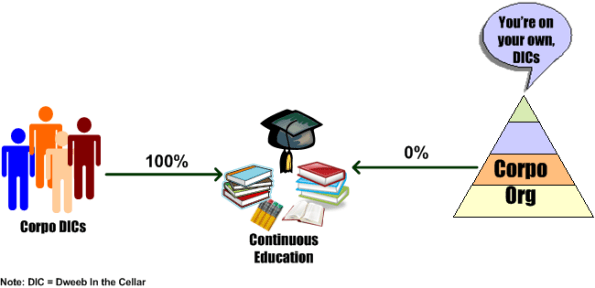
Because of the current economic environment, lots of recycled articles (take charge) regarding continuous education have appeared. Almost every one of them dispenses the same advice: “only you are responsible for continuously educating yourself and keeping your skills up to date”. Of course this is obviously true, but what about an employer’s duty to its stakeholders for ensuring that its workforce has the necessary training and skills to keep the company viably competitive in a rapidly changing landscape? Because of this duty, shouldn’t the responsibility be shared? What about fifty-fifty?
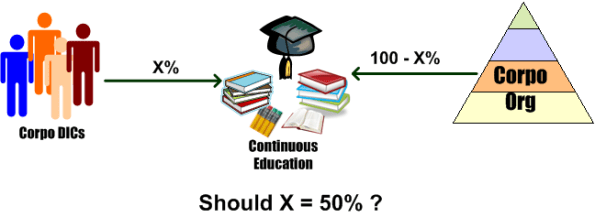
There are at least two ways that corpo managements (if they aren’t so self-absorbed that they’re actually are smart enough to detect the need) react to the need for continuing education of the people that produce its products and provide its services.
- Hire externally to acquire the new skills that it needs
- Invest internally to keep its workforce in synch with the times
Clueless orgs do neither, average orgs do number 1, above average orgs do 2, and great orgs do 1 and 2. Hiring externally can get the right skills in the right place faster and cheaper in the short run, but it can be much riskier than investing internally. Is your hiring process good enough to consistently weed out bozos, especially those that will be placed in positions that require leading people? If it’s a new skill that you require, how can your interviewers (most of whom, by definition, won’t have this new skill) confidently and assuredly determine if candidates are qualified? As everyone knows, face-to-face interviews, references and resumes can be BS smokescreens.
If external competitive pressures require a company to acquire deep, vertical and highly specialized skills, then hiring or renting from the outside may be the right way to go. It may be impractical and untimely to try and train its workforce to acquire knowledge and skills that require long term study. If you have a bunch of plumbers and you need an electrician to increase revenue or execute more efficiently, then it may be more cost effective and timely to hire a trained electrician than to train your plumbers to also become electricians (or it may not).
Which strategy does your corpocracy predominantly use to stay relevant? Number 1, number 2, both, or neither? If neither, why do you think that is the case? No cash, no will, neither?
Disconnected DICs
Without continuous, sincere, hard work from the leadership in a CCH (Command and Control Hierarchy) structure of human organization, it is all but guaranteed that the communication gap size between adjacent layers will exponentially increase when one traverses from the top level down to the bottom level.
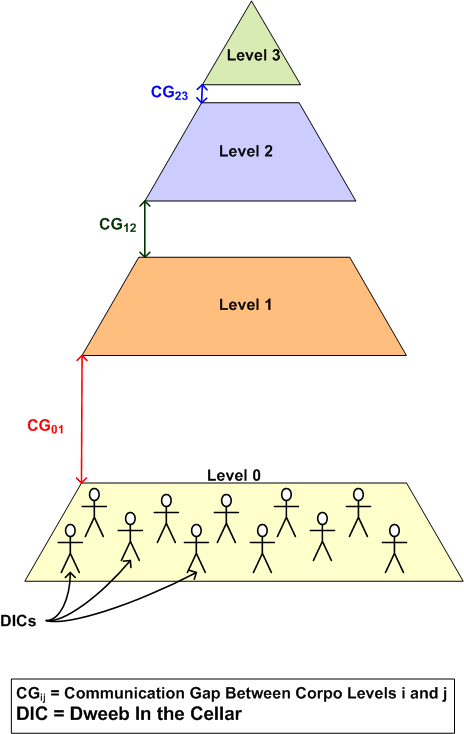
The communication gap between two non-adjacent levels is even wider, culminating with a gap size of infinity between the DICs at Level=0 and the corpo hierarchs at Level=MAX. Bummer.

Why am I here?
WTF?
Meh!
D'oh!

My BTC Address



 Bulldozer00's Blog