Archive
Requirements Before, Design After
The figure below depicts a UML sequence diagram of the behavior of a simulator during the execution of a user defined scenario. Before the code has been written and tested, one can interpret this diagram as a set of interrelated behavioral requirements imposed on the software. After the code has been written, it can be considered a design artifact that reflects what the code does at a higher level of abstraction than the code itself.
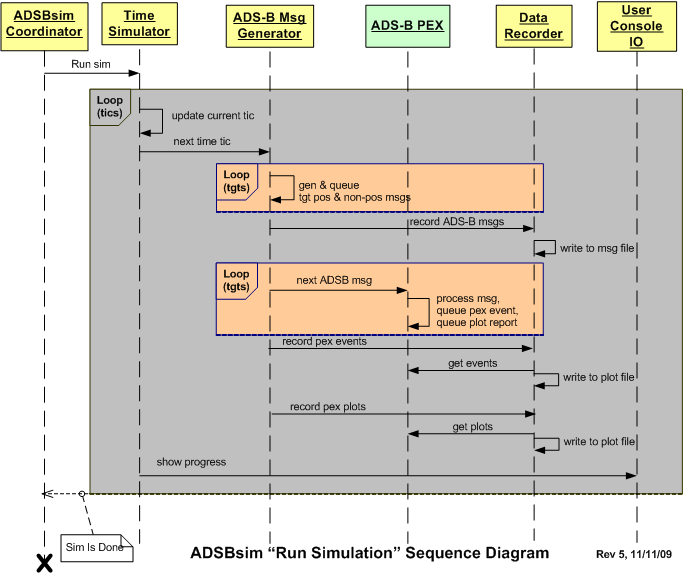
Interpretations like this give credence to Alan Davis’s brilliant quote:
One man’s requirement is another man’s design
 Here’s a question. Do you think that specifying the behavior requirements in the diagram would have been best conveyed via a user story or a use case description?
Culture Adjustment
I think that almost everyone heard about this week’s glitch in the air traffic control system that caused hours of flight delays. Here’s an interesting quote from the government’s GAO (FAA computer failure reflects growing burden on systems — Federal Computer Week):
“However, FAA faces several challenges in fulfilling NextGen’s objectives, including adjusting its culture and business practices, GAO concluded.”
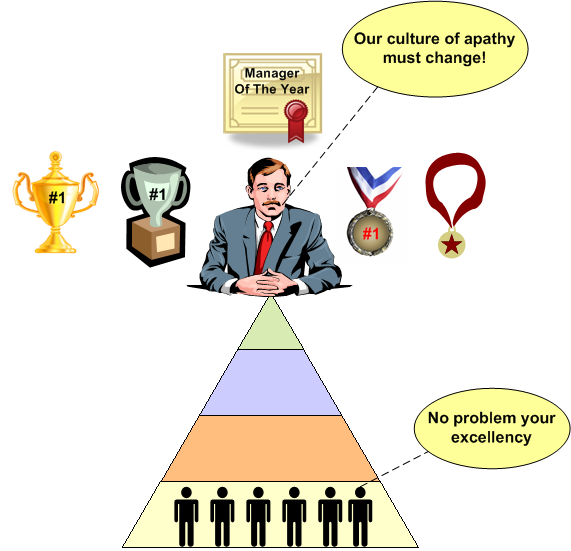
Well, duh. Every mediocre and under performing corpo borg needs to “adjust its culture and business practices”. It’s just that none of them have the competence to do it, regardless of how many titles and credentials that the corpocrats running the show adorn themselves and their sycophants with.
Partial Training
If you’re gonna spend money on training your people, do it right or don’t do it at all.
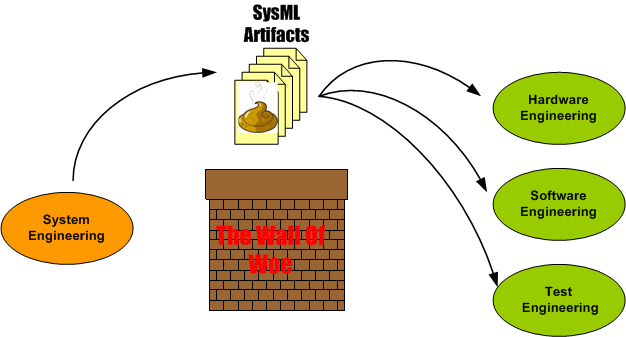
Assume that a new project is about to start up and the corpo hierarchs decide to use it as a springboard to institutionalizing SysML into its dysfunctional system engineering process. The system engineering team is then sent to a 3 day SysML training course where they get sprayed by a fire hose of detailed SysML concepts, terminology, syntax, and semantics.
Armed with their new training, the system engineering team comes back, generates a bunch of crappy, incomplete, ambiguous, and unhelpful SysML artifacts, and then dumps them on the software, hardware, and test teams. The receiving teams, under the schedule gun and not having been trained to read SysML, ignore the artifacts (while pretending otherwise) and build an unmaintainable monstrosity that just barely works – at twice the cost they would would have spent if no SysML was used. The hierarchs, after comparing product development costs before and after SysML training, declare SysML as a failure and business returns to the same old, same old. Bummer.
Under Pressure
Uh oh. One of my favorite companies, the SAS Institute, is under increasing pressure from big, deep pocketed rivals. This NY Times article, Rivals Take Aim at the Software Company SAS – NYTimes.com, elaborates on the details. Since I’m confident that they’ll overcome the competitive threat, that’s not what this post is about. It’s about what the SAS leadership, led by founder, CEO, and PHOR, Jim Goodnight, does to continuously grow and develop both the company and its people. Here are some snippets from the article and this linked-to 60 minutes article that reinforce my faith in the company’s ability to overcome all odds:
There is the subsidized day care and preschool. There are the four company doctors and the dozen nurses who provide free primary care. The recreational amenities include basketball and racquetball courts, a swimming pool, exercise rooms and 40 miles of running and biking trails. There is a meditation garden, as well as on-site haircuts, manicures, and jewelry repair. Employees are encouraged to work 35-hour weeks.
The office atmosphere is sedate. There are no dogs roaming the halls, no Nerf-ball fights, no one jumping on trampolines — no whiff of Silicon Valley. The SAS culture is engineered for its own logic: to reduce distractions and stress, and thus foster creativity.
Employee turnover at SAS averages 4 percent a year, versus about 20 percent for the overall software industry.
SAS has never had a losing year and never laid off a single employee.
“No, we’re not altruistic by any stretch of the imagination. This is a for-profit business and we do all these things because it makes good business sense,” says Jeff Chambers, director of human resources at SAS.
“You know, I guess 95 percent of my assets drive out the front gate every evening,” says Goodnight. “It’s my job to bring them back.”
Academics have studied the company’s benefit-enhanced corporate culture as a model for nurturing creativity and loyalty among engineers and other workers.
SAS invested heavily in research and development, and even today allocates 22 percent of the company’s revenue to research. The formula has paid off in steady growth, year after year. Revenue reached $2.26 billion in 2008, up from $1.34 billion five years earlier.
Unlike many other tech companies, SAS has had no recession-related layoffs this year. “I’ve got a two-year pipeline of projects in R & D,” Mr. Goodnight says. “Why would I lay anyone off?”
Mr. Goodnight recalls those days as a brief period of New Economy surrealism, and going public as a path wisely avoided. SAS, he says, is a culture averse to the short-term pressures of Wall Street, which he characterizes as “a bunch of 28-year-olds, hunched over spreadsheets, trying to tell you how to run your business.”
Goodnight says it’s pressure from Wall Street to please shareholders by delivering rising quarterly earnings that has poisoned the corporate well.
Mr. Goodnight, though 66, has no plans to retire himself. His fingerprints, colleagues say, remain all over the business, especially in meeting with customers and in overseeing research.

Poor Test Dudes
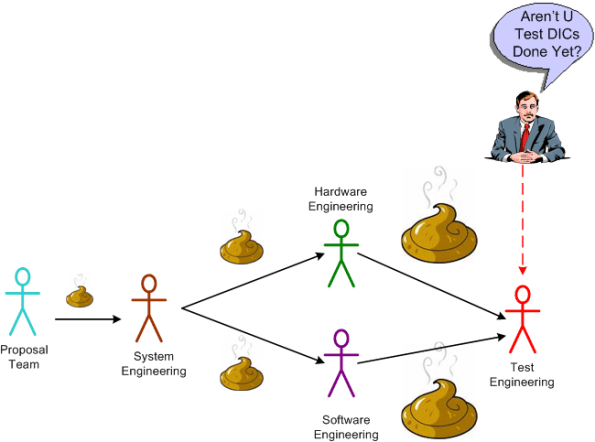
Out of all the types of DICs in a textbook CCH, the poor test dudes always have the roughest go of it. Out of necessity, they have mastered the art of nose pinching.
A Flurry Of Activity
It’s always fun to watch the initial stages of euphoria emerge and then disappear when a corpo-wide initiative that’s intended to improve performance is attempted. The anointed “design” team, which is almost always filled exclusively with managers and overhead personnel who conveniently won’t have to implement the behavioral changes that they poop out of the initiative themselves, starts out full of energy and bright ideas on how to solve the performance problem. After the kickoff, a resource-burning flurry of activity ensues, with meeting after meeting, discussion after discussion, and action item after action item being tossed left and right. When the money’s gone, the time’s gone, and the smoke clears, business returns to the same old, same old.
As a hypothetical example, assume that an initiative to institute a metrics program throughout the org has been mandated from the heavens. At best, after spending a ton of money and time working on the issue, the anointed design team generates a long list of complicated metrics that “someone else” is required to collect, analyze, and act upon. The team then declares victory and self-congratulatory pats on the back abound. At worst, the team debates the issue for a few meetings, conveniently forgets it, and then moves on to some other initiative – hoping that no one notices the useless camouflage that they left in their wake. Bummer.
The Requirements Landscape
Kurt Bittner, of Ivar Jacobson International, has written a terrific white paper on the various approaches to capturing requirements. The mind map below was copied and pasted from Kurt’s white paper.
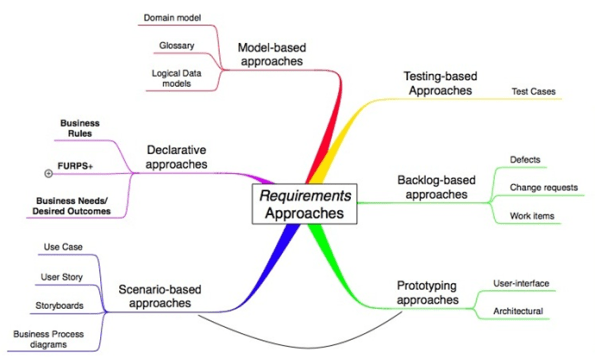
In his paper, Bittner discusses the pluses and minuses of each of his defined approaches. For the text-based “declarative” approaches, he states the pluses as: “they are familiar” and “little specialized training” is needed to write them. Bittner states the minuses as:
- They are “poor at specifying flow behavior”
- It’s “hard to connect related requirements”
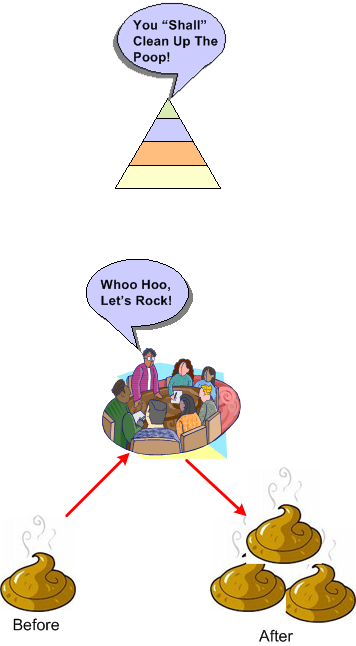
IMHO, as systems get more and more complex, these shortcomings lead to bigger and bigger schedule, cost, and quality shortfalls. Yet, despite the advances in requirements specification methodologies nicely depicted in Bittner’s mind map, defense/aerospace contractors and their bureaucratic government customers seem to be forever married to the text-based “shall” declarative approach of yesteryear. Dinosaur mindsets, the lack of will to invest in corpo-wide training, and expensive past investments in obsolete and entrenched text-based requirements tools have prevented the newer techniques from gaining much traction. Do you think this encrusted way of specifying requirements will change anytime soon?
We Promise To Change, And We Really Mean It This Time
GM is a classic example of a toxic Command and Control Hierarchical (CCH) corpocracy. In this NY Times article, the newly anointed hierarchs and their spin doctors promise that “things will be different” in the future. Uh, OK. If you say so.
According to corpo insiders, here’s the way things were.
…employees were evaluated according to a “performance measurement process” that could fill a three-ring binder.
“We measured ourselves ten ways from Sunday,” he said. “But as soon as everything is important, nothing is important.”
Decisions were made, if at all, at a glacial pace, bogged down by endless committees, reports and reviews that astonished members of President Obama’s auto task force.
“Have we made some missteps? Yes,” said Susan Docherty, who last month was promoted to head of United States sales. “Are we going to slip back to our old ways? No.”
G.M.’s top executives prized consensus over debate, and rarely questioned its elaborate planning processes. A former G.M. executive and consultant, Rob Kleinbaum, said the culture emphasized past glories and current market share, rather than focusing on the future.
“Those values were driven from the top on down,” said Mr. Kleinbaum. “And anybody inside who protested that attitude was buried.”
In the old G.M., any changes to a product program would be reviewed by as many as 70 executives, often taking two months for a decision to wind its way through regional forums, then to a global committee, and finally to the all-powerful automotive products board.
“In the past, we might not have had the guts to bring it up,” said Mr. Reuss. “No one wanted to do anything wrong, or admit we needed to do a better job.”
In the past, G.M. rarely held back a product to add the extra touches that would improve its chances in a fiercely competitive market.
“If everybody is afraid to do anything, do we have a chance of winning?” Mr. Stephens said in one session last month.
The vice president would say, ‘I got here because I’m a better engineer than you, and now I’m going to tell you how bad a job you did.’ ”
The Aztek was half-car, half-van, and universally branded as one of the ugliest vehicles to ever hit the market. … but his job required him to defend it as if it were a thing of beauty.
Here’s what they’re doing to change their culture of fear, malaise, apathy, and mediocrity:
G.M.’s new chairman, Edward Whitacre Jr., and directors have prodded G.M. to cut layers of bureaucracy, slash its executive ranks by a third, and give broad, new responsibilities to a cadre of younger managers.
Replacing a binder full of job expectations with a one-page set of goals is just one sign of the fresh start, said Mr. Woychowski.
Mr. Lauckner came up with a new schedule that funneled all product decisions to weekly meetings of an executive committee run by Mr. Henderson and Thomas Stephens, the company’s vice chairman for product development.
Mr. Stephens has been leading meetings with staff members called “pride builders.” The goal, he said, was to increase the “emotional commitment” to building better cars and encourage people to speak their minds.
“But now we need to be open and transparent and trust each other, and be honest about our strengths and weaknesses.”
So, what do you think? Do you think that these “creative” CCH dissolving solutions and others like them will do the trick? Do you think they’ll pull it off? Is it time to invest in the “new” GM’s stock?
Black And White Binary Worlds
In this interview with the legendary Grady Booch, (InformIT: Grady Booch on Design Patterns, OOP, and Coffee), Larry O’Brien had this exchange with one of the original pioneers of object oriented design and the UML:
Larry: Joel Spolsky said:
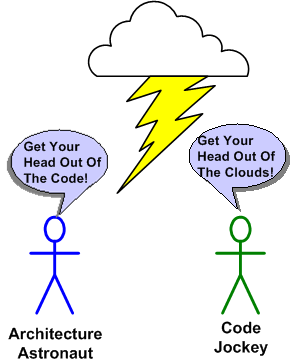
“Sometimes smart thinkers just don’t know when to stop, and they create these absurd, all-encompassing, high-level pictures of the universe that are all good and fine, but don’t actually mean anything at all. These are the people I call Architecture Astronauts. It’s very hard to get them to write code or design programs, because they won’t stop thinking about Architecture.”
He also said:
“Sometimes, you’re on a team, and you’re busy banging out the code, and somebody comes up to your desk, coffee mug in hand, and starts rattling on…And your eyes are swimming, and you have no friggin’ idea what this frigtard is talking about,….and it’s going to crash like crazy and you’re going to get paged at night to come in and try to figure it out because he’ll be at some goddamn “Design Patterns” meetup.”
Spolsky seems to represent a real constituency that is not just dismissive but outright hostile to software development approaches that are not code-centric. What do you say to people who are skeptical about the value of work products that don’t compile?
Grady: You may be surprised to hear that I’m firmly in Joel’s camp. The most important artifact any development team produces is raw, running, naked code. Everything else is secondary or tertiary. However, that is not to say that these other things are inconsequential. Rather, our models, our processes, our design patterns help one to build the right thing at the right time for the right stakeholders.
I think that Grady’s spot on in that both the code-centric camp and the architecture-centric camp tend to throw out what’s good from the other camp. It’s classic binary extremism where things are either black or white to the participants and the color grey doesn’t exist in their minds. Once a rigid and unwavering mindset is firmly established, the blinders are put on and all learning stops. I try to keep this in mind all the time, but the formation of a black/white mindset is hard to detect. It creeps up on you.
Construction Sequence
The figure below depicts a static structural bent SysML model of a small but non-trivial software program that I recently finished writing and testing. It’s a simulator harness that’s used to explore/test/improve candidate “Target Extractor” algorithms for inclusion into a revenue generating product.
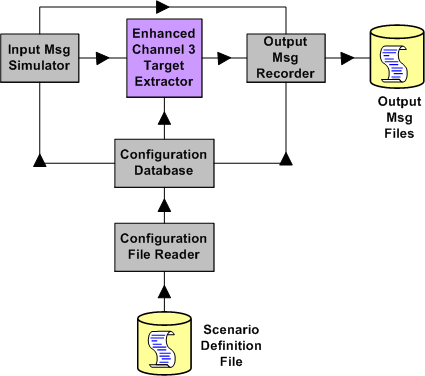
On program launch, a user-created scenario definition file is read, parsed, error-checked, and then stored in an in-memory database. Subsequent to populating the database, the program automatically:
- Generates a simulated stream of target message fragments characterized by the scenario definition that was pre-specified by the user
- Injects the message stream into the target extractor algorithm under test
- Processes the message stream in accordance with the plot extraction state machine algorithm specification
- Records the target extractor output response message stream to disk
The figure above is a model that represents the finished product – which ended up being the third build in a series of incremental builds. The figure below shows the functionality in the first two builds of the trio.
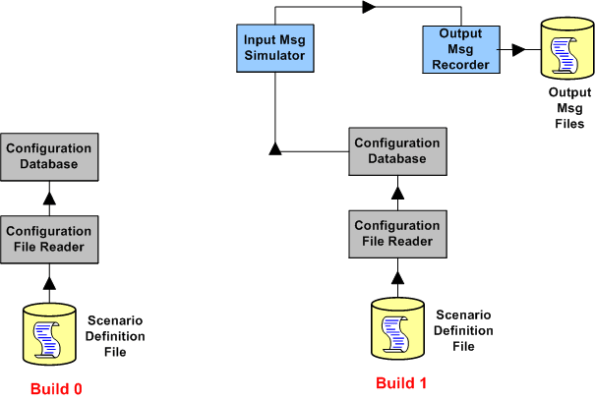
Even though the construction process that I used appears to have progressed in a nice and tidy linear and sequential flow (like the left portion of the figure below depicts), it naturally didn’t work out that way. The workflow progressed in accordance with the right portion of the figure below, with lots of high frequency single-step feedback loops and (thankfully) only a few two-step and three-step feedback loops.
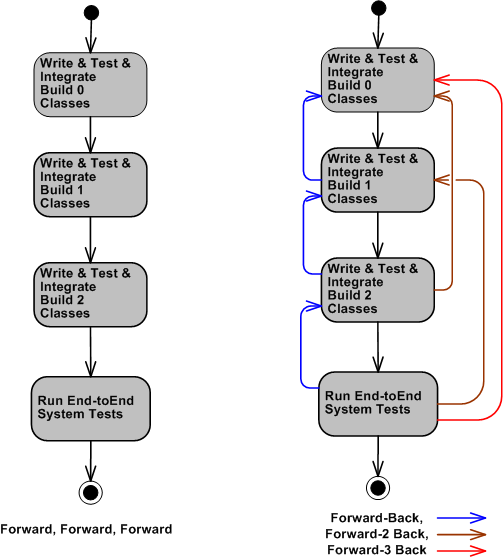
In a perfect world, the software construction process proceeds in a linear and sequential fashion. In the messy real world, mistakes and errors are always made, and stepping backward is the only way that these mistakes and errors can be corrected.
In standard textbook CCH orgs where an endless sea of linear and sequential thinking BMs rule the roost, going backwards is “unacceptable” because “you should have done it right the first time“. In these types of irrational macho cultures, fear of punishment reigns supreme – and nobody dares to discuss it. Fearful development teams either don’t go backwards to correct mistakes, or they try to fix mistakes covertly below the corpo radar. What type of org do you work for?

Why am I here?
WTF?
Meh!
D'oh!

My BTC Address



 Bulldozer00's Blog