Archive
One Of Four

Basement Garden
After concocting yesterday’s irreverent post, the universe whispered in my ear:
Put a visual to the saying: DYSCOs often treat their “associates” like mushrooms: Down in the basement and well fed with chit.
Since I don’t want to piss the universe off, here t’is:

Toxic Fungus
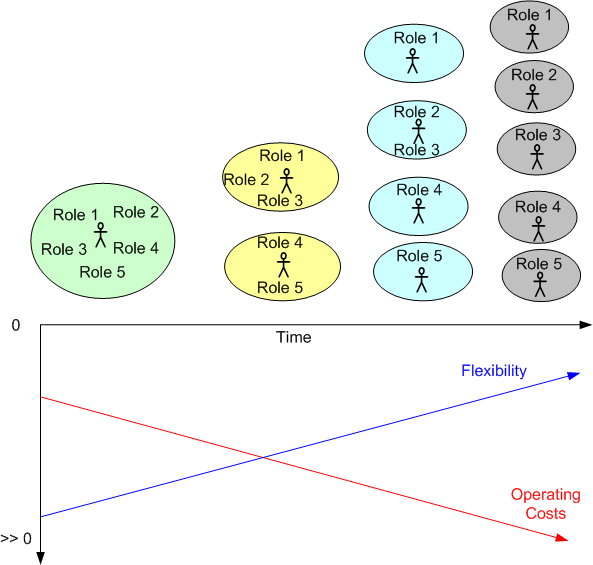
Unless due diligence is performed on the part of an org’s leadership junta/cabal/politburo, fragmentation of responsibility and unessential specialization can easily creep into “the system” – triggering a bloat in costs and increased operational rigidity. Like a toxic fungus, not only is it tough to prevent, it’s tough to eradicate. D’oh! I hate when that happens.
Admittance Of Imperfection
One of the traits I admire most about Bjarne Stroustrup is that he’s not afraid to look “imperfect” and point out C++’s weaknesses in certain application contexts. In his “Technical Report On C++ Performance“, Mr. Stroustrup helpfully cautions real time programmers to think about the risks of using the unpredictable/undeterministic features of the language:
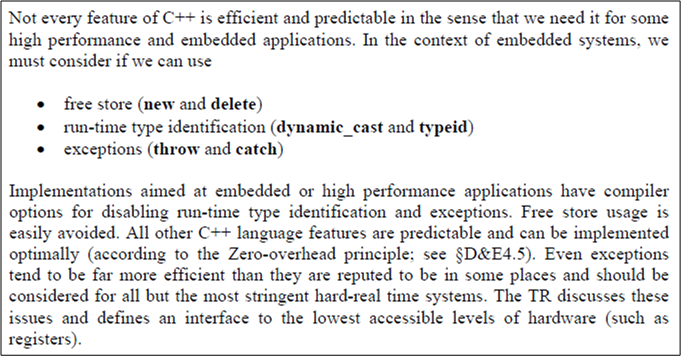
Of course, C++ antagonists are quick to jump right on his back when Bjarne does admit to C++’s imperfections in specific contexts: “see, I told you C++ sux!“.
Here’s a challenge for programmers who read this inane blog. Can you please direct me to similar “warning” clauses written by other language designers? I’m sure there are many out there. I just haven’t stumbled across one yet.
Persistent Discomfort
As part of the infrastructure of the distributed, multi-process, multi-threaded system that my team is developing, a parameterized, mutex protected, inter-thread message queue class has been written and dropped into a general purpose library. To unburden application component developers from having to do it, the library-based queue class manages a reusable pool of message buffers that functionally “flow” from one thread to the next.

On the “push” side of the queue, usage is as follows:
- Thread acquires a handle to the next empty Message buffer
- Thread fills Message buffer
- Thread returns handle to the queue (push)
On the “pop” side of the queue, usage is as follows:
- Thread acquires a handle to the next full Message buffer (pop)
- Thread processes the Message content
- Thread returns handle to the queue
So far, so good, right? I thought so too – at the beginning of the project. But as I’ve moved forward during the development of my application component, I’ve been experiencing a growing and persistent discomfort. D’oh!
Using the figure below, I’m gonna share the cause of my “inner thread” discomfort with you.
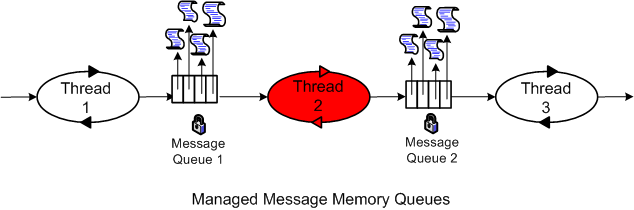
In order to functionally process an input message and propagate it forward, the inner thread must do the following work:
- Acquire a handle to the next input Message buffer from queue 1 (pop)
- Acquire a handle to the next empty output Message buffer from queue 2
- Utilize the content of the Message from queue 1 to compute/fill in the Message to queue 2
- Return the handle of the input message to queue 1
- Return the handle of the output message to queue 2 (push)
For small messages and/or when the messages are of different types, I don’t see much wrong with this inter-thread message passing approach. However, when the messages are big and of the same type, my discomfort surfaces. In this case (as we shall see), the “utilize” bullet amounts to an unnecessary copy. The more “inner” threads there are in the pipeline, the more performance degradation there is from unnecessary copies.
So, how can the copies be eliminated and system performance increased? One way, as the figure below shows, is to move message buffer management responsibility out of the local queue class and into a global, shared message pool class.
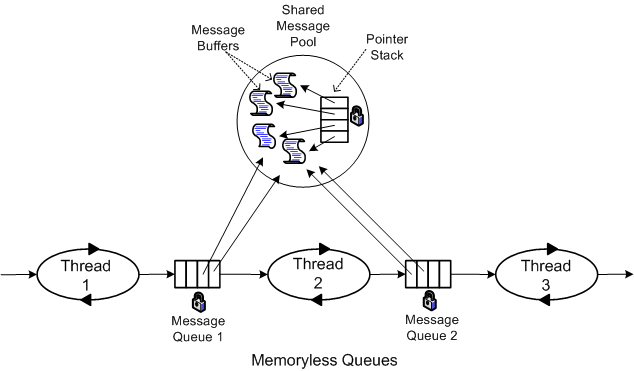
In this memory-less queue design, the two pipeline end point threads explicitly assume the responsibility of acquiring and releasing the Message buffer handles from the mutex protected, shared message pool. The first thread “acquires” and the last thread “releases” message buffer handles. Each inner thread, i, in the pipeline performs the following work:
- Pop the handle to the next input Message buffer from queue i-1
- Process the message
- Push the Message buffer handle to queue i
The key to avoiding unessential inner thread copies is that the messages must be intentionally designed to be of the same type.
As soon as I get some schedule breathing room (which may be never), I’m gonna refactor my application infrastructure design and rewrite the code to implement the memoryless queue + global message pool approach. That is, unless someone points out a fatal flaw in my reasoning and/or presents a superior inter-thread message communication pattern.
Writer’s Block!
After aimlessly doodling with my ad-hoc clipart pallet for awhile , I concocted this monstrosity:
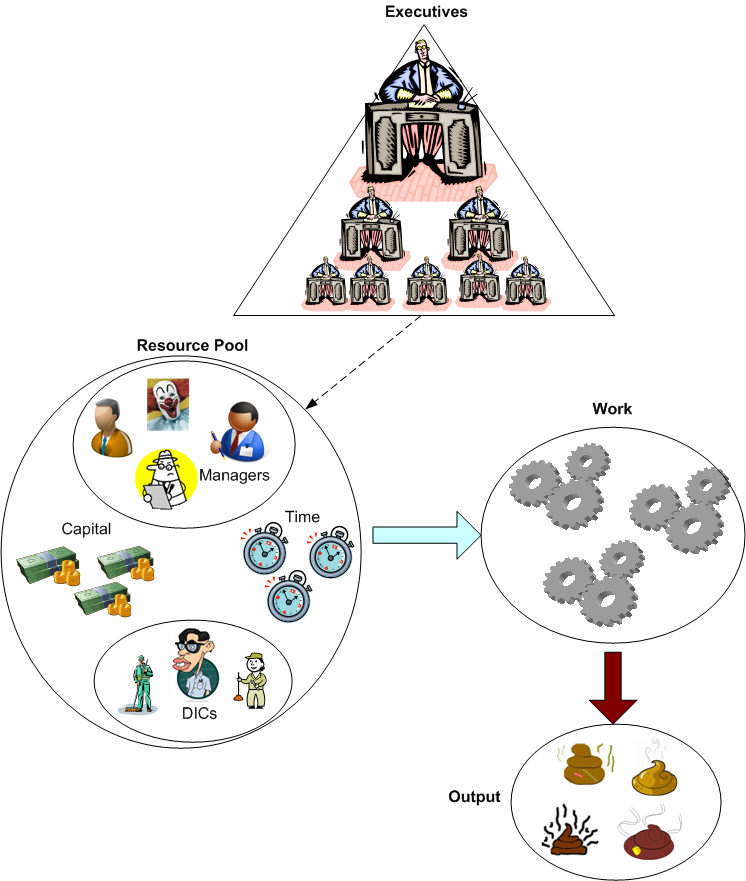
Surprisingly, I drew a blank when I tried to conjure up a delusional story to bind to the drawing. This must be what writer’s block is. D’oh!
Can you please fill in the void for me? Think of it as a creative writing assignment.
Is It Safe?

Assume that we place a large, socio-technical system designed to perform some safety-critical mission into operation. During the performance of its mission, the system’s behavior at any point in time (which emerges from the interactions between its people and machines), can be partitioned into 2 zones: safe and unsafe.
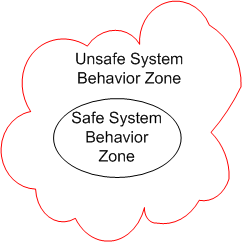
Since the second law of dynamics, like all natural laws, is impersonal and unapologetic, the system’s behavior will eventually drift into the unsafe system behavior zone over time. Combine the effects of the second law with poor stewardship on behalf of the system’s owner(s)/designer(s), and the frequency of trips into scary-land will increase.
Just because the system’s behavior veers off into the unsafe behavior zone doesn’t guarantee that an “unacceptable” accident will occur. If mechanisms to detect and correct unsafe behaviors are baked into the system design at the outset, the risk of an accident occurring can be lowered substantially.
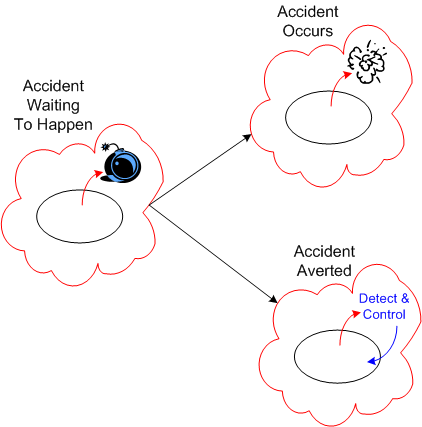
Alas, “safety“, like all the other important, non-functional attributes of a system, is often neglected during system design. It’s unglamorous, it costs money, it adds design/development/test time to the sacred schedule. and the people who “do safety” are under-respected. The irony here is that after-the-accident, bolt-on, safety detection and control kludges cost more and are less trustworthy than doing it right in the first place.
Design Disclosure
Recently, I had to publicly disclose the design of the multi-threaded CSCI (Computer Software Configuration Item) that I’m currently bringing to life with a small group of colleagues. The figure below shows the entities (packages, CSCs (Computer Software Components), Classes) and the inter-entity relationship schema that I used to create the CSCI design artifacts.
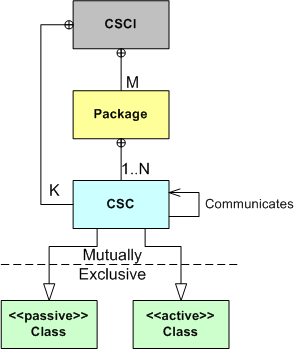
As the figure illustrates, the emerging CSCI contains M packages and K top level CSCs . Each package contains from 1 to N 2nd level CSCs that associate with each other via the “communicates” (via messages) relationship. Each CSC is of the “passive” or “active” class type, where “active” means that the CSC executes within its own thread of control.
Using the schema, I presented the structural and behavioral aspects of the design as a set of views:
- The threads view (behavioral )
- The packages view (structural)
- The class diagrams view (structural)
- The sequence diagrams view (behavioral)
Like any “real” design effort (and unlike the standard sequential design-code-test mindset of “authorities“), I covertly used the incremental and iterative PAYGO methodology (design-a-little, code-a-little, test-a-little, document-a-little) in various mini sequences that, shhhh – don’t tell any rational thinker, just “felt right” in the moment.
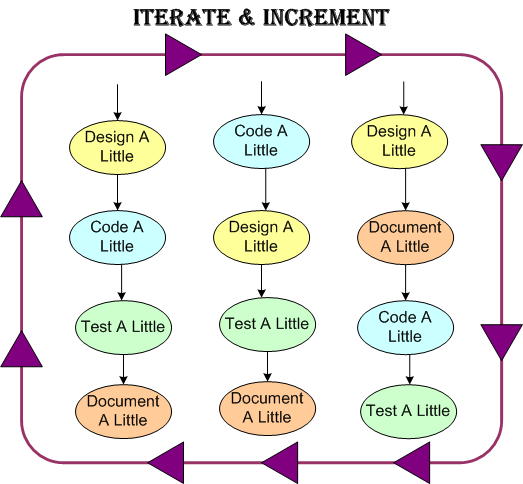
As we speak, the effort is still underway and, of course, the software is 90% done. Whoo Hoo! Only 10 more percent to go.
Exactly Two Years Hence
Before going any further, make a note of today’s date. Now, if you want to follow the timeline of a sad story, then perform the following procedure while noting the date of each post:
1 Read this post: My Company
2 Then read this post: The End Of An Era
3 Then read this post: Heartbroken, But Hopeful
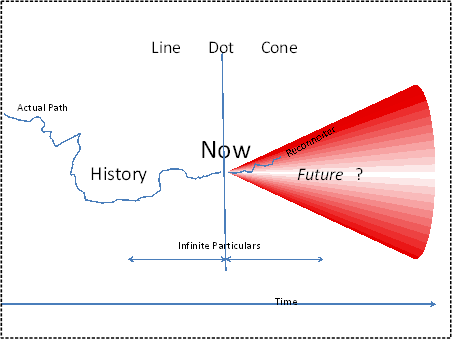
So, what does the future hold? Hell, I don’t freakin’ know. My friend Bill Livingston‘s line-dot-cone sketch says it all:
Unfriendly Fire
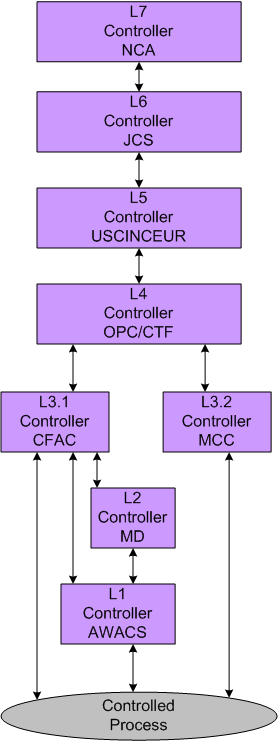
In Nancy Leveson’s new book, “Engineering A Safer World“, she analyzes (in excruciating detail) all the little screw-ups that occurred during an accident in Iraq where two F-15 fighters shot down two friendly black hawk helicopters – killing all aboard. To set the stage for dispassionately explaining the tragedy, Ms. Leveson provides the following hierarchical command and control model of the “system” at the time of the fiasco:
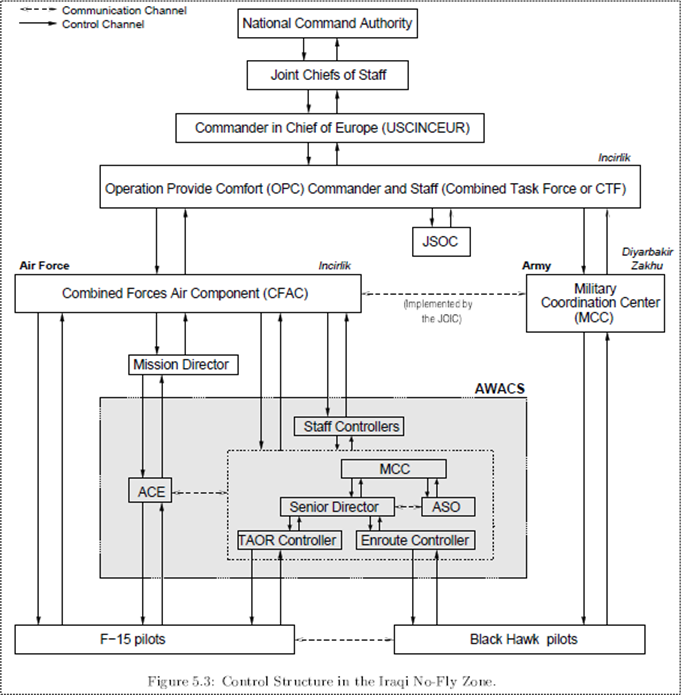
Holy shite! That’s a lot of levels of “approval required“, no?
In typical BD00 fashion, the dorky figure below dumbs down and utterly oversimplifies the situation so that he can misunderstand it and jam-fit it into his flawed UCB mental model. Holy shite! That’s still a lot of levels of “ask me for permission before you pick your nose“, no?
So, what’s the point here? It’s that every swingin’ dick wants to be an esteemed controller and not a low level controlleee. Why? Because….
“Work is of two kinds: first, altering the position of matter at or near the earth’s surface relatively to other such matter; second, telling other people to do so. The first kind is unpleasant and ill paid; the second is pleasant and highly paid.” – Bertrand Russell
People who do either kind of work can be (but perhaps shouldn’t be) judged as bozos, or non-bozos. The bozo to non-bozo ratio in the “pleasant” form of work is much higher than the “unpleasant” form of work. – BD00

Why am I here?
WTF?
Meh!
D'oh!

My BTC Address



 Bulldozer00's Blog