Archive
Battle Of The Blahs
Awareness, pure consciousness, egoless, no self, spirit, god, the peace that passeth all understanding, universal energy, eternal essence, eternal bliss, universal intelligence, mind, formless energy….. (add your own favorite word or phrase here).
All these words and phrases point to the same thing (or no-thing?) and attempt to describe what’s indescribable via words or thoughts. People argue endlessly over which is “right” or “correct” and miss the whole purpose of using them to communicate. It reminds me of the famous spiritual (Buddhist?) saying that goes something like this: “I’m pointing at the moon but you’re looking at my finger.”
As E. Tolle has said: “The analysis of pointers is pointless.”
What’s your favorite word or phrase that describes the indescribable?
Behavior And Performance
Assume that a company’s managers:
- Have a truly fair and objective system in place for judging employee behavior as good or bad
- Have a truly fair and objective system in place for judging job performance as good or bad
- Have the power to promote, fire, and tolerate (ignore) their employees.
For the moment, please indulge me by believing that assumptions 1 and 2 are true even though they are spectacularly and patently false. Given these 3 discretely valued parameters, there are 2 x 2 x 3=12 different combinations available to classify a company. The figure below shows 4 of these combos.

Which company would you want to work for? Which company comes closest to the company that you do work for?
A Shift In Perspective
At birth, everyone is egoless. We are pure awareness, a manifestation of universal consciousness. We have no agenda and no desire to make ourselves look good at the expense of others. We don’t get into zero-sum games and our outer purpose is directly synchronized with our inner purpose. When we get labeled with a name, start accumulating “credentials” and “expertise”, and we begin to internalize the human-made concepts of “I” and “me”, our heads expand in order to accommodate ego growth. As ego expands, consciousness contracts and we lose touch of the infinite source of energy that comprises our inner core. Our behaviors and actions become increasingly dominated by the artificial need to selfishly accumulate “things out there” and consume way more than we need. How do I know this? Because like you, I’m a perfect example of ego-domination. Give “me” more, “I” need more, it’s all about “me”, “I’m” smarter than “you”, “I’m” better looking than “you”, “I” have more and nicer things than “you”, “you” should want to be like “me”, to hell with “you” and to heaven with “me”. Duality and separation settle in.

As the lower graph in the above figure shows, some people may, by an unknown and humanly-uncontrollable act of grace, experience a shift in perspective at some point in their lives. The ego starts to deflate, consciousness starts rising, and the artificial mode of good/bad, dual thinking starts dissolving. For some people, the slope of the ego curve instantaneously flips to negative infinity at the point of transition and an “epiphany” occurs. Jill Bolte Taylor, Eckhart Tolle, Byron Katie, Sydney Banks, and the Buddha come to mind as examples of people who’ve experienced epiphanies.
Becoming aware that one is ego-dominated is not enough to trigger a transformation back to our true nature and a realignment of our outer purpose with our inner purpose. How do I know this? Because I’m aware of the fact that I’m dominated by the constraining, finite, and toxic force of the ego. The ego is brilliant in that it can argue with anything at any time and rationalize any action, no matter how horrendous the end result is.
So here “I” am, recognizing the fact that I’m a slave to “my” ego and hoping that an instantaneous shift in perspective will happen to “me”. Since I don’t have a clue on how to trigger the shift, I’m on a constant intellectual search for enlightenment. However, feverishly accumulating intellectual understanding is not the way to realize and experience “the peace that passeth ALL understanding”. Bummer.
Lost In Thought

Are U smart?
One of my favorite quotes iz: “If you’re so smart, how come you ain’t rich?”. My response iz: “I ain’t smart, and that’s why I ain’t rich”. What’s your response?
Business Acquisition And Execution
To become and maintain a successful business, a company must both acquire and efficiently execute ongoing chunks of business. When top management values both of these critical work activities equally, then all is well. When they value one over the other, and in my business domain it’s always business acquisition that’s shown preferential treatment, then mediocrity reigns.
How do you know when top management is one sided? It’s easy, just look around. Who gets the single offices and single cubes? Who gets the bigger salaries? Who do the executives give way more face time to?
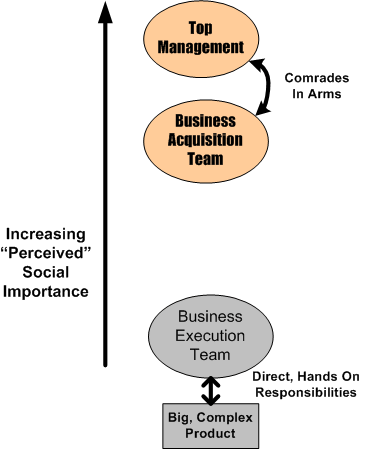
Business acquisition is glamorous and difficult, but in comparison, business execution is dirty, messy, and down right hard. When an acquisition team submits a proposal to a customer after a long and arduous courting period, it’s party time, and rightfully so. However, and this is key, the proposal doesn’t “have to work”. Products “have to work”, or else….
If a proposal is rejected and fails to acquire a chunk of business, then it’s usually because a competitor has offered up a similar or superior product for a lower price and/or a faster delivery time. The loser washes his hands clean and then just moves on to the next opportunity. It’s done and over with, kaput.
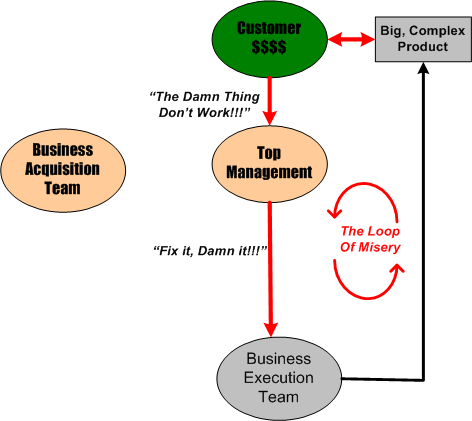
When a big, complex, and software-intensive product repeatedly and frequently fails in a customer’s day to day use of it, then continuous stress and pressure is placed on the execution team for what could be quite a long and sustained period of time. Until the execution team, usually through heroic acts of team sacrifice, makes the product behavior and performance “acceptable” to the customer, the two step chain of events is as follows: the customer pressures top management, and top management pressures the execution team. The loop of misery has been ignited. Notice that the acquisition team does not participate in the fun. In the worst case, the acquisition team merges with the top management team to apply greater pressure on the execution team.
Don’t be a stupid arse like me. If you’re given the choice between participating on an acquisition team or an execution team, choose the acquisition team 🙂
Round And Round We Go
Engineering Councils, Master Engineering Groups, Centers of Excellence, yada-yada-yada. Has your company repeatedly formed and dissolved elite groups like these over the years? The purpose of sanctioning these groups is always well-intentioned, but always doomed. Why are they doomed? Because:
- they are always underfunded and, at the first hint of corpo financial stress, they are abandoned because they are an overhead expense group that doesn’t create or add value.
- all of the sitting members have real day jobs that need to get done in order to put money in the corpo coffers and food on the table.
- they don’t actively solicit input from the people who have to operate by their decisions – if they ever make any decisions and produce non-verbal output at all.
- they ignore input from non-members when they do get it – losing credibility and respect in the process.
- they never agree to a systematic method of making decisions when they are formed.
- they spend all their time in philosophical debates, with each elite member trying show how smart he/she is.
I could probably make up some more excuses for the repeated cyclical failure of elite councils, but I’ll leave it as an exercise for you, dear reader, to add your own reasons to the list. Feel free to add your own thoughts on this via the comments section.
Each time the elite council idea is recycled, nobody seems to remember the failures of the past and the same unproductive group behavior emerges. Everybody but the BOTG (Boots On The Ground) innocently thinks that this time it will be “different”. I’ve participated in these elite groups in the past, but from now on, I’ll always respectfully decline membership when asked. The last time I was asked, I declined to sit on one of these boards (that’s exactly what they do – just sit) . However, I offered up my services to work on any specific and funded task that the group deemed important. Unsurprisingly, nobody has taken me up on my offer. Bummer :^)
So how can the elite council idea be successful and add value to an org? Just invert the reasons-for-failure list above. Even if you do manage to change the context from disabling to enabling, it still might not work but, at least it will have a chance.
Stagnation Or Growth?
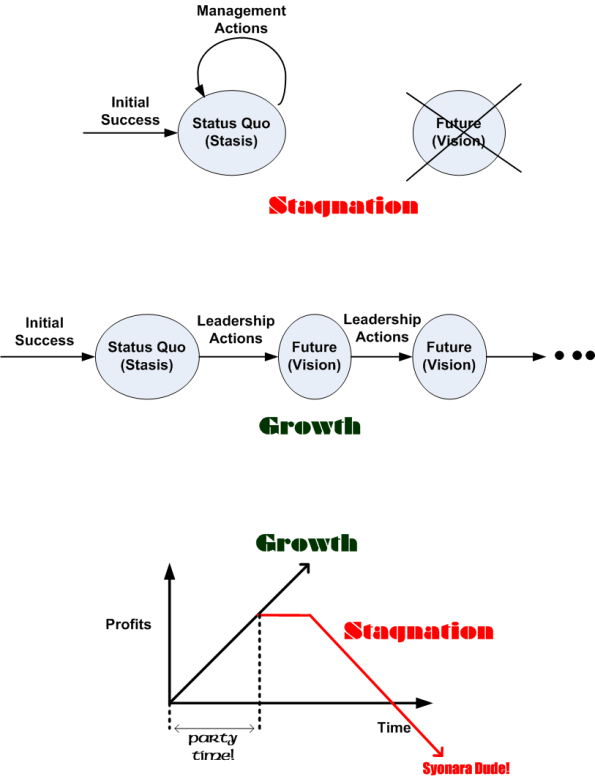
What type of system do you work in, day in and day out? Do you work for scared managers or courageous leaders?
Unnecessarily Complex, or Sophisticated?
I recently stumbled upon the following quote:
“A lot of people mistake unnecessary complexity for sophistication.” – Dan Ward
Likewise, these two quotes from maestro da Vinci resonate with me:
“Simplicity is the ultimate sophistication.” – Leonardo da Vinci
“In nature’s designs, nothing goes wanting, and nothing is superfluous.” – Leonardo DaVinci
When designing and developing a large software-intensive system, over-designing it (i.e. adding too much unessential complexity to the system’s innate essential complexity) can lead to disastrously expensive downstream maintenance costs. The question I have is, “how do you know if you have enough expertise to confidently judge whether an existing complex system is over-designed or not?”. Do you just blindly trust the subjective experts that designed the system when they say “believe me, all the complexity in the system is essential”? If you’re a true layman, then there is probably no choice – ya gotta believe. But what if you’re a tweener? Between a layman and an expert? It’s dilemma city.
The figure below depicts a simple model of a generic multi-sensor system. The individual sensors may probe, detect, and measure any one or more of a plethora of physical attributes in the external environment to which they are “attached”. For example, the raw sensor samples may represent pressure, temperature and/or wind speed measurements. They also may represent the presence of objects in the external environment, their positions, and/or kinematic movements.

The fusion processor produces an integrated surveillance picture from the inputs it receives via all of the individual sensors. This fused picture is then propagated further downstream for:
- display to human users,
- additional value-added processing,
- automatically issuing control actions to actuators (e.g. gates, lights, valves, motors) embedded in the external environment .
Now assume that you are given a model of a multi-sensor system as shown in the figure below. Is the feedback interface from the fusion processor back to one (and only one) sensor evidence of an over-designed system and/or unnecessary added complexity? Well, it depends.

If the feedback interface was purposely designed into the system in order to increase the native functionality or performance of the individual sensor processor that utilizes the data, then the system may not be over-designed and the added complexity introduced by designing in the interface may be essential. If the feedback loop only serves to “push back” into the sensor processor some functionality that the fusion processor can easily do itself, then the interface may be interpreted as adding some unessential complexity to the system.
In any system design or system analysis/evaluation process, effectively judging what is essential and what is unessential can be a difficult undertaking. The more innately complex a system is, the more difficult it is to ferret out the necessary from the unnecessary.
Scouts
The figure below is intended to show a successful and profitable company operating in an external environment that’s changing over time. Since the corporation achieved its current successful state by employing strategies and practices that worked well to get it there, it naturally employs the same techniques over and over again. This causes the corpo walls to harden and protect those inside of the org from the forces of external change.

If the external winds of change are characterized by a low velocity (more like a breeze than a tornado), then the company’s success may last for quite a long time even though it’s unconsciously stuck in neutral and not adapting to the external environment. However, as the breezy external environment transforms into a maelstrom of tornadoes as a result of new competitors appearing and the sudden emergence of game changing technologies like the internet, company revenues/profits and the corpo pyramid may come tumbling down. Conscious and enlightenend company leaders know that stasis is a corpo killer, but textbook spreadsheet managers don’t.
One way to “sense” when change is needed is to formally designate a cadre of “scouts” at all functional levels of the org, from marketing all the way down the corpo steps to engineering and customer service. I first heard about the concept of scouts from Steve McConnell many years ago, before the internet and the exponential rise of third world engineering know how. At the time, I thought it was a novel idea and now I think it may be essential for survival.
As the picture below illustrates, scouts can serve as external sensors/probes that monitor and make meaning of the rapidly changing external environment. They separate the wheat from the chaff and, if they’re paid attention and nurtured, they can provide accurate information to corpo decision makers regarding which new technology and practices to embrace, and which new products to prototype and try.

Of course, dysfunctional org executives who think highly of themselves but don’t think much of their people (while simultaneously praising them as the company’s most valuable assets), will get what they deserve. They won’t create the role of a “scout” and they’ll ignore or subtlely berate self-motivated people who voluntarily perform the role of a scout. In their minds, they think they are the only ones who are capable of steering the company toward the future – using the same worn out , obsolete thinking that used to work but is virtually useless. Bummer.


Why am I here?
WTF?
Meh!
D'oh!

My BTC Address



 Bulldozer00's Blog