Archive
Academic Authors
I read quite a few books penned by science authors. Those that I can actually understand are very informative and entertaining. Every single one of the books always has one or more great stories regarding historical confrontations between different warring factions over who’s theory and experimental data are more “truthful“. If you believe what’s written, some of those confrontations were really nasty.
Isn’t it ironic that people who are deemed so intelligent often resort to (so-called) childish tactics in order to discredit others and prove themselves right? Nah, because underneath the veneer of revered intelligence they’re just regular freakin’ people like you and me. They’re human beings with feelings, egos, and the instinct to survive and prosper no matter what the cost. Gasp!
Science books written for laymen always seem to include words like “prestigious”, “world reknowned”, “Nobel laureate”, and “respected” in order to influence the readers beliefs via appeals to authority. The more compliments that I read, the more cautious I become in evaluating the subject matter. Being the closet non-conformist that I am, I tend to cast those words aside and gravitate toward those arguments and logic that appeal to my inner soul in the form of resonant feelings. How un-scientific of whacky me.
Anyone who conducts an argument by appealing to authority is not using his intelligence; he is just using his memory. – Leonardo daVinci
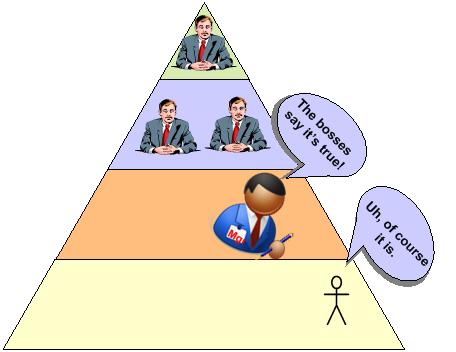
In case you haven’t noticed, I’m a total hypocrite. I appeal to authority all the time in feeble attempts to promote my views. I do it by inserting quotes from respected people into a lot of my blog posts, uh, like this one. Of course, I’m not using my intelligence. I’m using google.
Unnecessarily Complex, or Sophisticated?
I recently stumbled upon the following quote:
“A lot of people mistake unnecessary complexity for sophistication.” – Dan Ward
Likewise, these two quotes from maestro da Vinci resonate with me:
“Simplicity is the ultimate sophistication.” – Leonardo da Vinci
“In nature’s designs, nothing goes wanting, and nothing is superfluous.” – Leonardo DaVinci
When designing and developing a large software-intensive system, over-designing it (i.e. adding too much unessential complexity to the system’s innate essential complexity) can lead to disastrously expensive downstream maintenance costs. The question I have is, “how do you know if you have enough expertise to confidently judge whether an existing complex system is over-designed or not?”. Do you just blindly trust the subjective experts that designed the system when they say “believe me, all the complexity in the system is essential”? If you’re a true layman, then there is probably no choice – ya gotta believe. But what if you’re a tweener? Between a layman and an expert? It’s dilemma city.
The figure below depicts a simple model of a generic multi-sensor system. The individual sensors may probe, detect, and measure any one or more of a plethora of physical attributes in the external environment to which they are “attached”. For example, the raw sensor samples may represent pressure, temperature and/or wind speed measurements. They also may represent the presence of objects in the external environment, their positions, and/or kinematic movements.

The fusion processor produces an integrated surveillance picture from the inputs it receives via all of the individual sensors. This fused picture is then propagated further downstream for:
- display to human users,
- additional value-added processing,
- automatically issuing control actions to actuators (e.g. gates, lights, valves, motors) embedded in the external environment .
Now assume that you are given a model of a multi-sensor system as shown in the figure below. Is the feedback interface from the fusion processor back to one (and only one) sensor evidence of an over-designed system and/or unnecessary added complexity? Well, it depends.

If the feedback interface was purposely designed into the system in order to increase the native functionality or performance of the individual sensor processor that utilizes the data, then the system may not be over-designed and the added complexity introduced by designing in the interface may be essential. If the feedback loop only serves to “push back” into the sensor processor some functionality that the fusion processor can easily do itself, then the interface may be interpreted as adding some unessential complexity to the system.
In any system design or system analysis/evaluation process, effectively judging what is essential and what is unessential can be a difficult undertaking. The more innately complex a system is, the more difficult it is to ferret out the necessary from the unnecessary.

Why am I here?
WTF?
Meh!
D'oh!

My BTC Address



 Bulldozer00's Blog