Archive
Islands Of Sanity
Via InformIT: Safari Books Online – 0201700735 – The C++ Programming Language, Special Edition, I snipped this quote from Bjarne Stroustrup, the creator of the C++ programming language:
“AT&T Bell Laboratories made a major contribution to this by allowing me to share drafts of revised versions of the C++ reference manual with implementers and users. Because many of these people work for companies that could be seen as competing with AT&T, the significance of this contribution should not be underestimated. A less enlightened company could have caused major problems of language fragmentation simply by doing nothing.”
There are always islands of sanity in the massive sea of corpocratic insanity. AT&T’s behavior at that time during the historical development of C++ showed that they were one of those islands. Is AT&T still one of those rare anomalies today? I don’t have a clue.

Another Bjarne quote from the book is no less intriguing:
“In the early years, there was no C++ paper design; design, documentation, and implementation went on simultaneously. There was no “C++ project” either, or a “C++ design committee.” Throughout, C++ evolved to cope with problems encountered by users and as a result of discussions between my friends, my colleagues, and me.”
WTF? Direct communication with users? And how can it be possible that no PMI trained generic project manager or big cheese executive was involved to lead Mr. Stroustrup to success? Bjarne should’ve been fired for not following the infallible, proven, repeatable, and continuously improving, corpo product development process. No?

Motivility
In one of the Vital Smarts crew’s books (I forget which one, and I’m too lazy-ass to look it up) they mention motivation and ability as two important metrics that leaders can leverage to help people improve performance. To make things simple, but hopefully not simplistic, I’ve constructed a “Leader’s Action Table” (LAT) below using a binary “Present” or “Absent” value for each of the motivility attributes.
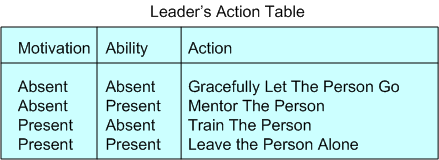
Since, by definition, a leader is pro-active and he/she cares about people and performance (both), he/she will take the time and effort to get to know his/her people well. The leader can then use the simple, two attribute , four action LAT to help his/her people grow and develop.
With bozo managers, the story is much different. Even if they stopped thinking about themselves and their careers long enough to consider the individual needs of their people in terms of the two motivility attributes, those bozeltines would get it back-asswards and hose everything up – of course. Instead of a LAT, they’d wield the BAT shown below. BATter up!

Do you think the LAT could be useful? What would your LAT look like? Are there any important attributes that you think are missing from the table? Should one or either of the motivility attributes be multi-valued instead of binary? Meh?
“Half of the harm that is done in this world is due to people who want to feel important. They do not mean to do harm… They are absorbed in the endless struggle to think well of themselves.” – T. S. Eliot
Best Of The Best
The breadth of variety of companies, markets, customers, industries, products, and services in the world is so wide and diverse that it can be daunting to develop objectively measurable criteria for “best in class” that cuts across all of the variability.
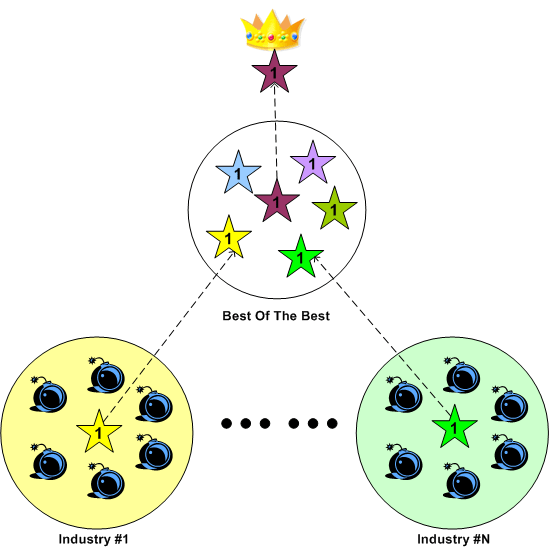
Being a simpleton, my pseudo-measurable criteria for a “best in class” company is:
- Everybody (except for the inevitable handful of malcontents (like me?) found in all organizations) who works in the company sincerely feels good about themselves, their co-workers, the products they build, their customers, and the company leadership.
That’s it. That’s my sole criterion (I told you I was a simpleton). Of course, the classical financial measures like year-over-year revenue growth, profitability, yada, yada, yada, matter too, but in my uncredentialed and unscholarly mind, those metrics are secondary. They’re secondary because good numbers are unsustainable unless the touchy-feely criterion is continuously satisfied.
The dilemma with any kind of “feel good” criteria is that there aren’t many good ways of measuring them. Nevertheless, one of my favorite companies, zappos.com, has conjured up a great way of doing it. Every year, CEO Tony Hsieh sends an e-mail out to all of his employees and solicits their thoughts on the Zappos culture. All the responses are then integrated and published, unedited, in a hard copy “Zappos Culture Book”.
The Zappos culture book is available free of charge to anyone who emails Tony (tony@zappos.com). Earlier this year, I e-mailed Tony and asked for a copy of the book. Lo and behold, I received the 400+ page tome, free-of-charge, four days later. I poured through the 100’s of employee, executive, and partner testimonials regarding Zappos’s actual performance against their espoused cultural values. I found no negative entries in the entire book. There were two, just two, lukewarm assessments of the company’s cultural performance. Of course, skeptics will say that the book entries were censored, and maybe they were, but I doubt it.
How would your company fare if it compiled a yearly culture book similar to Zappos’s? Would your company even entertain the idea? Would anyone feel comfortable proposing the idea? Is the concept of a culture book only applicable to consumer products companies like Zappos.com, or could its value be industry-independent?
Note: Zappos.com was recently bought out by Amazon.com. It should be interesting to see if the yearly Zappos culture book gets squashed by Jeff Bezos et al.
Proprietary Sneeze
In stodgy, arrogant, and paranoid corpocracies, everything is marked as proprietary: the company letterhead, the standard powerpoint layout, all documented processes (that (shhhh!) nobody follows), every e-mail, every conversation, the company newsletter, the recipes in the cafeteria, etc. Hell, when someone sneezes it’s deemed proprietary. Geez, what up wit dat?
“Lighten up Francis” – Sergeant Hulka (from the movie “Stripes”)
Heaven forbid that a competitor gets its slimy hands on any of your proprietary “stuff”. OMG, they’ll put you out of business by using all of your world-changing intellectual property against you. Anyone caught disclosing anything about the corpo innards will swiftly receive a peek-a-boo visit from a high ranking corpocrat, right?
To be fair, there probably is some stuff that really is proprietary, like some domain-specific algorithms and/or some custom hardware modules. But gimme a break Einstein. Regardless of what you espouse, the ubiquitous Bell curve says that you’re most likely not all that (pause for a yawn) great. Although you, like the vast majority of corpo citadels on the landscape, think and espouse that you’re obviously a cut above the rest, you’re not. Deal with it. Remove the camouflage that everyone is aware of, but is forbidden to discuss.
When you explicitly “allow” your people to discuss the undiscussables in a truly open and receptive environment without publicly or privately tarring and feathering them, then you’ve taken the first courageous step toward differentiating yourself from the herd. Mooo!

Note: I’m just a Dilbertonian DIC (Dweeb In the Cellar) who makes things up, so don’t believe a word I say.
Fifty-Fifty
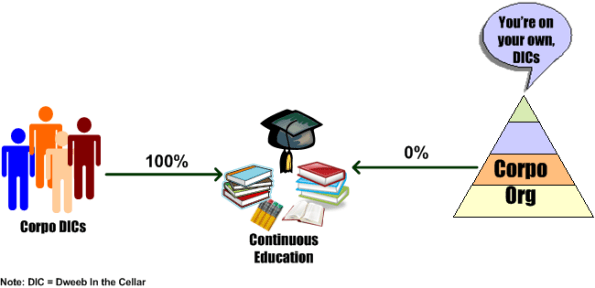
Because of the current economic environment, lots of recycled articles (take charge) regarding continuous education have appeared. Almost every one of them dispenses the same advice: “only you are responsible for continuously educating yourself and keeping your skills up to date”. Of course this is obviously true, but what about an employer’s duty to its stakeholders for ensuring that its workforce has the necessary training and skills to keep the company viably competitive in a rapidly changing landscape? Because of this duty, shouldn’t the responsibility be shared? What about fifty-fifty?
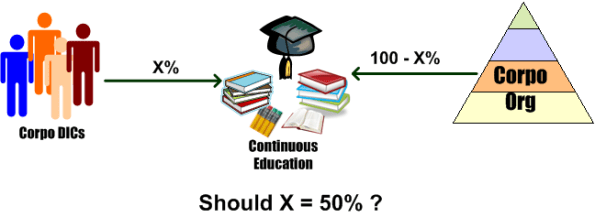
There are at least two ways that corpo managements (if they aren’t so self-absorbed that they’re actually are smart enough to detect the need) react to the need for continuing education of the people that produce its products and provide its services.
- Hire externally to acquire the new skills that it needs
- Invest internally to keep its workforce in synch with the times
Clueless orgs do neither, average orgs do number 1, above average orgs do 2, and great orgs do 1 and 2. Hiring externally can get the right skills in the right place faster and cheaper in the short run, but it can be much riskier than investing internally. Is your hiring process good enough to consistently weed out bozos, especially those that will be placed in positions that require leading people? If it’s a new skill that you require, how can your interviewers (most of whom, by definition, won’t have this new skill) confidently and assuredly determine if candidates are qualified? As everyone knows, face-to-face interviews, references and resumes can be BS smokescreens.
If external competitive pressures require a company to acquire deep, vertical and highly specialized skills, then hiring or renting from the outside may be the right way to go. It may be impractical and untimely to try and train its workforce to acquire knowledge and skills that require long term study. If you have a bunch of plumbers and you need an electrician to increase revenue or execute more efficiently, then it may be more cost effective and timely to hire a trained electrician than to train your plumbers to also become electricians (or it may not).
Which strategy does your corpocracy predominantly use to stay relevant? Number 1, number 2, both, or neither? If neither, why do you think that is the case? No cash, no will, neither?
Right, Right, Right.
Great leaders get the right info to the right people at the right time. They don’t hide behind the “it’s not my job” cliche. They don’t just “delegate this” and “delegate that” like a card dealer at a casino. They don’t just sit back in their throne, get manicures, and “review and approve”. They don’t just passively collect “status and schedule” information. They don’t set ambiguous and indecipherable direction, and then change it at will whenever it suits their personal agenda. They don’t mandate the latest management “technique” after they read about it in a 2 page Harvard Business Review article.
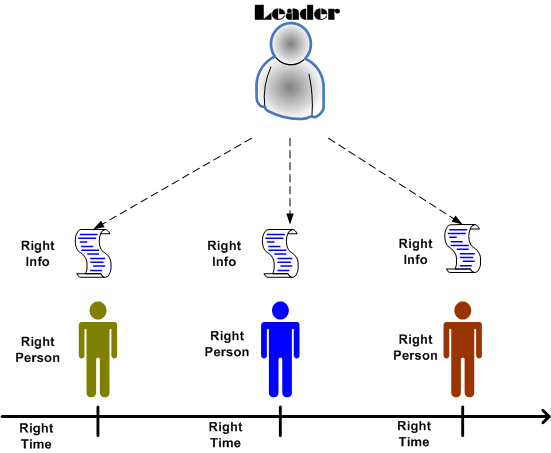
If getting the right info to the right people at the right time requires a leader to generate some of the information him/herself, then they do it.
Delegating only works when the delegator works too. – Robert Half
Cisco CEO “Gets It”
Cisco Systems Inc. CEO John Chambers “gets it”. In this interview, he states:
“Today’s world requires a different leadership style — moving more into a collaboration and teamwork, including learning how to use Web 2.0 technologies. If you had told me I’d be video blogging and blogging, I would have said, no way. And yet our 20-somethings in the company really pushed me to use that more.”
Ossified corpo executive teams that still operate according to the 1920’s doctrine of separation, closed door meetings, and infrequently used, one-way communication channels, deserve what they get – mediocrity and a disconnected work force.
On the subject of interviewing potential leaders, Mr. Chambers also “gets it”:
“Then I ask them who are the best people you recruited and developed, and where are they today? And that tells an awful lot.”
He knows that in order to build a viable, sustainable, and robust company, you’ve got to actively develop people and not just sit on your throne issuing brilliant commands from an omniscient position of superiority.
Analysis Paralysis Vs. 59 Minutes
“If I had an hour to save the world, I would spend 59 minutes defining the problem and one minute finding solutions” – Albert Einstein
If they didn’t know that Einstein said the quote above, MBA taught and metrics-obsessed “go-go-go” textbook managers would propose that the person who did say it was a slacker who suffered from “analysis paralysis”. In the Nike age of “just do it” and a culture of “act first and think later” (in order to show immediate progress regardless of downstream consequences), not following Einstein’s sage advice often leads to massive financial or human damage when applied to big, multi-variable hairball problems.
The choice between “act first, think later” (AFTL) and “think first, act later” (TFAL) is not so simple. For small, one dimensional problems where after-the-fact mistakes can be detected quickly and readjustments can be made equally as quickly, AFTL is the best way to go. However, most managers, because they are measured on schedule and cost performance and not on quality (which is notoriously difficult to articulate and quantify), apply the AFTL approach exclusively. They behave this way regardless if the situation cries out for TFAL because that’s the way that hierarchical structured corpo orgs work. Since the long term downstream effects of crappy decisions may not be traceable back to the manager who made them, and he/she will likely be gone when the damage is discovered, everybody else loses – except the manager, of course. Leaders TFAL and managers AFTL.
Ineffective Immediately
“Ninety percent of what we call ‘management’ consists of making it difficult for people to get get things done” – Peter Drucker
If you believe this classic Drucker quote to be true, then whenever you receive an executive e-mail that contains the standard MBA textbook words “effective immediately”, mentally replace them with “ineffective immediately”. That way, you won’t be disappointed or surprised when your local work environment doesn’t change at all, or it changes for the worse.
To be fair, managers, like you and me, are just trying their best to make things better for all stakeholders. It’s just that they, for the most part (90% to be exact) have no clue on how to go about doing that.
The FAE
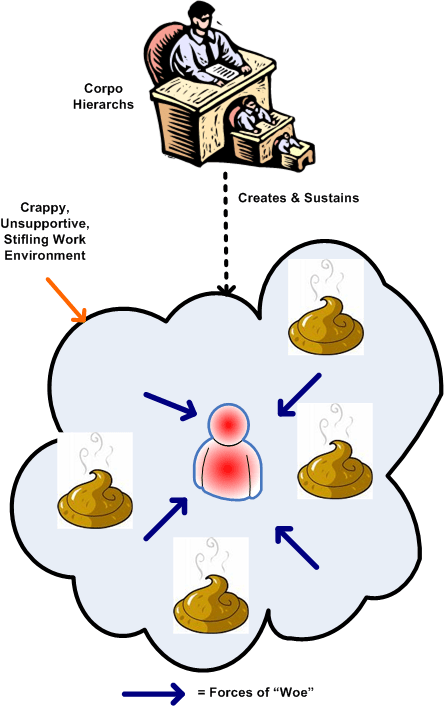
Over the years, I’ve read quite a few books and articles on managing the soft side of an organization. In many of these info sources, I’ve seen the term FAE = Fundamental Attribution Error mentioned. The FAE represents the tendency of a manager to instinctively and unthinkingly blame a person’s character and/or work ethic for under-performance. The real cause, which cannot possibly be true in a corpo manager’s conditioned mind, is likely that his/her inability to create, nurture, and continuously sustain a helpful, supportive, learning work environment is killing productivity and creating under-performers.
Of course, the FAE cannot account for all under-performance in an absolute sense. There are self-made underperformers (like BD00) in every org, regardless of the quality of the surrounding work environment.

Why am I here?
WTF?
Meh!
D'oh!

My BTC Address



 Bulldozer00's Blog